
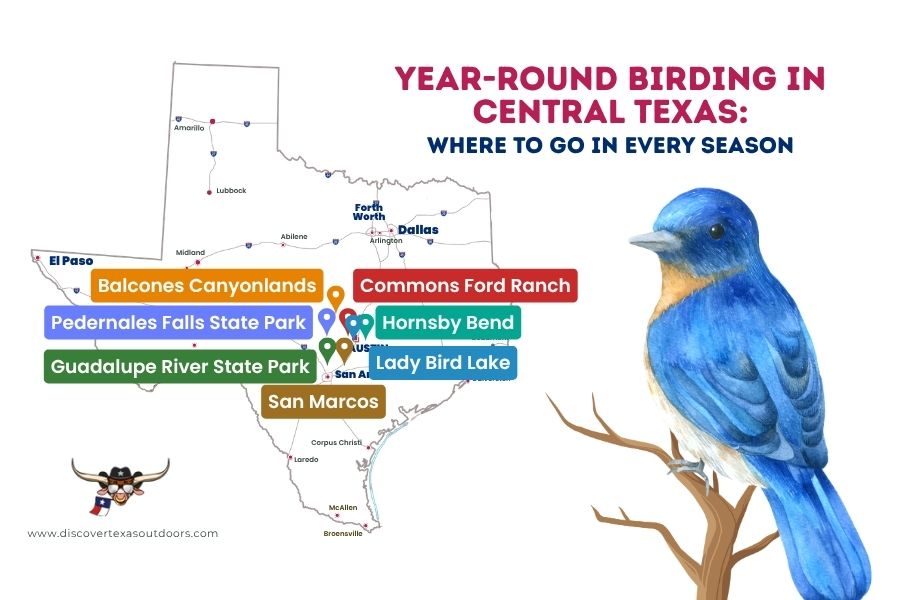
Central Texas is one of those places where birding rarely feels “out of season.” The region sits along major migratory routes, blends rivers with limestone hills, and packs a surprising range of habitats into short drives—riparian corridors, oak-juniper woodlands, open grassland, wetlands, and lake shorelines. That variety is what makes year-round birding possible. Even when migration slows down, local residents and winter visitors keep your checklist moving.
This guide is built for planning. You’ll find reliable birding locations across Central Texas, plus a season-by-season look at what’s happening on the calendar so you can choose the right place at the right time—whether you’re visiting in January, chasing spring songbirds in April, or sneaking out for a quiet sunset walk in October.
What “Central Texas” Birding Looks Like
In practical terms, Central Texas birding usually means the Austin area and the Texas Hill Country—places like Austin, San Marcos, New Braunfels, Johnson City, Burnet, and the Highland Lakes. The backbone habitats here are:
- Rivers and creeks (Guadalupe, Colorado, San Marcos, Pedernales) that attract herons, kingfishers, swallows, and wintering ducks.
- Oak-juniper woodlands that are famous for specialty species like the golden-cheeked warbler, which breeds only in Texas.
- Wetlands and managed ponds that can be wildly productive for shorebirds, ducks, and raptors in cooler months.
- Lake edges, coves, and brushy margins that keep birds close even when the middle of the day gets hot.
If you’re building a year-round plan, the best approach is simple: keep a rotation of “always reliable” spots (wetlands, river corridors, lake edges), then add seasonal targets (spring migrants, summer breeders, winter waterfowl).
Best Places to Go Birding in Central Texas
Hornsby Bend (Austin area)
View this post on Instagram
If you want one location that delivers in every season, Hornsby Bend Bird Observatory belongs near the top of the list. It’s widely known for the sheer volume and variety of birds recorded there, and it’s especially strong for wintering waterfowl and shorebirds when migration and cool weather concentrate birds in wet areas.
What makes it so consistent is habitat diversity—ponds, lagoons, open edges, and brushy areas that shift “what’s good” as the year changes. If you’re planning a winter birding day, this is where you can expect ducks, coots, and raptors to keep things interesting even when woodland trails feel quiet.
Lady Bird Lake + the Hike-and-Bike Trail (Austin)
View this post on Instagram
Lady Bird Lake is one of the easiest “fit it into your day” birding routes in Central Texas. A walk on the trail can turn into a solid list quickly because the shoreline attracts common waterbirds, seasonal visitors, and year-round residents. The lake is also an established hotspot for sightings, and it’s a practical spot for learning: you can see and hear birds at close range without needing a long hike.
This is a great choice for short winter walks (look for ducks, cormorants, herons) and spring mornings when songbirds filter through trees and brush along the water.
Commons Ford Ranch (Austin)
View this post on Instagram
Commons Ford is a strong all-season option because it blends woodland habitat, creekside edges, and open areas—the kind of mix that pulls in migrants during spring and keeps resident birds around all year. It’s often praised as a premier Austin-area hotspot, and it can be especially productive during spring migration when birds move through the canopy.
If you’re trying to build skills—learning bird sounds, picking up movement in the treetops, practicing patient scanning—this is a place where those habits pay off.
Balcones Canyonlands National Wildlife Refuge (Hill Country)
Balcones Canyonlands is a cornerstone of Central Texas Hill Country birding because it was established to protect the nesting grounds of the black-capped vireo and golden-cheeked warbler.
These are high-interest birds for many people, and the refuge is one of the best public settings to experience the habitat that supports them.
Timing matters here. If your goal is the vireo, nesting season is typically March through July.
For the warbler, spring and early summer are the headline months, when breeding activity is underway in the Hill Country woodlands.
Guadalupe River State Park + Honey Creek (near Spring Branch)
View this post on Instagram
River corridors are the secret to year-round birding in Central Texas, and Guadalupe River State Park is a standout because it combines riparian habitat with woodland and savannah. TPWD notes distinct habitats within the park and Honey Creek area, including mature bald cypress and a diverse mix of trees that support a wide bird list.
This is a strong choice when you want a “walk and see what happens” day—especially in spring and fall when mixed habitat increases your chances of catching migrants plus residents in one outing.
Pedernales Falls State Park (near Johnson City)
View this post on Instagram
Pedernales Falls State Park offers classic Hill Country scenery—limestone, river corridors, woodlands—and it’s a rewarding place to bird because the habitat diversity changes as you move through the park. It’s also a good option for combining birding with hiking or a scenic day trip.
This is a particularly satisfying spring and fall stop when migrants are moving, but it’s also good in winter for quieter walks where you can focus on sparrows, wrens, and woodland birds.
Barton Creek Greenbelt (Austin)
The Greenbelt is a practical year-round birding choice because it’s accessible, scenic, and long enough to let you choose your distance. It’s also part of a broader protected system where sensitive habitat supports notable species, including the golden-cheeked warbler along the creek corridor.
Conditions vary by season and rainfall—some stretches can be more “creek walk” than “waterbird route”—but that variation is part of why it stays interesting across the year.
San Marcos (river parks and green spaces)
San Marcos is positioned along the Central Flyway and is widely promoted as a birding-friendly destination with riverside parks and natural areas that support birdwatching.
If you’re planning a weekend where birding is one of several outdoor stops, San Marcos works well as a base: easy walking routes, water nearby, and enough green space to keep things productive across seasons.
Seasonal Birding Patterns in Central Texas
Spring (March–May): Migration and Hill Country specialties
Spring is peak energy. Expect movement, singing, and new arrivals. Woodlands and creek corridors become especially productive as migrants pass through, and Hill Country breeders start to settle in. This is also the season many birders target specialty species tied to oak-juniper habitat, like the golden-cheeked warbler (breeding season window is a key planning detail).
Best strategy: start early, focus on edges—where woodland meets water—and plan at least one stop in Hill Country habitat plus one wetland/river stop.
Summer (June–August): Early mornings, shade, and resident birds
Summer birding is absolutely worth doing, but the rhythm changes. You’ll get the best results at first light—when birds are active and temperatures are manageable. River corridors and shaded trails are your friend in summer. Look for residents, local breeders, and birds tied to water. On the Hill Country side, remember that golden-cheeked warblers migrate out later in summer.
Best strategy: go early, bring water, and pick routes with shade and access to water (rivers, creeks, lakeshore).
Fall (September–November): Second migration and shifting wetlands
Fall can be excellent, especially as migration ramps up again and wetlands start to change with seasonal patterns. At wetland sites, you’ll often see the transition as shorebirds and landbirds move through and wintering birds begin to arrive. Hornsby Bend’s seasonal notes highlight how this shift plays out as the year turns toward winter, with ducks arriving and shorebird presence changing over time.
Best strategy: rotate between woodland trails and wetlands. If you only have time for one stop, choose a place with multiple habitats.
Winter (December–February): Waterfowl, raptors, and reliable lists
Winter is where Central Texas birding becomes wonderfully steady. You might not hear constant song, but you can build strong lists with ducks, coots, shorebirds, and raptors—especially around wetlands and open water. Hornsby Bend is well known for winter waterfowl and shorebird viewing, with hundreds of species recorded overall.
Best strategy: prioritize wetlands and lake edges, bring binoculars for scanning, and don’t rush—winter birding rewards slow observation.
Practical Birding Tips That Help All Year
Bring the right optics for the place.
On wooded trails, binoculars are usually enough. Around wetlands and big water, a spotting scope (even a small one) can change your day.
Learn a handful of “anchor birds.”
In each habitat, choose a few common species and learn them well. Once you can quickly identify the familiar birds, your brain has more space to notice what’s unusual.
Use sound to find birds first.
In Central Texas woodlands, a lot of birds will be heard before they’re seen. Pause often. Listen. Then scan the canopy and edges where movement matches the sound.
Dress for sun and thorns.
Light long sleeves and closed-toe shoes make most Hill Country trails more comfortable year-round.
Respect sensitive habitat.
Some areas protect nesting birds and fragile ecosystems. Stay on trails, follow posted rules, and give birds space—especially in spring and early summer nesting season.