
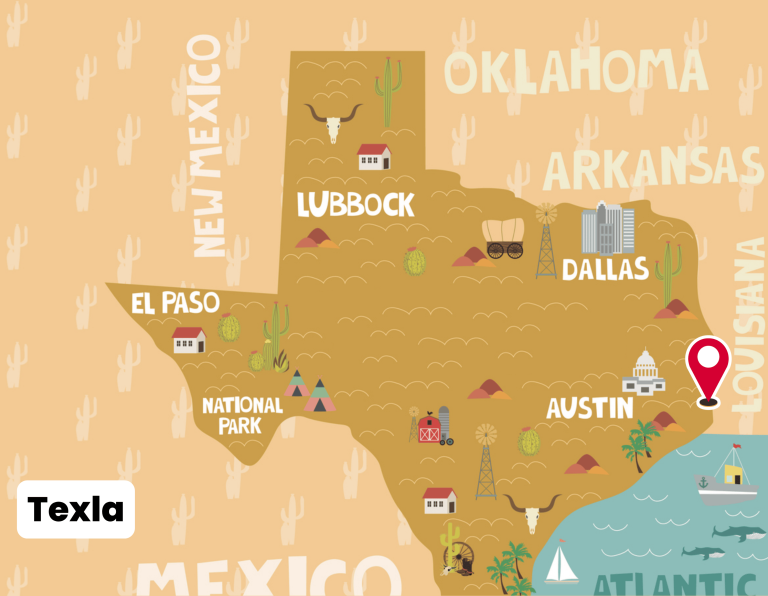
Texla was a short-lived sawmill town in Orange County, Texas, founded in 1905 as Bruce and renamed a year later to reflect its position near the Texas–Louisiana border. Built around the lumber trade, it grew to about 600 residents with housing, a post office, and railroad access. The town’s fortunes rose and fell with its sawmill, which passed through several owners before closing in 1929 when local timber was depleted. Today, nothing remains of Texla, and it is remembered as one of East Texas’s vanished lumber towns.
Origins as Bruce (1905)
The community that later became Texla began in 1905, when a post office was established under the name Bruce, honoring postmaster Charles G. Bruce. At this time, the settlement was little more than a small outpost built around the timber trade, which dominated southeastern Texas in the early 20th century. Its location in Orange County, near the Louisiana border, placed it in the heart of prime pine forest country and along the Orange and Northwestern Railway, which made large-scale lumber operations possible.
Rise of the Lumber Industry
Shortly after Bruce was established, the Harrell-Votaw Lumber Company opened a sawmill in the area. This development transformed the settlement from a rural stop into a growing lumber camp.
In 1906, the mill was purchased by the R. W. Wier Lumber Company of Houston. At this time, the name of the community was changed to Texla, a creative blend of “Texas” and “Louisiana,” reflecting both its location and the company’s effort to brand the mill town with a distinctive identity.
By the late 1900s, Texla had expanded into a full-fledged sawmill town, complete with worker housing, a company store, a post office, and rail service to ship processed lumber out of the region.
Population and Daily Life
At its peak, Texla was home to about 600 residents, a sizeable figure for a single-industry mill town of the era. Nearly all residents were tied directly or indirectly to the lumber operation. Life revolved around the mill’s schedule: workers labored long shifts, while families relied on company-provided amenities.
As with other sawmill towns in East Texas, the community was largely transient. Many workers came from other lumber regions, and few saw Texla as a permanent home, since its survival depended entirely on the forests that surrounded it.
Ownership Changes and Expansion
Texla’s lumber operations changed hands several times during its short existence:
-
1905–1906: Harrell-Votaw Lumber Company established the original mill.
-
1906–1917: R. W. Wier Lumber Company took over, expanded production, and renamed the town Texla.
-
1917–1918: Ownership transferred to the Miller-Link Lumber Company (sometimes linked with the Orange Lumber Company).
-
1918–1920s: After a devastating fire in 1918, the mill was rebuilt in 1919 as a double-circular mill of equal capacity. Soon afterward, the Peavy-Moore Lumber Company of Deweyville acquired the property and operated it until the timber supply was depleted.
This cycle of ownership was typical in lumber towns, where companies quickly moved in, harvested nearby forests, and sold out or abandoned operations once resources thinned.
Fire and Reconstruction
A critical moment came in 1918, when a fire destroyed the mill. Fires were common in sawmill towns, where sawdust piles and wooden machinery created constant hazards.
In 1919, the mill was rebuilt and modernized. The new facility resumed production and kept the town alive for another decade. However, the surrounding forests were being rapidly cut, and despite the reinvestment, Texla’s fate was already sealed.
Decline and Abandonment
By the late 1920s, the timber near Texla had been exhausted. The Peavy-Moore Lumber Company dismantled the mill in 1929, ending the town’s primary reason for existence. The post office closed the same year, marking the official collapse of the community.
Although Texla faded quickly, reports note that scattered residences and buildings still stood as late as 1975. Eventually, even these remnants disappeared, leaving only the land where the town once thrived. Today, Texla is classified as a ghost town, with no surviving structures.
Interesting Facts about Texla
-
Name Origin: “Texla” was a portmanteau of Texas and Louisiana, chosen after the R. W. Wier Company’s acquisition in 1906.
-
Mill Technology: The rebuilt 1919 sawmill featured a double-circular design, a modern improvement at the time.
-
Corporate Successions: Over less than 25 years, Texla saw four major lumber companies operate its mill: Harrell-Votaw, R. W. Wier, Miller-Link, and finally Peavy-Moore.
-
Railroad Link: The Orange and Northwestern Railway was central to Texla’s growth, enabling shipment of lumber to markets beyond Texas.
-
Ephemeral Community: Despite reaching 600 residents, Texla never developed beyond its role as a lumber camp. Once the forest was gone, so was the town.
Legacy
Texla is one of many East Texas sawmill towns that boomed and vanished within a single generation. Its story illustrates the economic promise and environmental costs of the lumber industry during the early 20th century. While nothing remains on the site today, its history reflects the pattern of rapid development, short-lived prosperity, and abandonment that shaped much of the region’s settlement history.
Photos:
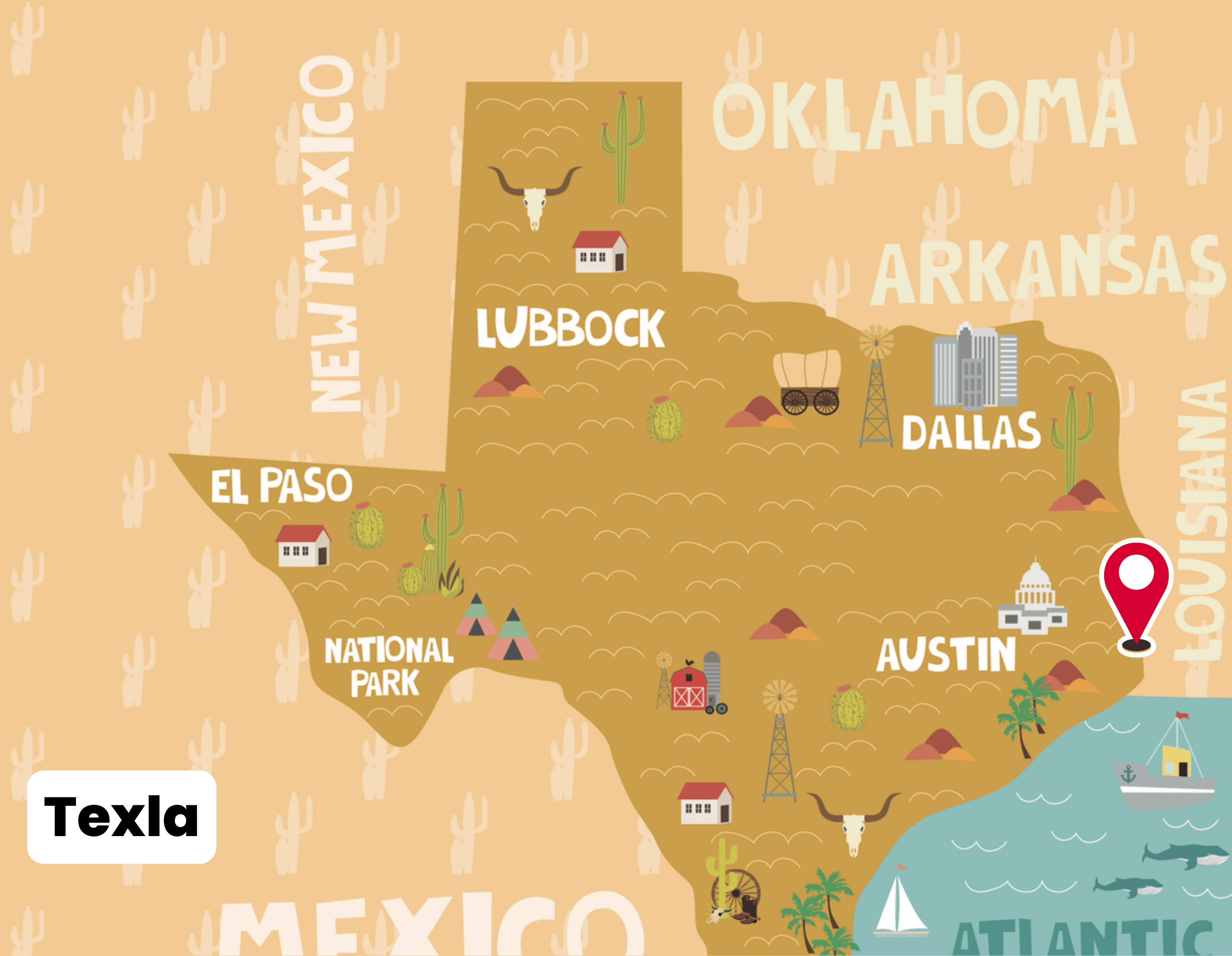
Texla
Map:
Sorry, no records were found. Please adjust your search criteria and try again.
Sorry, unable to load the Maps API.
Orange County
Texas
United States
- Access to the site itself likely requires permission from landowners. Pets may only be allowed on adjacent public roads; explorers should stay clear of private property. This aligns with general guidance on ghost-town visitation.
- Scenic driving along nearby routes, spotting any historical markers, or exploring the surrounding logging-region landscape remains. While not formally noted, these are common activities in similar sites.
- None—no facilities, public buildings, or visitor infrastructure exists.