
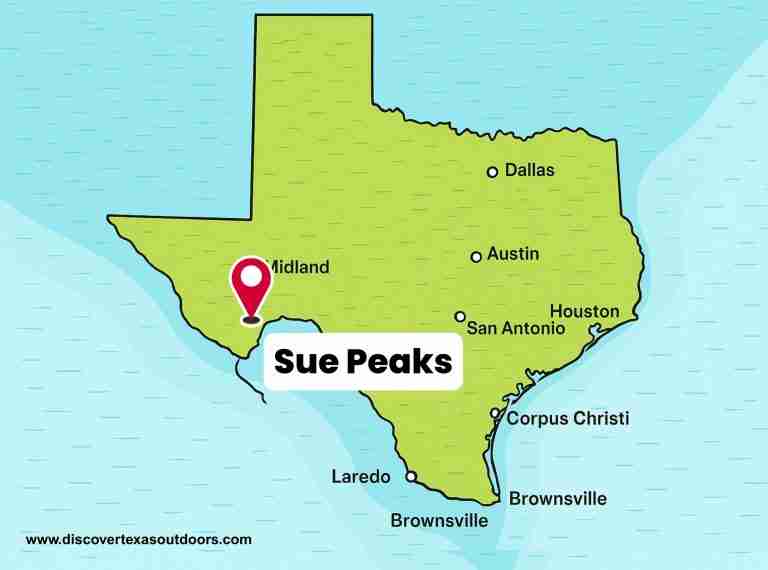
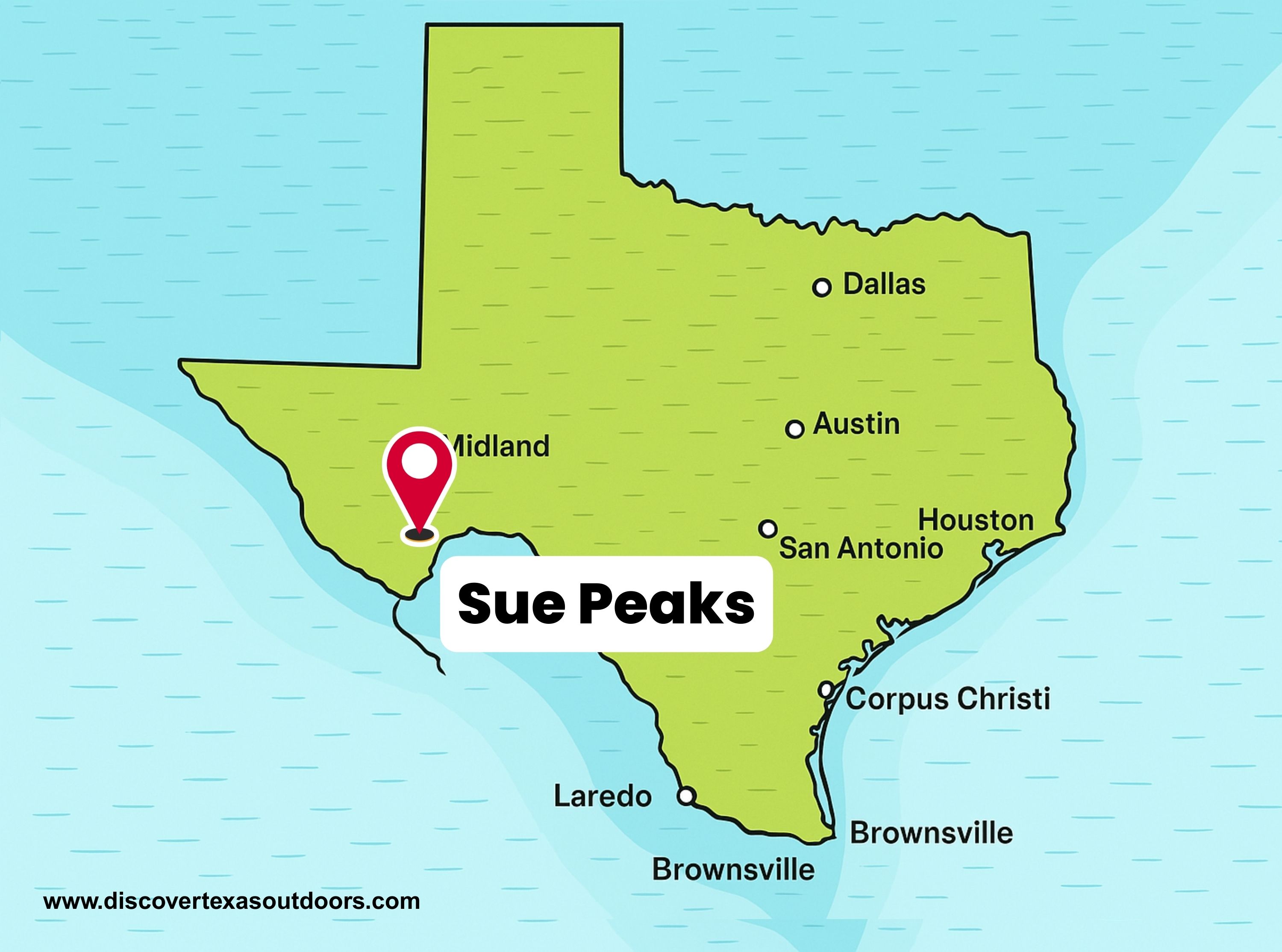
Sue Peaks consists of two prominent summits located just inside the northeastern boundary of Big Bend National Park in southeastern Brewster County, Texas. The higher of the two summits rises to an elevation of approximately 5,854 feet (1,784 meters), while the neighboring peak to the northwest reaches about 5,845 feet (1,782 meters). These peaks stand roughly 2,050 feet (625 meters) above Telephone Canyon, which lies two miles to the south. The surrounding landscape is rugged, with shallow, stony soils that support a mix of oak, juniper, and mesquite vegetation typical of the Chihuahuan Desert foothills.
Geological Setting
The region around Sue Peaks forms part of the complex geologic framework of Big Bend National Park. The area has been mapped as including exposures of the Sue Peaks Formation, a Lower Cretaceous (Early Cretaceous) geological unit composed primarily of limestone and shale. This formation is characteristic of the sedimentary layers that define much of Brewster County and reflects the area’s marine origins during the Cretaceous period. These deposits provide valuable insight into the ancient environments that once covered this part of Texas, when shallow seas dominated the landscape.
Terrain and Ecology
The terrain surrounding Sue Peaks is marked by rugged slopes, rocky ridges, and narrow canyons that create a striking contrast between elevation and desert lowlands. The vegetation is adapted to arid conditions, consisting mainly of desert scrub and sparse woodland. Oak and juniper trees grow along the ridges, while mesquite and creosote bush thrive in the lower areas. This combination of plant life provides habitat for a range of desert species, including reptiles, small mammals, and birds that inhabit the transition zone between desert floor and mountain foothill.
Hiking and Recreation
While not as widely visited as other destinations in Big Bend National Park, Sue Peaks attracts experienced hikers and climbers interested in off-trail routes and panoramic views. Reports from climbing communities describe the Northwest Slopes route as a challenging ascent, classified as a Class 3 scramble with an elevation gain of about 2,500 feet over a round-trip distance of roughly 12 miles. The climb rewards adventurers with sweeping views of the surrounding canyons and distant peaks of the Chisos Mountains. Because the route is unmaintained, proper preparation, navigation skills, and awareness of desert conditions are essential for safety.
Significance in the Big Bend Landscape
Sue Peaks contributes to the diverse topography that defines Big Bend National Park, an area known for its combination of desert basins, river canyons, and mountain ranges. The peaks serve as a notable landmark in the southeastern portion of the park, representing both the geological history and ecological variety of the region. For visitors seeking solitude and a deeper appreciation of the park’s natural formations, Sue Peaks offers a glimpse into the quieter, more remote character of Big Bend’s wild terrain.
Photos:
Map:
Sorry, no records were found. Please adjust your search criteria and try again.
Sorry, unable to load the Maps API.
Big Bend National Park
Texas
79830
United States
Pets are allowed in Big Bend National Park but are restricted to developed areas, including campgrounds and paved roads. They are not permitted on trails, in the backcountry, or on unpaved roads. Pets must be kept on a leash no longer than six feet at all times.
- Backcountry hiking and exploration (no established trails to Sue Peaks)
- Wildlife observation
- Photography
- Geological study
- Visitor center
- Campground with restrooms and potable water
- Park headquarters