
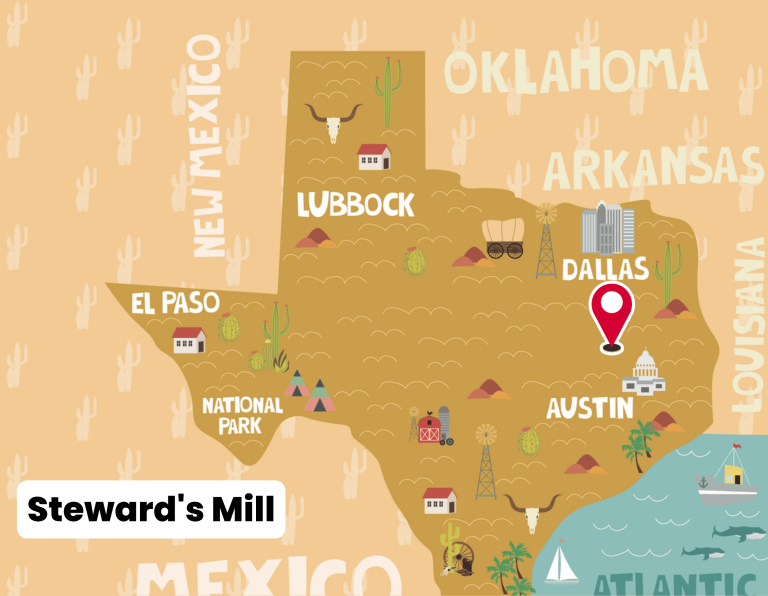
Stewards Mill, located in northwestern Freestone County, is one of the county’s oldest communities and a preserved example of early Texas rural life.
Early Settlement and the Gristmill
The settlement began in 1849 when Washington Steward, a native of South Carolina, built a water-powered gristmill on Mill Creek. His mill quickly became an important agricultural hub, drawing farmers from as far away as Ellis and Dallas counties who needed their corn and wheat ground into meal and flour. The community that grew around the mill took on Steward’s name.
In 1860, Steward also donated land for a cemetery, which became the burial site for members of his family, including two sons who died during the Civil War. This cemetery remains in use and contains some of the oldest marked graves in Freestone County.
The General Store
In 1867, Dr. James I. Bonner opened a general merchandise store that would serve as the economic and social center of Stewards Mill for more than a century. Known locally as the Stewards Mill Store, it supplied local families with dry goods, tools, and farm necessities. The store operated under various owners until the late 1960s, giving it over 100 years of continuous operation.
In 1964, the store was recognized as a Recorded Texas Historic Landmark. Visitors today can still see many of the 1960s-era fixtures—wooden counters, bins, and shelves—as well as the original millstone from Washington Steward’s 1849 operation, which remains embedded in the store’s doorstep.
Harmony Church
Another key institution was the Harmony Presbyterian Church, built in 1876. It became a shared worship space for several Protestant denominations, including Presbyterians, Methodists, and Baptists. Its role as a multi-denominational church reflected the cooperative spirit of a small rural population. The building still stands and is considered one of the oldest surviving church structures in the county.
Population Trends
Stewards Mill never grew into a large town but remained a close-knit farming community. Census estimates record about 70 residents in 1880, making it one of the more active rural centers in Freestone County at the time. By 1947, the population had declined to around 55. In the decades that followed, numbers dropped further, reaching only 22 residents by 1968, a figure that held steady through 2000.
Present Day
Today, Stewards Mill is regarded as a historic community rather than an active town. A handful of homes remain occupied. The landmarks—the old store building, Harmony Church, and cemetery—continue to preserve the settlement’s history. Despite its small size, Stewards Mill offers a rare, tangible glimpse into the everyday life of Texas farming communities in the post-frontier era.
Key Facts at a Glance
-
Founded: 1849 around Washington Steward’s gristmill
-
Cemetery: Established in 1860 on land donated by Washington Steward
-
General Store: Opened 1867 by Dr. James I. Bonner, operated until late 1960s, designated a Recorded Texas Historic Landmark in 1964
-
Millstone: Original millstone embedded in the store’s doorstep
-
Church: Harmony Presbyterian Church built in 1876, shared by multiple denominations, still standing
-
Population Peak: ~70 in 1880
-
Population Decline: ~55 in 1947; ~22 from 1968 through 2000
-
Current Status: Few residents, historic landmarks remain (store, church, cemetery)
Photos:

Steward's Mill
Map:
Sorry, no records were found. Please adjust your search criteria and try again.
Sorry, unable to load the Maps API.
Freestone County
Texas
United States
- Yes—on-leash allowed along public roads; ask before entering private property
- Photograph historic store, church & cemetery; genealogical research; scenic rural exploring
- None