
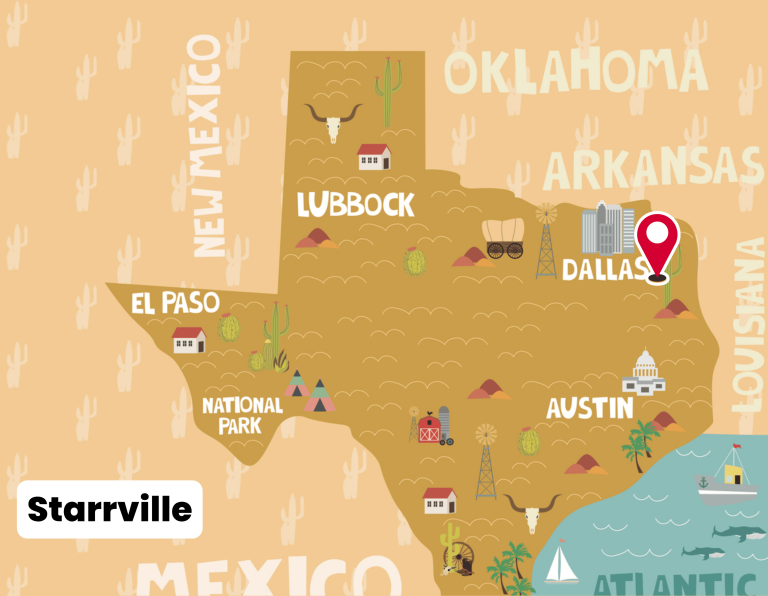
Starrville, located in Smith County, was founded in 1852 when the Reverend Joshua Starr, a Methodist minister originally from Alabama, purchased 640 acres of the Hall Survey. Before that, the area had been known as Gum Springs, a settlement that served as a stop along the Dallas–Shreveport stagecoach road as early as 1849. The location at a crossroads made it a natural gathering place for travelers and settlers.
Rev. Starr took an unusual step for the time by embedding prohibition covenants in his land deeds. These legal clauses prohibited the sale of liquor, gambling, and other vices. If a buyer violated the covenant, ownership of the land could legally revert back to Starr. This made Starrville one of the earliest “dry” communities in East Texas.
Institutions and Community Life in the 1850s
By the mid-1850s, Starrville had become a thriving small town. Key features included:
-
Religious and Civic Life: The Methodist church was built in 1853 and served as a central gathering place.
-
Postal Service: A post office was first established under the name Gum Springs in 1849 and renamed Starrville in 1857.
-
Education: Starrville became known for its schools. Separate male and female academies operated, and in 1860 the Starrville Union Academy was chartered as a coeducational institution. Another notable school was the Anna Judson Female Institute, reflecting the community’s early investment in higher learning.
-
Businesses and Professions: By the late 1850s, the town supported a hotel, sawmills, gristmills, blacksmith and wagon shops, a foundry, and cotton gins. Medical professionals, including doctors and dentists, also served the area.
This combination of schools, businesses, and religious institutions made Starrville an important settlement in Smith County during the 19th century.
Civil War Era
During the Civil War, Starrville hosted troops under General Henry McCulloch, who camped in the area in 1862 before marching to Little Rock. This military presence highlights the community’s regional significance at the time.
Decline After the Railroad
Starrville’s fortunes began to change in the 1870s. When the Tyler Tap Railroad (later part of the Cotton Belt line) sought routes through the area, town leaders declined to allow the tracks to pass through Starrville. This decision proved costly. The nearby town of Winona welcomed the railroad, and businesses and residents gradually shifted there to take advantage of better economic opportunities.
By the 1890s, Starrville’s population was around 200 residents, but by 1904 it had dropped to 122. In 1907, the post office and the Masonic lodge both moved to Winona, further reducing Starrville’s role as a local center.
Starrville in the 20th and 21st Centuries
Starrville never regained its earlier prominence but has remained a small unincorporated community. Historical structures and sites preserve its 19th-century heritage:
-
The Starrville Methodist Church, dating back to the 1850s, continues to stand as a symbol of the town’s founding.
-
The Starrville Cemetery holds graves of early settlers, ministers, and community leaders.
-
A former school building has been repurposed as a community center.
Though smaller than in its heyday, Starrville is recognized in historical markers and local histories as an early cultural and educational hub of East Texas.
Key Facts About Starrville
-
Founded: 1852 by Rev. Joshua Starr
-
Original Name: Gum Springs (until 1857)
-
Notable for: Early prohibition land covenants; thriving academies in the 1850s–60s
-
Population Peak: About 200 in the 1890s
-
Decline: Triggered by refusal to accept railroad access; institutions relocated to Winona by 1907
-
Today: An unincorporated community with preserved historic sites, especially the church and cemetery
Photos:
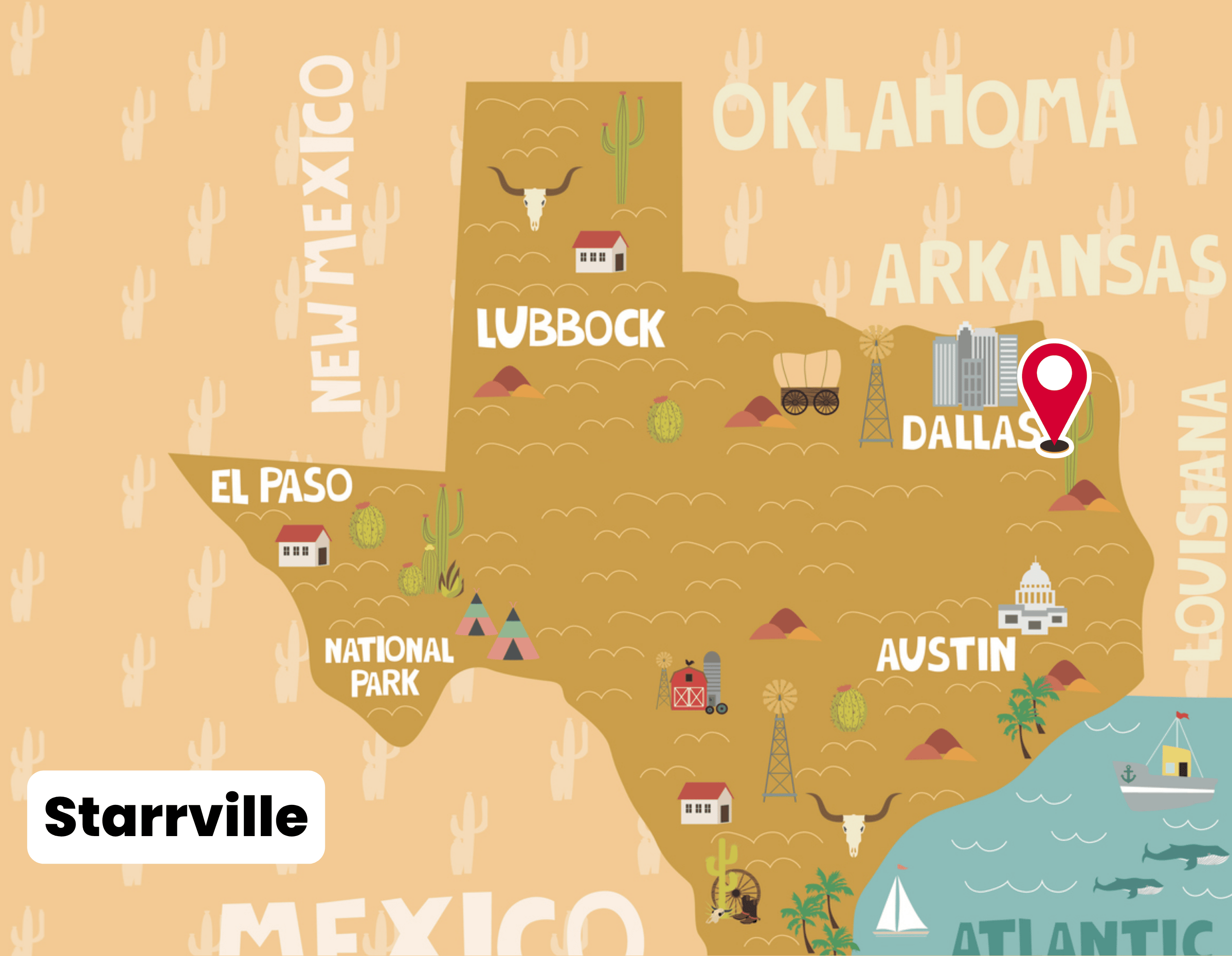
Starrville
Map:
Sorry, no records were found. Please adjust your search criteria and try again.
Sorry, unable to load the Maps API.
Smith County
Texas
United States
- Yes, leashed pets allowed at cemetery and roadside; request permission to pass beyond
- Explore historic church, cemetery, cotton gin remains, photograph landscape, rural heritage walk
- Cemetery plots and driveway parking (managed by SCA); otherwise no restrooms or signage