
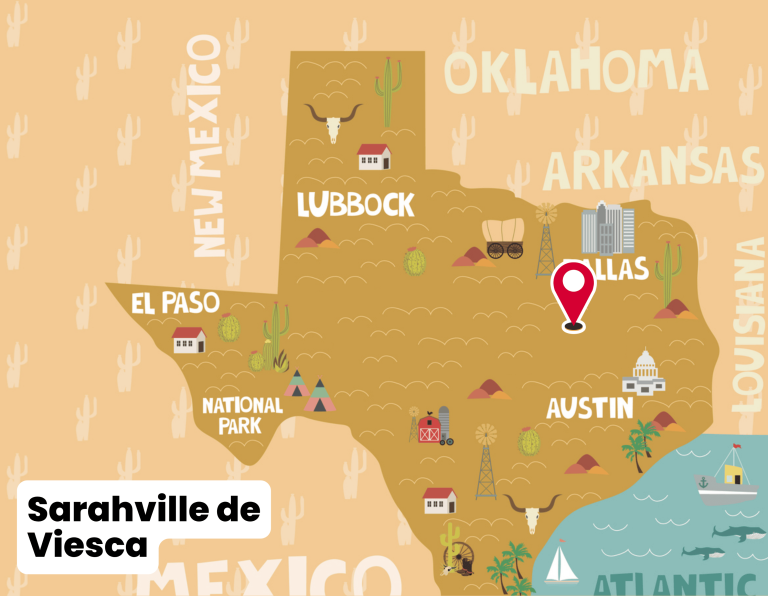
Sarahville de Viesca was founded in 1834 by Sterling C. Robertson, empresario of Robertson’s Colony. The settlement was established on the west bank of the Brazos River at the falls, about four miles southwest of present-day Marlin, Falls County, Texas. Robertson named the town for his mother, Sarah (Maclin) Robertson, and for Agustín Viesca, then governor of Coahuila y Tejas.
At the time, the Brazos falls area was a strategic location. It offered a reliable river crossing, fertile lands, and an accessible point for settlers moving into central Texas. Sarahville de Viesca was laid out to serve as the administrative and commercial hub of Robertson’s Colony.
Role in the Colony
The town became the location of the land office for Robertson’s Colony. Here, colonists registered their land titles and secured property grants. This made Sarahville de Viesca an important administrative center in early Mexican Texas.
By 1835, the community had a population of roughly 200 people. A fortification known as Fort Viesca was constructed to protect the colonists from raids and potential conflict. The fort later came to be known as Fort Milam, in honor of Benjamin R. Milam, a leader in the Texas Revolution.
Abandonment and Relocation
In 1836, during the upheaval of the Texas Revolution, settlers abandoned Sarahville de Viesca. The advance of the Mexican army and the general evacuation of central and eastern Texas—known as the Runaway Scrape—forced residents to flee. Native American raids in the area also contributed to the instability.
Though briefly reoccupied after the Revolution, the original site did not survive as a permanent town. Instead, settlers established a new community on the east bank of the Brazos River. This new settlement became known as Bucksnort, which for a short time served as a local trading and social center.
Decline and Rise of Marlin
By the late 1830s, both Sarahville de Viesca and Bucksnort had declined. The final blow came with the establishment of Marlin in 1851, which became the permanent county seat of Falls County. Marlin’s location, combined with its role as a center of commerce, law, and government, drew population and activity away from the earlier settlements.
Present-Day Site
No original structures of Sarahville de Viesca remain today. The location is commemorated by a Texas Historical Commission marker. The site is near the crossing of Farm-to-Market Road 712 and the Brazos River, south of Marlin. The area includes a Falls on the Brazos Park, which preserves access to the historic falls and offers modern recreational use.
Historical Significance
Although short-lived, Sarahville de Viesca holds an important place in Texas history as:
-
One of the earliest colonial settlements in the Robertson Colony.
-
The site of a land office that administered land titles for settlers in Mexican Texas.
-
A community that transitioned from civilian settlement to fortified post (Fort Viesca/Fort Milam) during turbulent years of revolution.
-
A forerunner to Bucksnort and ultimately Marlin, the community that survived as the county seat.
Summary
Sarahville de Viesca was a frontier experiment that illustrates the challenges of early colonization in Texas. Founded with optimism and administrative purpose, it could not withstand the upheavals of revolution and frontier conflict. Its story links to the broader themes of colonization, defense, and the shifting centers of settlement that shaped central Texas.
Photos:
Sarahville de Viesca
Map:
Sorry, no records were found. Please adjust your search criteria and try again.
Sorry, unable to load the Maps API.
Falls County
Texas
United States
- Yes, on-leash in the park
- Historical marker viewing, picnic, interpretive park, genealogy, light archaeology
- Picnic tables, parking, marker; no restroom or visitor center