
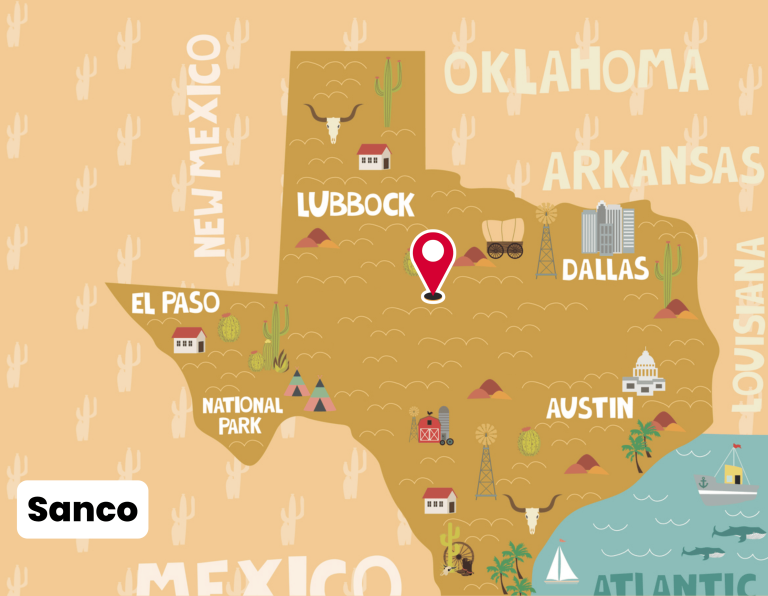
Sanco is a small, nearly abandoned community in northern Coke County, Texas. It traces its beginnings to the early 1880s, when ranching families established homesteads along Yellow Wolf Creek in what was then Tom Green County. The settlement was named in honor of Comanche Chief Sanaco, who, together with Chief Yellow Wolf, was known to camp in the area.
A post office was established in 1888 inside the stone home of rancher J. L. Durham. This building initially served multiple purposes, functioning not only as a post office but also as a schoolhouse and church. The opening of the post office marked the start of Sanco as a recognizable community.
Community Growth
During the first two decades of the 1900s, Sanco developed into a modest rural town.
-
Churches: A Methodist church was established, becoming a central place for worship and gatherings.
-
Education: In 1907, the townsite shifted slightly to flatter land near a more reliable water source. That same year, rancher Ulmer Bird donated land for a new school. This school consolidated smaller local schools from the surrounding ranch areas, such as Horse Mountain and Meadow Mountain.
-
Economy: A cotton gin began operating around 1905 and was active into the 1920s. Cotton brought a brief period of prosperity before the industry collapsed due to falling prices, drought, and the devastating spread of the boll weevil.
-
Commerce: A general store opened, serving as the hub for goods and supplies. At its height, the town also supported a blacksmith shop and other small services.
Decline
Like many rural Texas communities, Sanco’s fortunes declined during the 1920s. Several factors contributed:
-
Boll weevil infestations damaged cotton crops.
-
Drought and poor rainfall made farming difficult.
-
Low commodity prices discouraged agricultural production.
-
The expansion of rural mail routes reduced the need for a small-town post office.
The post office closed in 1920, reopened in 1924, and then was permanently discontinued in 1976. The community’s general store closed in the early 1970s, and with it, Sanco lost its last functioning business.
Despite the hardships, Sanco remained home to a small but steady population. Census figures record about 30 residents from 1970 through 2000, which represented its peak and long-term average. This stability was unusual, as many comparable rural towns disappeared entirely by mid-century.
Present Day
Today, Sanco is considered a ghost town. Only scattered, abandoned buildings remain as evidence of its past. These include remnants of the school and other stone structures. Visitors to the area often encounter historical markers that recount the town’s origins and its ties to the Comanche presence in the region.
Key Facts about Sanco
-
Founded: Early 1880s by ranching families.
-
Name Origin: Honoring Comanche Chief Sanaco, with connections to Chief Yellow Wolf.
-
Post Office: First opened in 1888 in J. L. Durham’s rock home; closed 1920; reopened 1924; closed permanently 1976.
-
Education: First school in Durham’s home; consolidated school built in 1907 on land donated by Ulmer Bird.
-
Religion: Methodist church established; no major sources confirm a Baptist church.
-
Economy: Cotton gin active from about 1905 into the 1920s; general store and blacksmith shop also served the community.
-
Decline: Driven by boll weevil infestations, drought, low crop prices, and rural route mail expansion.
-
Population: Averaged about 30 residents from the 1970s through 2000.
-
Current Status: Ghost town with only abandoned structures remaining.
Photos:
Sanco
Map:
Sorry, no records were found. Please adjust your search criteria and try again.
Sorry, unable to load the Maps API.
Coke County
Texas
United States
- Yes, on-leash on roads; permission needed for private land
-
Ghost-town viewing and exploration via roadside access
-
Rural photography (abandoned buildings and local history)
-
Heritage research, particularly on early Texas settlement patterns
-
Scenic driving on nearby backroads
- None