
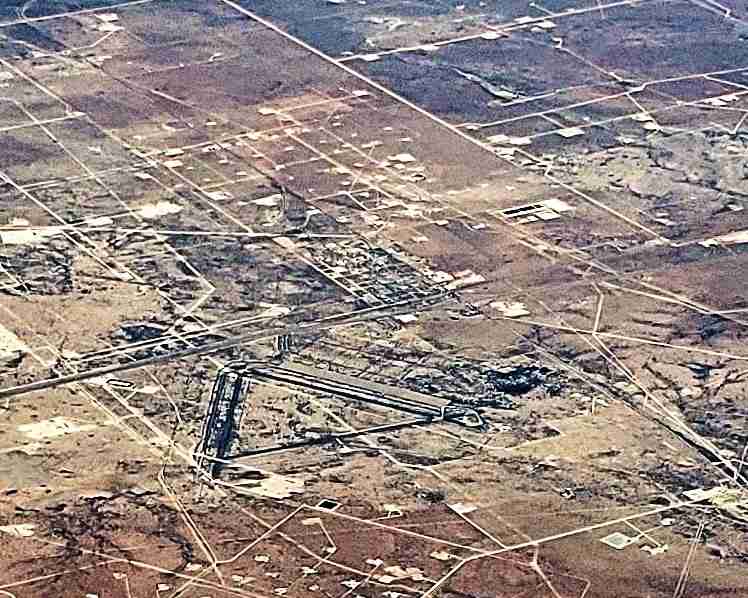
Pyote traces its origins to the early 1880s as a Texas & Pacific Railway watering stop known as Pyote Tank. A telegraph office was established there in 1881, before the completion of the railway line. The town’s name has been linked to either coyote (reportedly mispronounced by Chinese railroad workers) or to the peyote cactus found in the region.
Oil Boom and Decline
For decades, Pyote remained a small railroad stop. Its growth accelerated in 1926 when oil was discovered in neighboring Winkler County. By 1928, Pyote had grown to an estimated 3,500 residents and became a trading and shipping hub for the surrounding oilfields. However, when the Texas & Pacific built a railroad spur to Monahans, Pyote lost much of its shipping traffic, and its boomtown prosperity faded.

Rattlesnake Bomber Base
During World War II, the U.S. Army Air Forces established the Pyote Army Air Base in 1942. The site was nicknamed the “Rattlesnake Bomber Base” because construction unearthed numerous rattlesnake dens in the desert environment. The base trained bomber crews and, at its peak in 1944, housed more than 6,000 officers and enlisted personnel.
After the war, Pyote’s dry climate made the base a convenient location for the long-term storage and preservation (“pickling”) of surplus aircraft. Hundreds of B-17 Flying Fortresses and B-29 Superfortresses were mothballed there. Among them was the Enola Gay, the B-29 that dropped the atomic bomb on Hiroshima. It was stored at Pyote from January 1952 until December 1953, when it was transferred to Andrews Air Force Base.
The base remained active through the early Cold War but was gradually scaled back. It was officially closed in 1963.
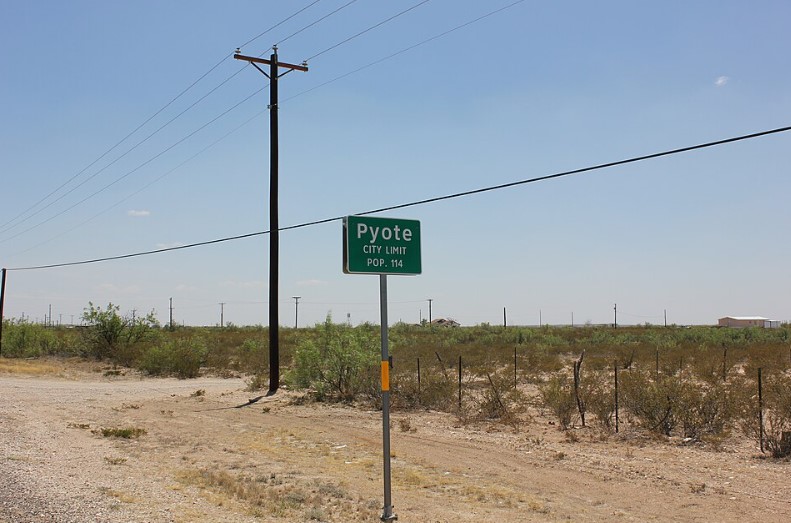
Later Years
Following the base closure, some of the land and facilities were repurposed. The West Texas State School, a juvenile correctional facility, operated on part of the former air base property until its closure in 2010.
Today, remnants of the bomber base—including large concrete runways and deteriorating hangars—still mark the landscape. Local preservation groups and museums have documented its history as one of Texas’s most important World War II training and storage sites.
Modern Pyote
According to the 2020 U.S. Census, Pyote has a population of 72 residents. Once a bustling oil boomtown and wartime training center, the community is now a quiet rural town in Ward County. Its identity is shaped by the remains of its military past and its place in the history of Texas oil and rail development.
Facts
-
Founded: Early 1880s as Pyote Tank, a Texas & Pacific Railway watering station.
-
Oil Boom: Peaked around 1928 with ~3,500 residents; later declined as Monahans took over as shipping hub.
-
Pyote Army Air Base: Built 1942; “Rattlesnake Bomber Base” nickname from rattlesnake dens; housed 6,000+ personnel.
-
Aircraft Storage: Hundreds of B-17 and B-29 bombers stored post-WWII; Enola Gay stored 1952–53.
-
Closure: Base closed 1963; West Texas State School operated on site until 2010.
-
Population: 72 residents in 2020.
Photos: