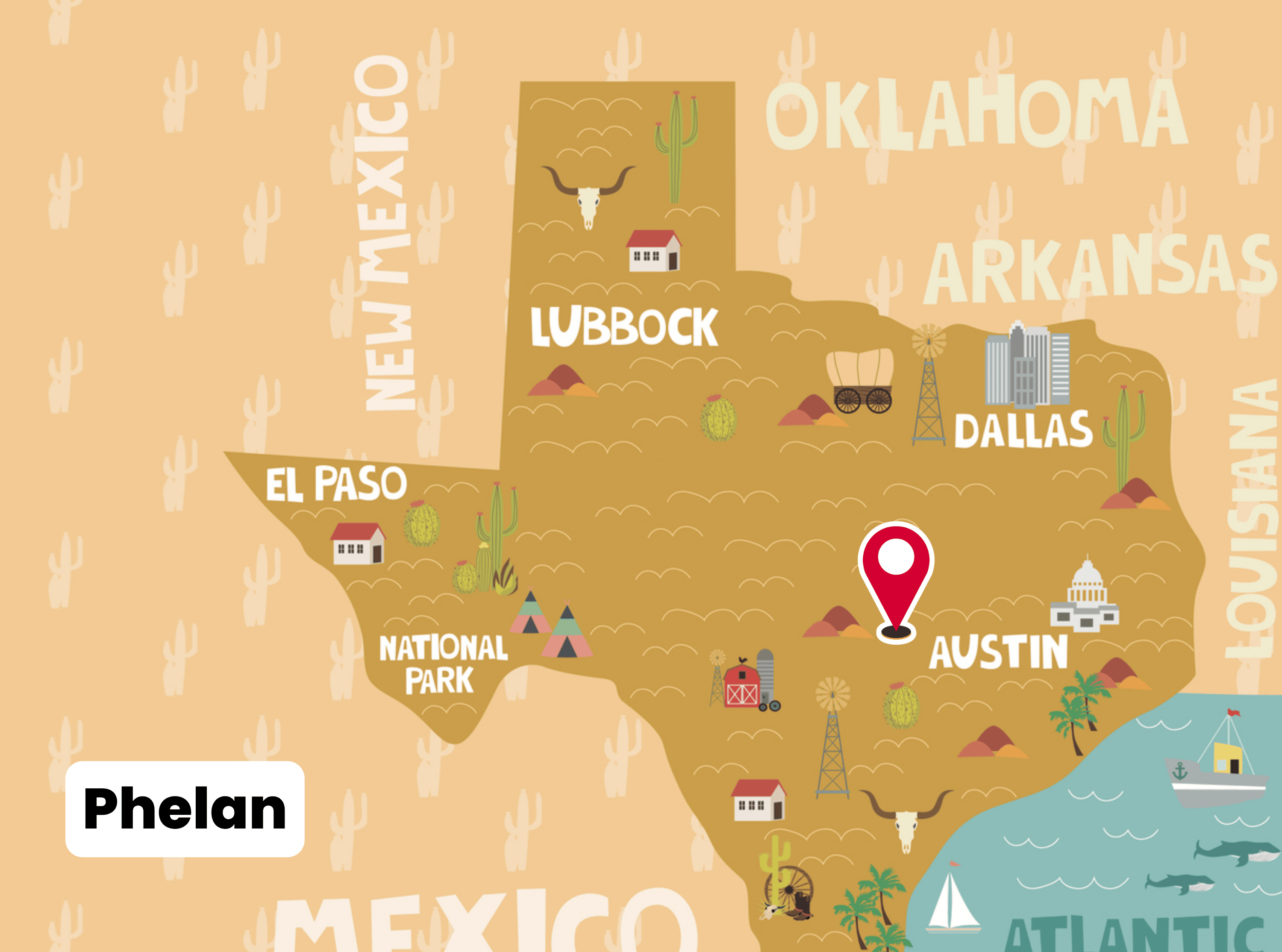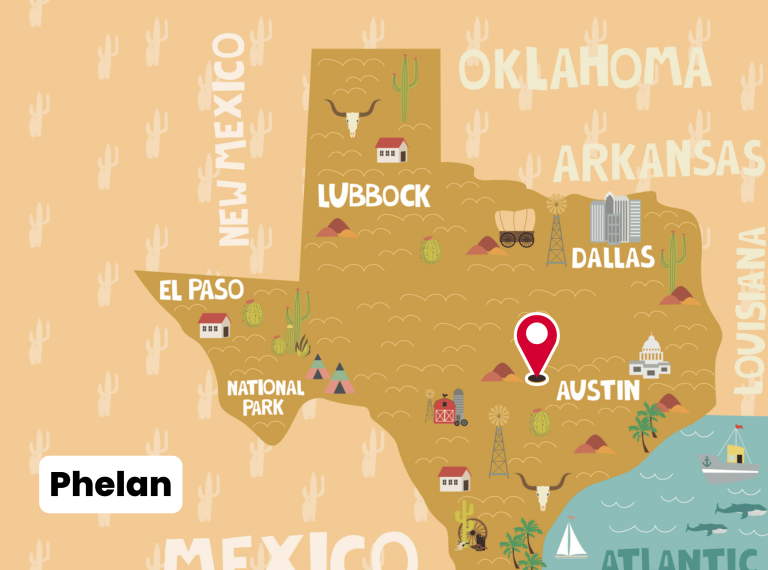
Phelan is a historic ghost town in Bastrop County, Texas, located about two miles north of the city of Bastrop near the intersection of Farm to Market Road 157 and Phelan Road. Today, it is on private property, and little remains of the once active community beyond scattered foundations, remnants of mining shafts, and the Phelan Cemetery.
Founding and Early Development
The town was established in 1903 by John C. Phelan, a businessman who founded the Independence Mining Company to exploit local deposits of lignite coal. Bastrop County was one of the few areas in Texas where lignite mining had significant commercial potential, and Phelan was organized as a company town to support this industry.
To serve the growing settlement, a post office was established in 1905, with John Phelan himself listed among its postmasters. A few years later, in 1910, a school was built for the children of miners. Many of the laborers employed in the mines were of Mexican heritage, and the school provided for their families within the community.
Peak Years
By 1914, Phelan had reached its peak. The town supported a population of about 800 people, along with a general store and other small services tied to the mining economy. Coal from the Independence Mining Company was shipped for local use and contributed to Bastrop County’s modest role in Texas’s early energy industry.
Decline
The fortunes of Phelan were closely tied to the success of coal mining, and as the industry began to decline, so did the town.
-
By 1925, the population had fallen sharply to around 200 residents.
-
The post office closed in 1931, ending a key institution in the community.
-
The school remained in operation through 1933, serving the shrinking population until it too was shut down.
Although mining activity lingered into the 1940s, it was no longer on the same scale as before. Eventually, the mines closed completely, leaving little to sustain the town.
Present Condition

Today, Phelan is considered a ghost town. The original settlement has disappeared, and most structures have been lost to time and overgrowth. What remains are subtle traces of the community’s past:
-
The Phelan Cemetery, where former residents are buried, is still intact. Many of the gravestones feature Catholic imagery and Spanish-language epitaphs, reflecting the heritage of the town’s Mexican mining families.
-
Scattered foundations and the remains of old mining shafts mark the land once occupied by homes, schools, and stores.
The site is not open to the public, but it stands as a reminder of Bastrop County’s brief coal-mining era and the communities that rose and fell with it.
Summary
Phelan’s history reflects the rise and fall of Texas coal mining in the early 20th century. Founded in 1903 around a lignite operation, it quickly grew into a town of 800 with its own post office, school, and store. Within two decades, however, the decline of coal led to rapid depopulation. By the 1930s, the institutions that once anchored the town had closed, and by the 1940s, mining had ended altogether. Today, Phelan survives only as a ghost town marked by its cemetery and faint traces of its industrial past.
Photos: