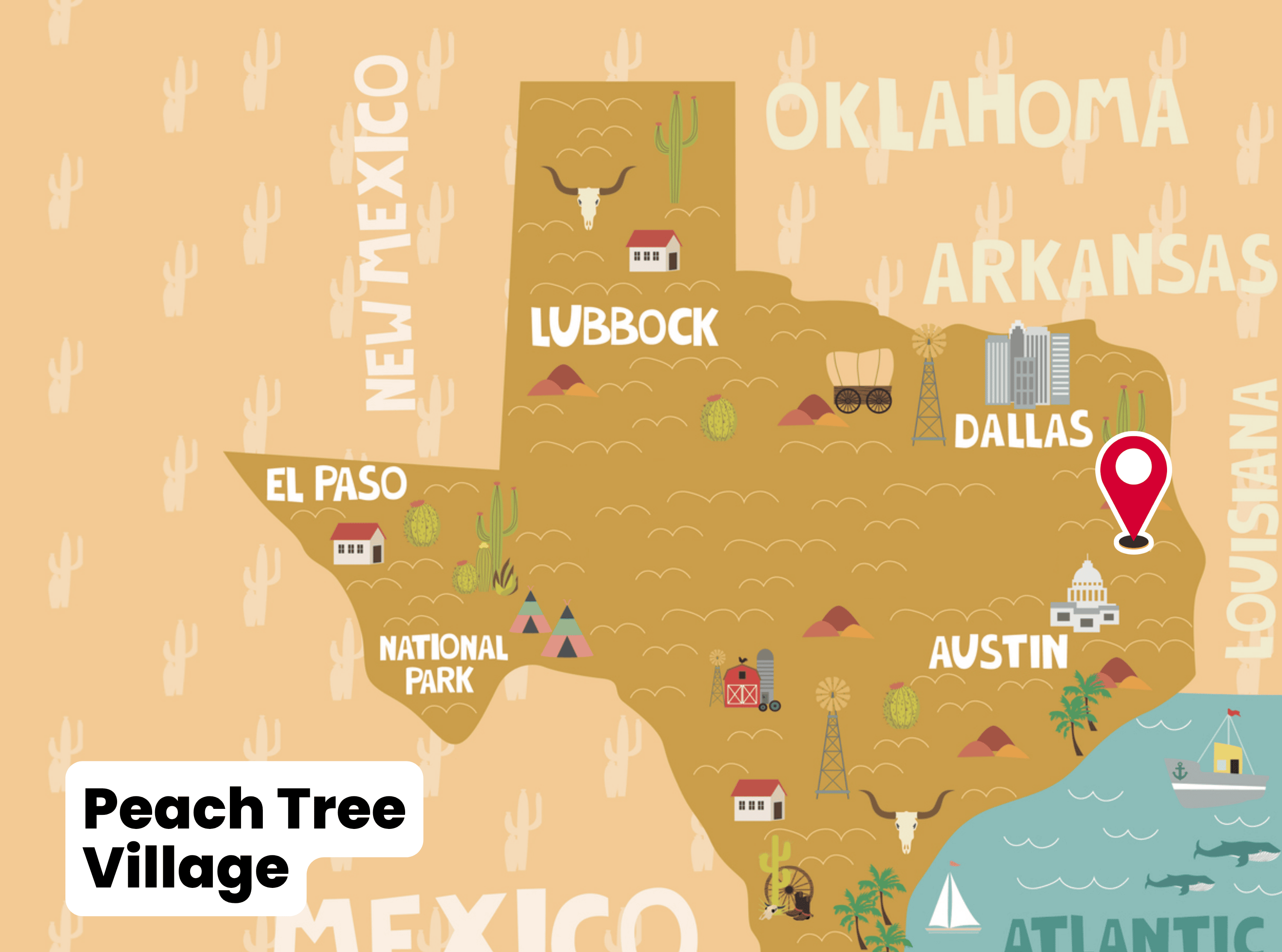
Peach Tree Village, located in Tyler County, Texas, was one of the earliest settlements in the area. Its origins are tied to the Alabama Indians, who migrated into East Texas from the southeast during the late 18th and early 19th centuries. The site was called Ta-Ku-La, traditionally translated as “Peach Tree,” and served as a center for the tribe. By the 1830s, conflicts over land ownership and encroachment by Anglo settlers led most of the Alabama people to leave the immediate area, though the Alabama-Coushatta community still maintains a reservation in Polk County today.
Growth as a Frontier Community
As more settlers arrived, Peach Tree Village developed into an important crossroads for travelers and pioneers. Several early roads and trails passed through the site, linking it to places such as Nacogdoches, Huntsville, San Antonio, and the Gulf Coast. By the mid-1800s, Peach Tree Village had become a small but notable community. It was home to a private academy, commercial establishments, and local services. In 1858, a post office was opened, and Peach Tree Village functioned as one of the county’s earliest centers of activity.
John Henry Kirby
The most famous individual associated with Peach Tree Village was John Henry Kirby, born nearby in 1860. Kirby became one of Texas’s most prominent businessmen during the late 19th and early 20th centuries. He founded the Kirby Lumber Company, played a major role in the expansion of the state’s lumber and oil industries, and was deeply involved in banking and business ventures. His success earned him the nickname “the Father of Industrial Texas.”
In 1912, Kirby honored his parents by commissioning the construction of a red-brick chapel in Peach Tree Village. Known as the Peach Tree Village Chapel or sometimes simply “the Chapel,” it was designed as a lasting memorial.
Decline and Relocation
Peach Tree Village began to decline in the 1880s with the arrival of the Trinity and Sabine Railway. The rail line bypassed the settlement, leading residents and businesses to relocate about two miles away to what became the town of Chester. The Peach Tree Village post office was closed in 1883 and re-established in Chester. Over time, the original village lost its population, leaving behind only the chapel and a few historic sites.
Preservation and Legacy

The Peach Tree Village Chapel remains the most visible reminder of the community’s past. The property, along with the Kirby family home, was later donated to Tyler County through the involvement of Governor Allan Shivers. Today, the site is preserved and maintained as part of Camp Ta-Ku-La, which uses the area for youth camps and community events. Historical markers on site recount the Alabama Indian roots of the village, its significance as a frontier crossroads, and its association with John Henry Kirby.
Key Facts
-
Peach Tree Village was originally associated with the Alabama Indians, who called it Ta-Ku-La, meaning “Peach Tree.”
-
The community developed in the early to mid-1800s as a crossroads settlement with a post office (1858), academy, and businesses.
-
John Henry Kirby, born in the area in 1860, became a leading Texas industrialist and built the brick memorial chapel in 1912.
-
The village declined after the railroad led to the founding of Chester in 1883.
-
The chapel and Kirby home were later donated to Tyler County and are now maintained as part of Camp Ta-Ku-La.
Photos: