
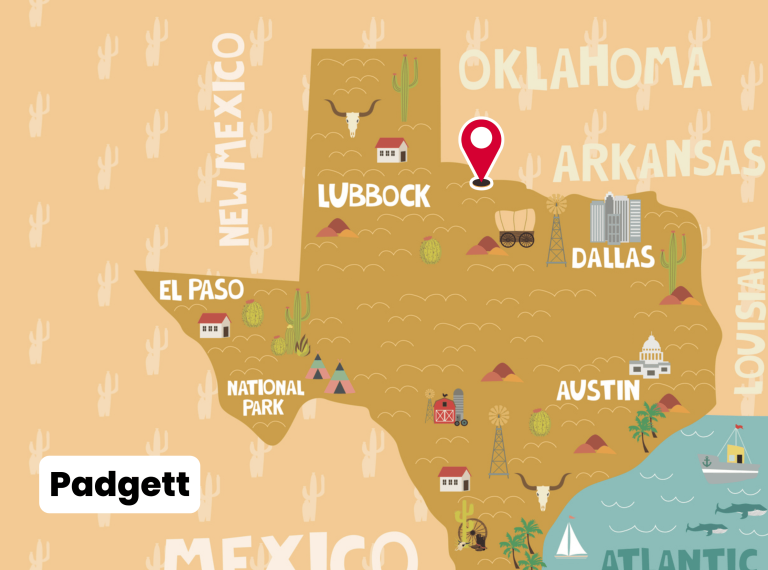
Padgett was founded in the mid-1870s, during a period of settlement across Young County following the Civil War and the end of frontier conflicts. The community was named for Isaac Bird Padgett, a pioneer settler who arrived in the area in 1875. Like many small farming settlements in North Texas at the time, Padgett developed around the needs of local ranchers and farmers. Its location about nine and a half miles southwest of Olney along what is now State Highway 79 gave it access to nearby markets and towns.
Community Development
By the turn of the 20th century, Padgett had become a modest but active rural community. It contained a cotton gin, reflecting the crop’s role as the backbone of the local economy. Several small businesses operated in town to support farming families, alongside a post office, which connected residents with the wider region.
Church life was particularly strong in Padgett. Records note the presence of four or five churches at its height, showing the importance of faith communities in daily life. In addition, Padgett supported a two-teacher community school, providing basic education for children from surrounding farms and ranches.
Education and Consolidation
The town’s school was formally known as Padgett School No. 28. Like many rural Texas schools, it served as both an educational and social center for the community. However, as transportation improved and consolidation movements gained momentum, smaller schools were merged into larger districts. In 1944, Padgett School No. 28 was absorbed into the Olney Schools, marking the end of local schooling in Padgett.
Decline in the Mid-20th Century
Following the school’s closure, Padgett entered a long decline. Families increasingly moved to larger towns such as Olney for work, education, and access to services. By the late 1960s and early 1970s, most of Padgett’s institutions had closed, and the once-active community had largely disappeared. This pattern was common across Texas, where many rural towns withered as populations shifted to more urban centers.
Legacy and Present Day
Today, the Padgett Cemetery stands as the main surviving landmark of the community. The cemetery contains the graves of early settlers, families, and descendants who helped establish and sustain Padgett during its active years. Local historians note that a few ruins remain in the area, but the cemetery is the most visible reminder of the town’s existence.
Padgett’s story reflects the broader history of rural Texas—small settlements built on agriculture and local institutions, sustained for decades, and later diminished as economic and social changes reshaped the region.
Photos:
Padgett
Map:
Sorry, no records were found. Please adjust your search criteria and try again.
Sorry, unable to load the Maps API.
Young County
Texas
United States
-
Leashed pets are allowed when visiting via public roads or cemetery property (with owner’s permission).
-
Please stay on designated property and be mindful of private land boundaries.
-
Ghost‑town exploration: visit Padgett Cemetery, look for headstones and traces of former structures.
-
Historical photography: capture the serene rural setting and memorial markers.
-
Genealogical research: cemetery may have records on early settlers and local families.
-
Scenic country drive: enjoy a drive along SH 79 through Young County farmlands.
-
None onsite (no restrooms or signage).
-
Nearby Olney (~10 mi NE) supplies fuel, food, lodging, groceries, and postal services.