
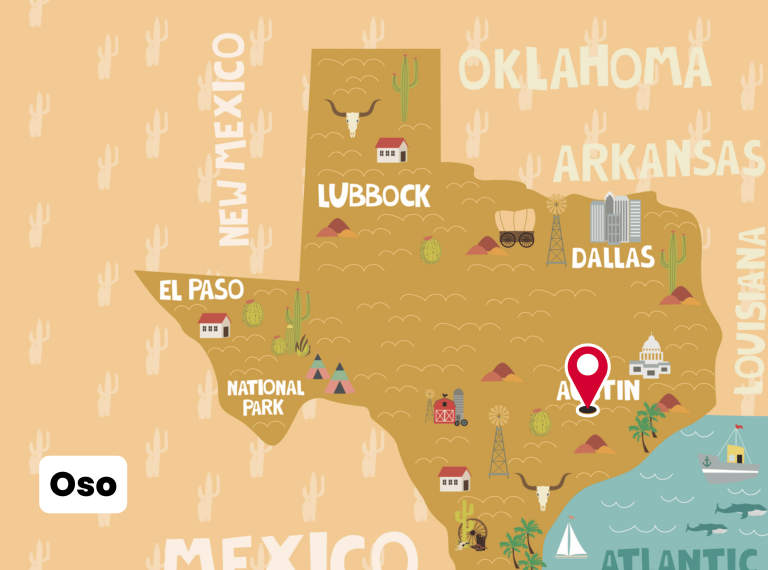
Oso was a rural community in southwestern Fayette County, Texas, located about three miles northeast of Flatonia on the divide between Haw and Rocky Creeks. The name Oso, meaning “bear” in Spanish, was chosen during its early years of development in the 19th century.
Early Settlement and Development
The settlement began in the mid-1800s. A post office was established at Oso in 1858, a clear marker of its early community organization. At its peak, Oso supported small farms and a modest trade network. The community included a school, a general store, a cotton gin, a tannery, and a blacksmith shop. These businesses and services served the surrounding farm families, who primarily raised cotton and other agricultural products suited to the land between Haw and Rocky Creeks.
Decline After the Railroad
In 1874, the Galveston, Harrisburg and San Antonio Railway built its line through nearby Flatonia. The new railroad offered far better transportation and trade opportunities, and businesses soon shifted their focus there. Many merchants and settlers left Oso for Flatonia, leading to a steep decline.
By the late 19th century, Oso had lost its post office and much of its population. According to the Handbook of Texas, by 1900 “only the place name remained,” marking the end of Oso as an active community.
Pine Springs Cemetery
The most enduring landmark of the Oso area is Pine Springs Cemetery, one of the older burial grounds in Fayette County. The first recorded burial dates to 1853, five years before the post office was established. The cemetery contains the graves of early settlers and remains an important historical site, preserving the memory of the families who once lived in the community.
Historical Significance
While little physical evidence of Oso survives beyond Pine Springs Cemetery and occasional traces of old building sites, its story reflects a common pattern in 19th-century Texas history. Many small rural settlements emerged to serve local farming communities, only to decline or disappear entirely when railroads shifted economic activity to new towns.
Today, Oso is remembered primarily through local history records and the cemetery, which continues to mark the presence of the community in Fayette County’s past.
Highlights:
-
Settlement established by mid-1800s.
-
Post office in operation from 1858 until decline after 1874.
-
Supported farms, a school, cotton gin, tannery, blacksmith shop, and store.
-
Decline tied directly to the 1874 railroad through Flatonia.
-
Pine Springs Cemetery (est. 1853) is the main surviving landmark.
Photos:
Oso
Map:
Sorry, no records were found. Please adjust your search criteria and try again.
Sorry, unable to load the Maps API.
Fayette County
Texas
United States
-
Leashed pets are allowed when visiting via public roads.
-
Access onto private property (including the cemetery) requires landowner permission, and pets must be controlled.
-
Historical exploration: Visit Pine Springs Cemetery and observe the remains of the school site or homesteads.
-
Photography: Capture quiet rural settings, weathered grave markers, and vast farmlands.
-
Genealogy research: Cemetery records may reveal data about early settlers.
-
Scenic country drive: Enjoy Fayette County’s tranquil FM‑road corridors.
-
None on-site: No restrooms, visitor signage, or interpretive installations.
-
Nearby Flatonia (~3 mi SW): Full services including fuel, food, dining, lodging, and a museum.