
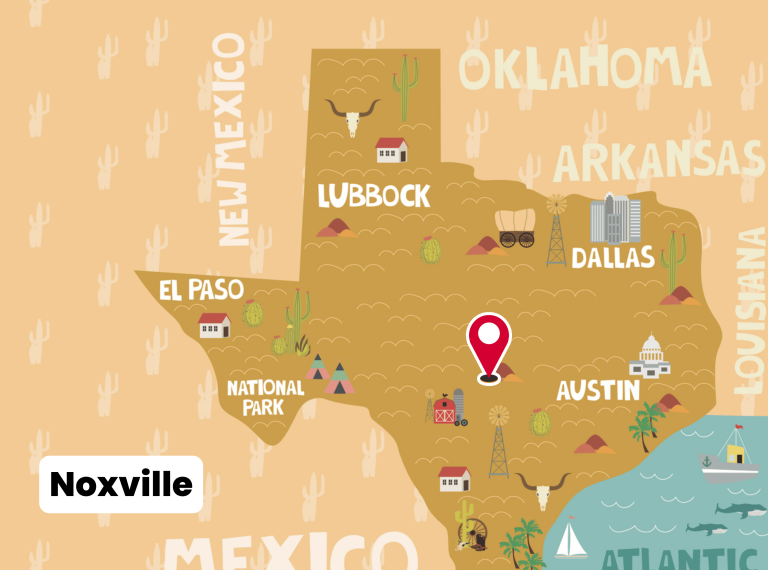
Noxville is a small unincorporated community in Kimble County, Texas, with roots in the late 19th century. Today, it is considered a ghost town, though its cemetery and historic schoolhouse remain as reminders of its past.
Early Settlement
The area around present-day Noxville was first settled in 1869 when Creed Taylor, one of the early Anglo pioneers of Kimble County, built a two-story limestone house on the James River. His home became a landmark for the growing ranching community in this part of the Texas Hill Country.
A decade later, in December 1879, Noah Nox, a settler originally from Illinois, opened a general store on the Little Devils River, about four and a half miles east of Taylor’s home. At the same time, his wife, Persis Nox, became the first postmistress when the U.S. Post Office established a branch at the store. This marked the formal founding of Noxville.
Relocation and Community Growth
In December 1911, the center of Noxville shifted when postmaster Jason A. Milam moved the post office and store to the west side of the James River. This relocation effectively created a “new” Noxville, while the original site on the Little Devils River became known as Old Noxville.
By the 1880s, the community had built a native stone schoolhouse, believed to be the first stone school in Kimble County. It served local children until 1940, when the Noxville school district was consolidated into the Harper Independent School District in neighboring Gillespie County. Even after the school closed, the building remained important—it was used as a local voting precinct until the late 1960s. The schoolhouse still stands today as a historical landmark.
The Noxville Cemetery, established early in the town’s history, continues to be maintained and is still in use for local burials.
Connection to the Cattle Trails
During the late 19th century, Noxville lay along the route of the Great Western Cattle Trail, one of the major livestock trails that carried millions of Texas Longhorns north to railheads in Kansas and beyond. While precise numbers are hard to verify, it is well established that herds passed through the region near Noxville between the 1870s and 1880s, helping tie the community to the broader cattle-driving era of Texas history.
Decline and Ghost Town Status
Noxville never grew into a large town. According to state records, the community generally had a population of fifteen or fewer residents until 1974, when it was briefly estimated at seventy-five. By the 2000 census, however, the number of residents had dwindled to just three, and Noxville came to be regarded as a ghost town.
Today, only a handful of families live in the area. The schoolhouse and cemetery remain as the most visible ties to its past, while ranching continues to define the surrounding countryside.
Key Facts about Noxville
-
Founded: 1879, with the establishment of the post office by Noah and Persis Nox
-
First settlement: 1869, stone house of Creed Taylor on the James River
-
Relocated: 1911, post office and store moved west under Jason A. Milam
-
School: Native stone schoolhouse built c. 1880, closed in 1940, voting precinct until 1968
-
Cemetery: Still active and maintained
-
Population: Around 15 or fewer until 1974; estimated at 75 in 1974; 3 in 2000
Photos:

Noxville
Map:
Sorry, no records were found. Please adjust your search criteria and try again.
Sorry, unable to load the Maps API.
Kimble County
Texas
United States
-
Leashed pets allowed along FM 479 and in visible public areas like the cemetery.
-
Access to private land or the riverbed requires landholder permission.
-
Cemetery Visit: Active burial grounds with graves of early settlers.
-
Historic Landmarks (view only): Stone schoolhouse still stands near the cemetery, visible from the public right-of-way.
-
Scenic Drive: FM 479 passes through rugged Hill Country terrain.
-
Photography: Hill Country landscapes and roadside views of historic structures (no trespassing).
-
On-site: Cemetery grounds. No designated parking, restrooms, or visitor facilities.
-
Nearby Services: Junction (~21 miles west) offers fuel, food, lodging, and access to South Llano River State Park.