
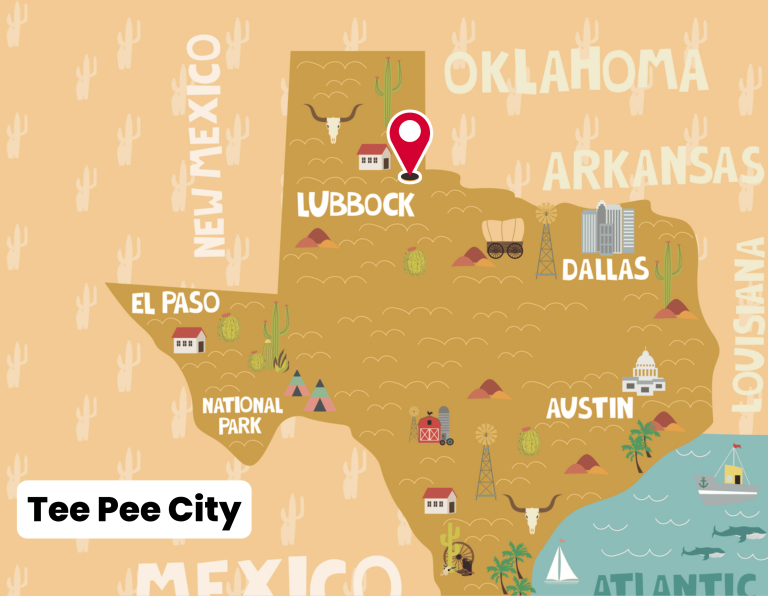
Tee Pee City was a short-lived frontier settlement in Motley County, Texas, founded around 1875 at the junction of Tee Pee Creek and the Middle Pease River. Established by traders Charles Rath and Lee Reynolds as a buffalo-hunting and trading outpost, it quickly gained a reputation for rowdy saloons, shoot-outs, and lawlessness that often drew the attention of the Texas Rangers.
A post office, school, and small businesses served hunters and ranchers, but the town declined after the buffalo herds vanished and ranching interests grew. In 1904 the Matador Land & Cattle Company purchased the land, closed its saloon, and effectively ended the community. Today, only a historical marker and a small cemetery mark the site.
Founding and Early Years
Tee Pee City was established around 1875 at the meeting of Tee Pee Creek and the Middle Pease River in what is now Motley County, Texas. It began as a buffalo-hunting and trading settlement, created by Charles Rath and Lee Reynolds, who were experienced traders from Dodge City, Kansas. They brought freight wagons, livestock, and even fixtures for a saloon and dance hall. The name “Tee Pee” came from the tipi poles left behind by Comanche encampments along the creek, marking the site’s earlier Native presence.
When Rath and Reynolds moved on, they left the town in the hands of Isaac Armstrong and his partner Sharp, who operated its main building. This structure, built from picket wood, had two rooms: one served as a small hotel, and the other functioned as a saloon and dance hall where entertainment often turned rowdy. Tee Pee City quickly became a hub for buffalo hunters, traders, and drifters, with an economy tied directly to the booming hide trade.
Growth and Institutions
Despite its reputation for lawlessness, Tee Pee City developed several formal institutions:
-
Post Office (1879–1900): Established with A. B. Cooper as the first postmaster, the post office operated for over two decades. Cooper also ran the general store, first from a dugout and later from a stone building.
-
School (1895–1902): One of the earliest in the region, the school educated children from ranching families and settlers before it closed due to declining population.
-
Businesses and Facilities: At its peak, Tee Pee City supported a general store, hotel, saloon, dance hall, and eventually a small cemetery.
The town was a lively stop for buffalo hunters and cattlemen, who came for supplies, mail, and entertainment.
Violence and Lawlessness
The settlement became notorious for violence and rowdiness. Drunken brawls, gambling disputes, and shoot-outs were common, and stories of robberies and killings spread across the region. The town earned a reputation as a “wild” frontier hub, much like Dodge City itself.
Because of this, Texas Rangers, led by G. W. Arrington, frequently patrolled Tee Pee City to restore order. Their presence was necessary, as law enforcement was otherwise minimal, and saloons often drew dangerous crowds of buffalo hunters and drifters.
Decline and Closure
The town’s fate was sealed when the buffalo herds disappeared by 1878, removing its primary source of economic activity. Though some ranching families remained, Tee Pee City steadily declined through the late 19th century.
By the early 1900s, only remnants of the once-busy outpost were active. The school closed in 1902, and in 1904 the Matador Land & Cattle Company purchased the land. Known for maintaining strict rules for its cowboys, the ranch banned visits to Tee Pee City and shut down its saloon, effectively dismantling the community. The post office had already closed in 1900, leaving little reason for the site to survive.
Legacy and Remains
By the 1930s, Tee Pee City was a ghost town. In 1936, the Texas Historical Commission placed a marker at the site to commemorate its history. Today, the marker has been relocated to a roadside park east of Matador, Texas, while the original site sits on private land.
A small cemetery remains, containing the graves of Isaac Armstrong, who died in 1884, two children of postmaster A. B. Cooper (James Motley Cooper and Nellie Elizabeth Cooper), and their aunt, Mrs. A. S. Johnson. These headstones are among the few physical traces of the community.
Key Facts About Tee Pee City
-
Comanche Connection: The name came from tipi poles found along Tee Pee Creek, reminders of earlier Comanche encampments.
-
Frontier Outpost: Started as a buffalo-hunting and trading post, supplying hides and goods during the 1870s.
-
Lawless Reputation: Known for shoot-outs, drunken brawls, and robberies, requiring Texas Ranger intervention.
-
Matador Ranch Influence: The Matador Land & Cattle Company purchased the land in 1904, banned its operations, and ended the town’s existence.
-
Historic Marker: A 1936 Texas Centennial marker and a small cemetery are all that remain of the once-rowdy settlement.
Photos:
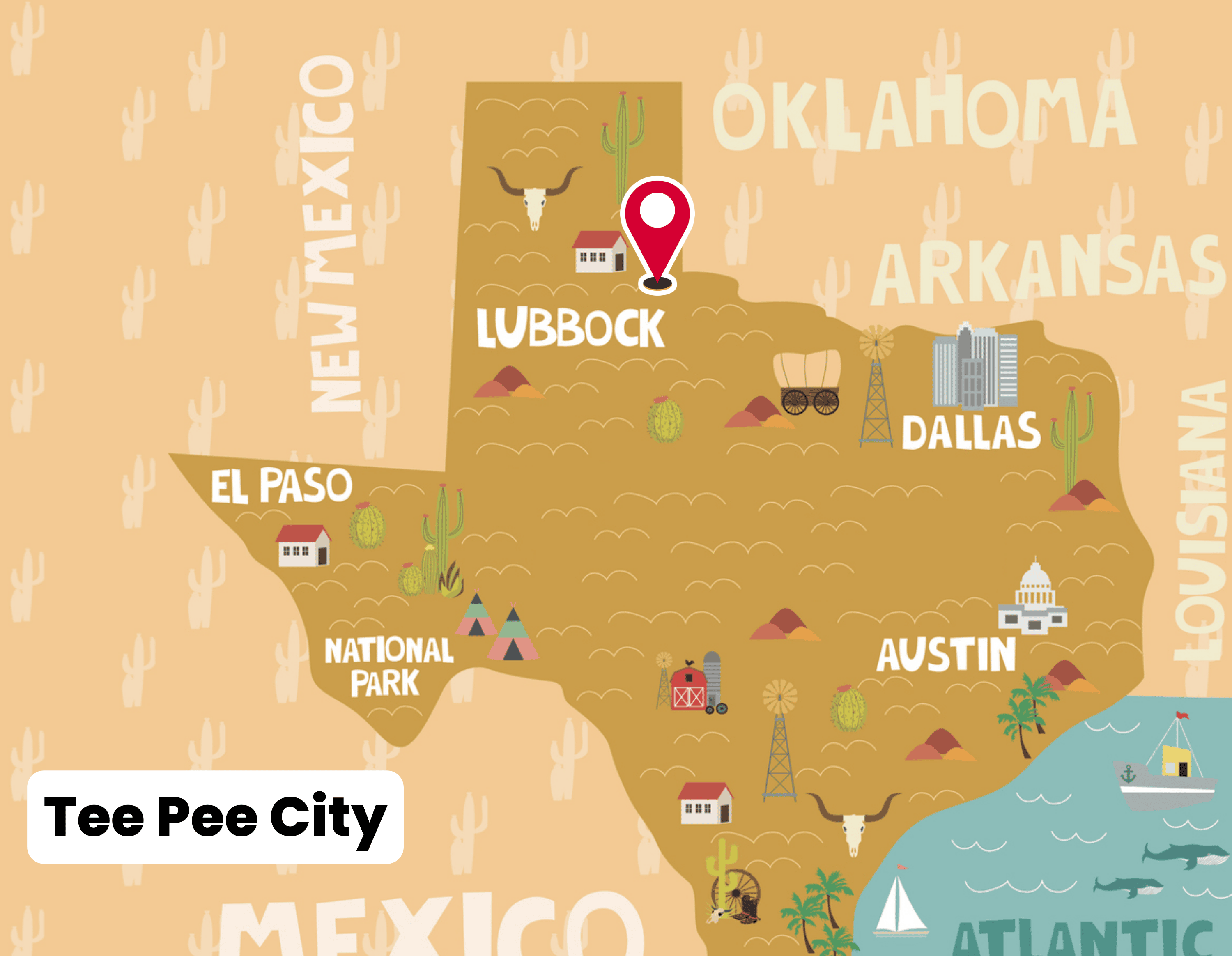
Tee Pee City
Map:
Sorry, no records were found. Please adjust your search criteria and try again.
Sorry, unable to load the Maps API.
Motley County
Texas
United States
- Yes (on-leash along the public roadside)
- View the historical marker, photograph the small cemetery, explore the Pease River basin
- Marker, limited roadside pull-off; no facilities