
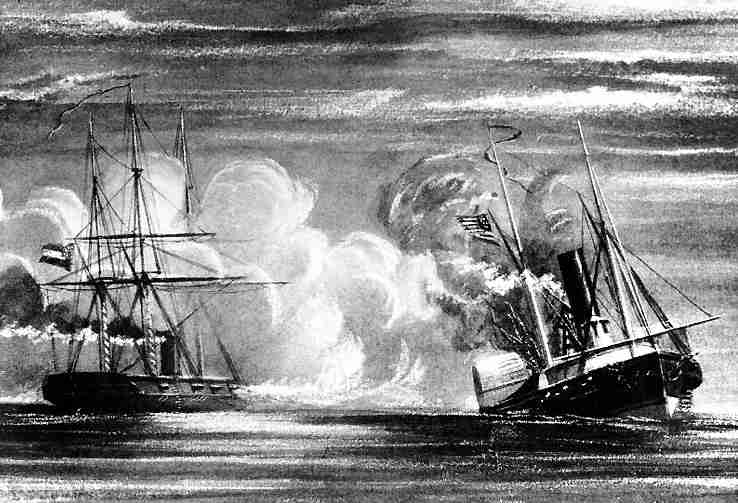
The Action off Galveston Light was a naval engagement of the American Civil War, fought on October 4, 1863, in the Gulf of Mexico near Galveston, Texas. It was part of the Union Navy’s wider blockade strategy along the Texas coast, aimed at disrupting Confederate trade and supply lines. The action involved Union blockading vessels and Confederate “cottonclad” steamers supported by shore defenses.
Background
Galveston was the most important port city in Texas during the Civil War. The Union briefly captured the city in October 1862, but Confederate forces under Major General John B. Magruder retook it on January 1, 1863, at the Battle of Galveston. Afterward, Galveston remained under Confederate control, guarded by shore batteries and locally converted armed steamers known as “cottonclads” because their sides were protected with compressed cotton bales.
The Union Navy sought to enforce a blockade of Galveston, with warships patrolling the approaches. Confederate forces, however, frequently attempted to run supplies in and out of the port.
The Engagement
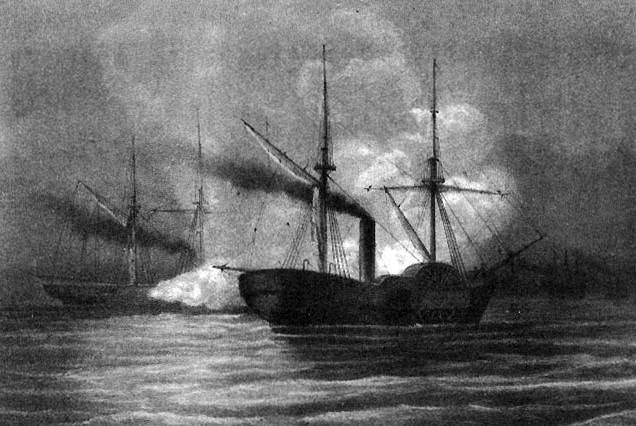
On October 4, 1863, Union blockading ships, including the gunboat USS Clifton commanded by Lt. Commander Richard L. Law, encountered two Confederate cottonclad steamers, the CSS Uncle Ben and the CSS Josiah Bell, commanded by civilian-turned-naval officer Leon Smith.
-
The Confederate ships, reinforced by shore batteries, engaged Clifton and attempted to drive her off.
-
The shallow coastal waters limited maneuverability for Union vessels.
-
After sustaining damage and under pressure from Confederate fire, Clifton was forced to retire.
The action lasted only a few hours but highlighted the difficulty of enforcing the blockade against determined Confederate defenses.
Commanders and Leaders
-
Union: Lt. Commander Richard L. Law (USS Clifton)
-
Confederate: Leon Smith (naval commander of cottonclad flotilla)
-
Overall Confederate authority in Texas: Major General John B. Magruder
Strength
-
Union forces: The USS Clifton and supporting blockading vessels.
-
Confederate forces: Cottonclad steamers Josiah Bell and Uncle Ben, supported by shore artillery around Galveston.
Casualties and Losses
Casualties were light on both sides.
-
Union Losses:
The Union side sustained moderate damage to the USS Clifton during the fighting. The gunboat came under heavy fire from both Confederate cottonclads and shore batteries, forcing her to retire from the engagement. Casualties were reported as light, with only a handful of sailors wounded. Despite limited personnel losses, the inability to maintain an effective position marked a tactical setback. -
Confederate Losses:
Confederate losses were minimal. Both the Josiah Bell and Uncle Ben sustained little damage, thanks to their protective cotton armor and maneuverability in shallow water. Casualties among their crews were few, and the shore batteries were largely unscathed. The Confederates succeeded in defending the port without significant material or personnel loss.
Overall, the action was inconclusive in terms of destruction but clearly a tactical Confederate success because the Union could not achieve its blockade objectives during the encounter.
Result and Aftermath
The Action off Galveston Light ended in a Confederate victory. The Union Navy, unable to overcome the combined resistance of cottonclads and shore defenses, was forced to withdraw its vessels from close blockade positions.
-
Immediate Result: The Confederates retained control of Galveston and demonstrated once again that improvised naval forces, when used effectively with shore batteries, could frustrate Union blockading efforts.
-
Impact on Galveston: Galveston remained a critical Confederate port, allowing blockade runners to slip through with supplies from Mexico and overseas. Goods such as weapons, medicines, and luxury items continued to reach Texas, while cotton exports provided badly needed income for the Confederacy.
-
Union Strategy: Although the Union blockade around Galveston continued after the battle, it was never fully airtight. The Union would maintain an offshore presence but lacked the ability to retake and hold the city without a larger combined land-sea operation.
-
Long-Term Outcome:
Galveston remained under Confederate control for the rest of the war, never falling again to Union forces. It was not until the Confederate surrender in 1865 that Union troops formally reoccupied the city. The action highlighted the limits of Union naval power in shallow coastal waters and underscored the ingenuity of Confederate defenders in prolonging their hold on Texas.
Significance
The Action off Galveston Light demonstrated the resilience of Confederate coastal defenses and the challenges faced by the Union blockade along the Texas coastline. Though not a major battle, it was part of the ongoing contest for control of key Gulf ports that shaped the economic and logistical course of the war in the western theater.
Photos: