

Castle Peak is a notable summit located about eight miles south of Merkel in southwestern Taylor County, Texas. Rising to an elevation of approximately 2,341 feet (714 meters), it stands as one of the highest and most prominent natural features in the county. The hill’s distinctive shape resembles the towers of a fortress, which inspired early travelers to give it the name “Castle Peak.” Before it acquired this name, it was known as Abercrombie Peak, in honor of Lieutenant Colonel J. J. Abercrombie, who commanded the first troops stationed at nearby Fort Phantom Hill.
Historical Significance
In the mid-19th century, Castle Peak served as an important landmark for travelers and stagecoach drivers along the Butterfield Overland Mail route, which operated from 1858 to 1861. The peak’s visibility across the flat West Texas plains made it a reliable point of reference. Reports from travelers noted that Castle Peak could be seen from as far as thirty to forty miles away, helping to guide those moving across the rugged frontier. Waterman L. Ormsby, a reporter for the New York Herald and the first through passenger on the Butterfield route, remarked that the formation resembled a fortress rising above the plains.
To commemorate its role in Texas transportation history, the Texas Historical Commission erected a marker in 1968. Located along Farm Road 1235, the marker recognizes Castle Peak as a beacon for stagecoaches and a natural guidepost in the early days of westward travel through the region.
Geological and Paleontological Context
Castle Peak is part of a landscape shaped by millions of years of erosion and deposition. The area is known for its exposure of Early Permian formations, particularly those belonging to the Choza Formation of the Clear Fork Group. These rocks record a time when much of present-day West Texas was covered by shallow inland seas and mudflats. The site has yielded significant trace fossils, including the footprints of ancient four-legged vertebrates that lived more than 280 million years ago. These fossilized tracks offer insight into the prehistoric ecosystems that once existed in what is now Taylor County.
Legacy
Today, Castle Peak remains a quiet but striking feature of the West Texas horizon. While it may no longer serve as a navigational landmark for travelers, it continues to attract geologists, historians, and those interested in Texas’s natural and cultural heritage. The site stands as both a geological record of deep time and a historical marker of human passage across the Texas frontier.
Photos:
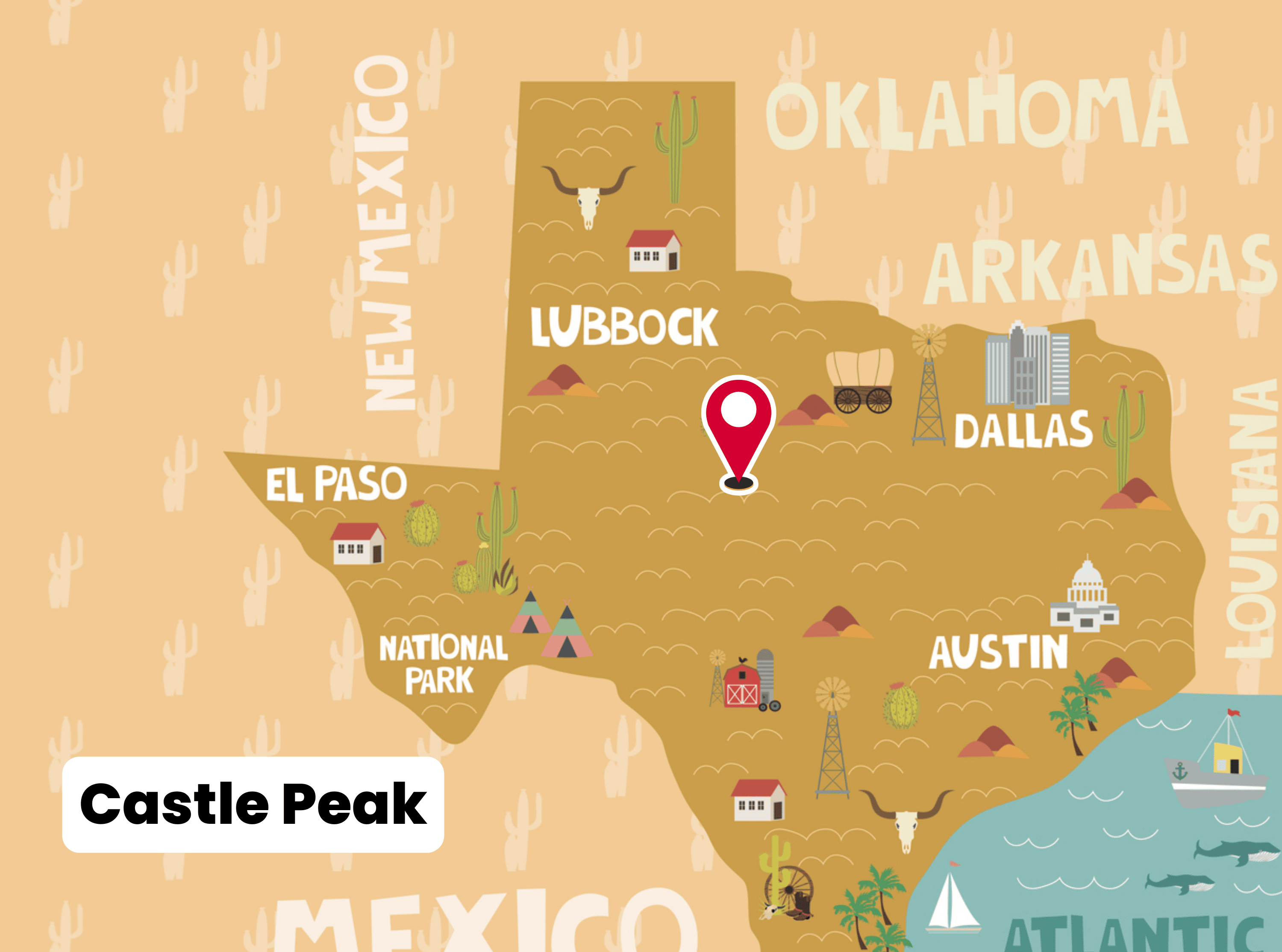
Castle Peak
Map:
Sorry, no records were found. Please adjust your search criteria and try again.
Sorry, unable to load the Maps API.
Mount Pleasant
Texas
79536
United States
Yes
- Hiking
- Rock Climbing
- Wildlife Watching
- Picnic Areas
- Restrooms
- Trails