

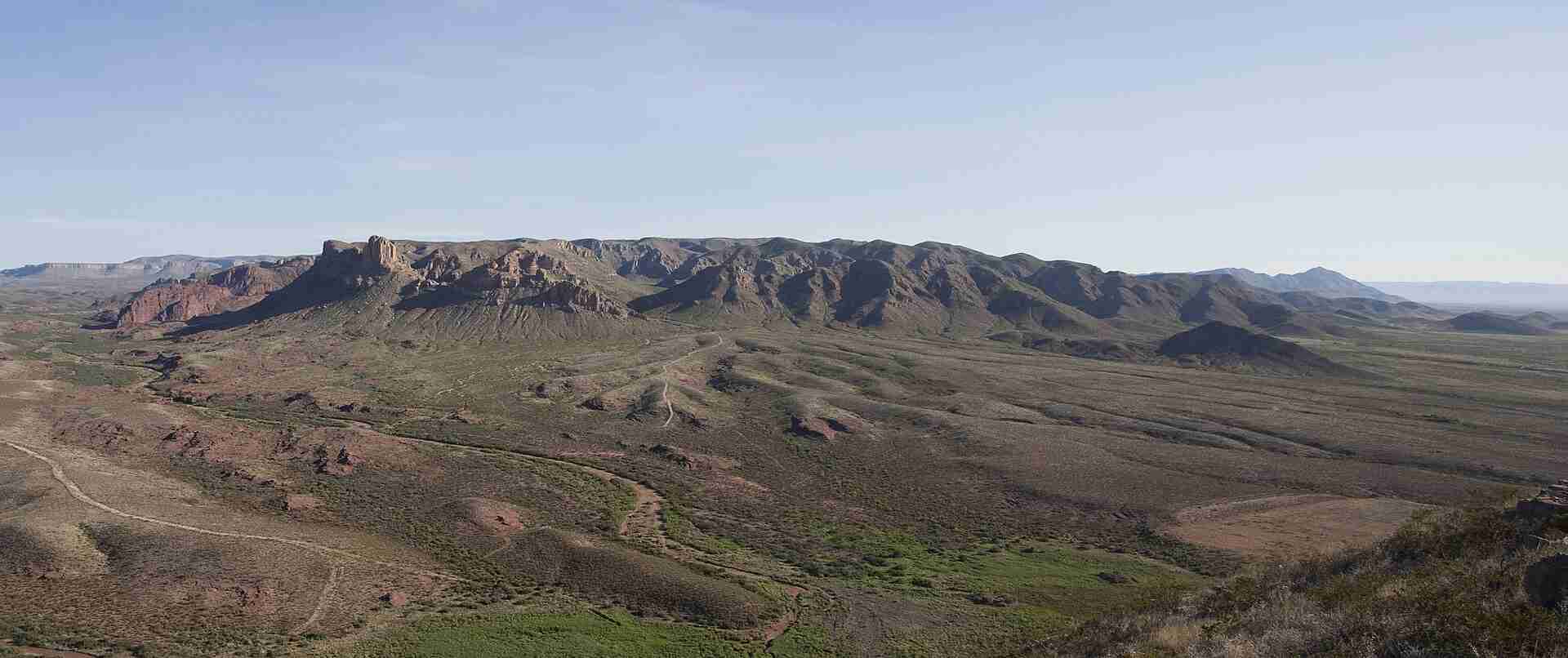
The Beach Mountains are located in southwestern Culberson County, Texas, about three miles north of the town of Van Horn. The range lies within the Trans-Pecos region, a rugged and arid part of far West Texas. The mountains rise sharply from the surrounding desert floor, reaching a maximum elevation of 5,827 feet (1,776 meters) above sea level. Roughly circular in shape, the range measures about eight kilometers across and stands about 550 meters above the desert plain. The steep slopes and narrow canyons make the area visually distinct, with neighboring ranges such as the Baylor Mountains to the north and the Sierra Diablo to the northwest framing the view.
Geology and Formation
Geologists describe the Beach Mountains as an erosional remnant of ancient marine sediments. The range is composed primarily of sedimentary rocks from the Ordovician and Cambrian periods, dating back approximately 500 million years. Along the western slopes, erosion has exposed even older Precambrian rocks, revealing the area’s deep geologic history. These formations provide valuable insight into the processes that shaped West Texas over hundreds of millions of years, from ancient seas to uplifted terrain carved by wind and water.
Flora and Fauna
The Beach Mountains sit within the Chihuahuan Desert, and their vegetation reflects the hardy life of this environment. Lower slopes and desert flats host plants such as yucca, creosote bush, mesquite, and several cactus species. Higher elevations and rocky ridges support live oak, pinyon pine, juniper, and patches of desert grasses adapted to thin soils. The region also supports important wildlife. In 1991, 26 desert bighorn sheep were released into the Beach Mountains as part of a reintroduction program by Texas wildlife officials. These efforts helped reestablish bighorn populations across multiple mountain ranges in West Texas, restoring part of the state’s natural heritage.
History and Naming
The Beach Mountains are named for J. H. Beach, an early settler who came to the Van Horn area in the 1880s. The land encompassing the range is privately owned and remains largely undeveloped. While not designated for public recreation, the mountains hold scientific and ecological importance due to their geology, wildlife habitat, and distinctive landscape.
Significance
As part of the Trans-Pecos region, the Beach Mountains represent both natural history and modern conservation in action. Their rock layers record hundreds of millions of years of geologic change, while their steep slopes provide a refuge for desert species. Rising above the desert basin, the Beach Mountains remain a quiet but remarkable landmark in the remote terrain of far West Texas.
Photos:
Map:
Sorry, no records were found. Please adjust your search criteria and try again.
Sorry, unable to load the Maps API.
Van Horn
Texas
79855
United States
Yes
- Hiking
- Camping
- Wildlife Observation
- Paved Trails
- Restrooms
- Picnic Areas
Leaflet, Beach Mountains Culberson County Texas, CC BY-SA 4.0