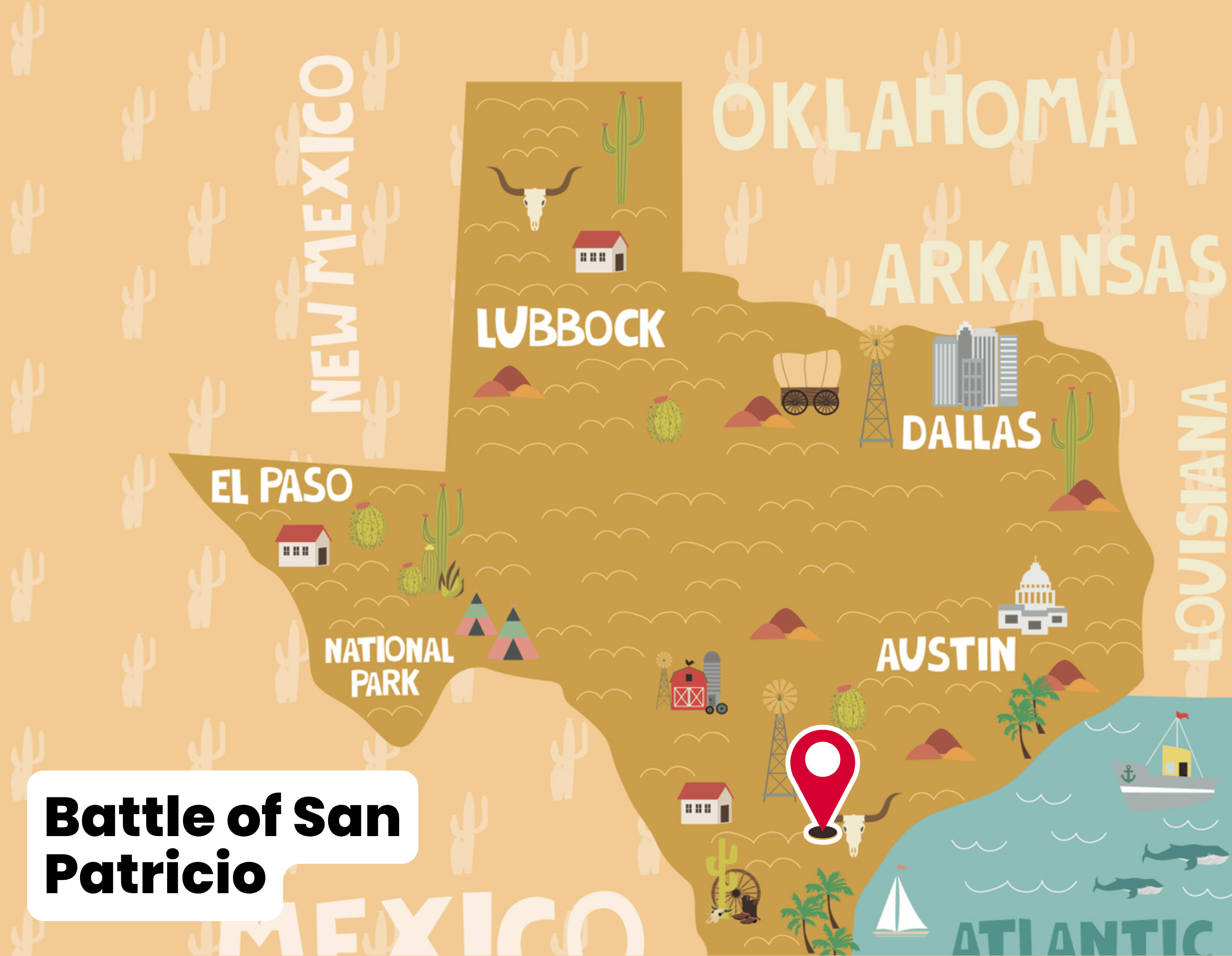
The Battle of San Patricio was a significant skirmish during the Texas Revolution, fought on February 27, 1836, in the town of San Patricio, Texas. The engagement resulted in a decisive Mexican victory and highlighted the strength of General José de Urrea’s army during Mexico’s counteroffensive against Texian rebels.
Background

In late 1835, Texian insurgents had driven Mexican troops out of much of Texas after victories at Gonzales, Goliad, and San Antonio de Béxar. Flush with success, some Texian leaders, including Frank W. Johnson and Dr. James Grant, organized an expedition to invade Mexico by way of Matamoros. This campaign, known as the Matamoros Expedition, lacked clear authorization from the Texian provisional government and was plagued by poor planning and limited supplies.
Johnson and his small force of around 40 men established themselves in San Patricio, a settlement originally founded by Irish immigrants. The Texians hoped to regroup there before pushing south toward Matamoros. Meanwhile, Mexican General José de Urrea, advancing north along the Texas coast with several hundred troops, learned of Johnson’s presence and moved to strike.
The Battle
On the night of February 26–27, 1836, Urrea’s force of about 200 Mexican soldiers approached San Patricio under cover of darkness. The Texians had failed to maintain effective guards or pickets, leaving them vulnerable to a surprise attack.
Just before dawn, Urrea’s men entered the town quietly and surrounded the buildings where the Texians were quartered. The Mexican soldiers launched a sudden assault, catching the Texians completely off guard.
The fighting was brief but one-sided. Many Texians were killed in their sleep or shot down while attempting to escape. Johnson himself managed to flee with four men, but the majority of his command was either killed or captured. The small Texian force was effectively destroyed.
Outcome
The battle was a clear Mexican victory.
-
Texian casualties: Nearly all of Johnson’s men were killed or taken prisoner.
-
Mexican casualties: Light, with only a few men lost.
General Urrea, known for his comparatively humane treatment of prisoners, spared the lives of those who surrendered at San Patricio. This contrasted sharply with later events such as the Goliad Massacre, where Texian prisoners were executed under orders from General Santa Anna.
Significance
The Battle of San Patricio was one of the first engagements in Urrea’s campaign to suppress the Texian rebellion along the Gulf Coast. It demonstrated Mexico’s renewed strength after early Texian successes and exposed the weaknesses of poorly organized Texian expeditions.
The defeat crippled the Matamoros Expedition and discouraged further Texian attempts to invade Mexican territory. It also foreshadowed a series of Mexican victories in the spring of 1836, including those at Refugio and Coleto, before the tide turned in favor of the Texians at the decisive Battle of San Jacinto in April.
Though smaller in scale than the Alamo or San Jacinto, the battle was important in showing that the revolution was far from over and that Texian independence was not assured until much later.
Commanders and Forces
-
Texian Forces:
-
Commander: Frank W. Johnson
-
Strength: Approximately 40 men
-
Casualties: Most killed or captured; Johnson escaped
-
-
Mexican Forces:
-
Commander: General José de Urrea
-
Strength: Approximately 200 men
-
Casualties: Minimal
-
Legacy
The town of San Patricio, settled primarily by Irish immigrants, became the namesake of the engagement. For many years, the battle was remembered locally as a symbol of the heavy price paid by Texians during the early stages of the revolution. Today, the Battle of San Patricio is studied as part of the broader story of the Texas Revolution, illustrating both the ambitions and the vulnerabilities of the Texian cause in 1836.
Photos: