
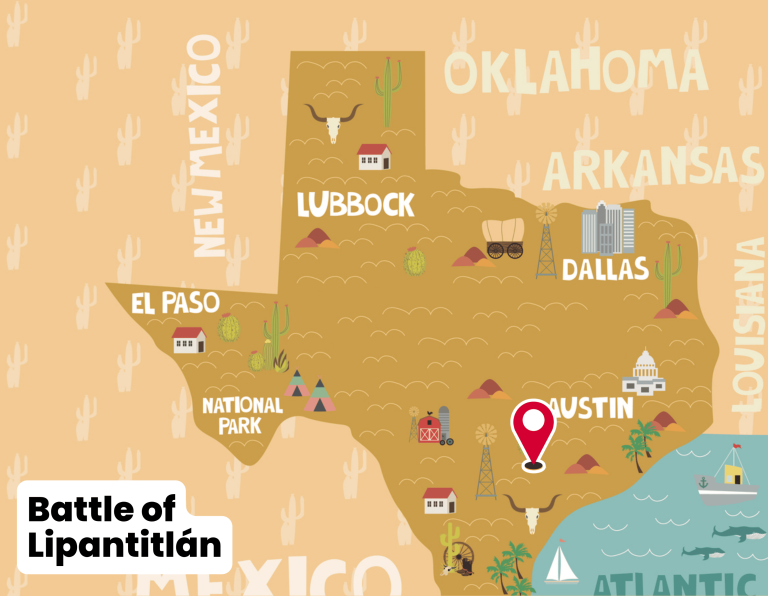
The Battle of Lipantitlán took place on November 4, 1835, during the early phase of the Texas Revolution. It was fought near the Nueces River, close to present-day San Patricio, Texas. The engagement was a small but important Texian victory that disrupted Mexican control along the Gulf Coast and cut off communications between Mexican forces in Texas and the interior of Mexico.
Background
In the fall of 1835, Texian forces were gaining momentum after their initial clashes with Mexican troops at Gonzales (October 2) and Goliad (October 9). Mexican forces, however, still maintained small garrisons in various posts across Texas. One of these was at Lipantitlán, a fortification near San Patricio. The post provided the Mexican army with a way to monitor the coastal plains and maintain communication routes with Matamoros, an important base just across the Rio Grande.
Texians recognized that the fort was a potential threat to their operations and decided to eliminate it before focusing on larger campaigns such as the Siege of Béxar.
Forces and Commanders
-
Texian forces: About 70 men, commanded by Captain Ira Westover. These men had recently participated in earlier operations in the Goliad area.
-
Mexican forces: Roughly 30 to 40 soldiers, commanded by Lieutenant Nicolás Rodríguez. They were stationed at the fort at Lipantitlán.
The Battle
On November 3, 1835, Captain Westover led his Texian detachment toward San Patricio. The following day, the Texians engaged the Mexican garrison at Lipantitlán. After a brief but determined fight, the Texians overran the position.
The Mexican defenders, unable to hold their ground, retreated across the Rio Grande. During the action, the Texians captured a small amount of military equipment, including at least one cannon, along with supplies stored at the fort.
Casualties
Reports of casualties vary. Texian losses were minimal, with some accounts noting only one man wounded. Mexican losses were several killed and wounded, though exact numbers are not well documented. The survivors abandoned the post and withdrew southward.
Outcome
The Texians secured a clear victory. By driving Mexican forces out of Lipantitlán, they effectively eliminated the last major Mexican foothold along the Texas Gulf Coast. This gave the Texians control over the coastal route and cut Mexican communications between Goliad and Matamoros. The capture of supplies and artillery further strengthened the Texian position.
Significance
Although relatively small in scale, the battle had notable consequences:
-
It secured the Texian flank in the coastal region, ensuring that future operations would not be threatened from San Patricio.
-
It boosted Texian morale, reinforcing the sense that Mexican forces could be expelled from Texas posts one by one.
-
It contributed to the momentum leading into the Siege of Béxar, where Texians would soon push to expel Mexican General Martín Perfecto de Cos from San Antonio.
The engagement demonstrated the Texians’ growing organizational ability and their determination to remove Mexican authority from Texas territory.
Photos:
Battle of Lipantitlán
Map:
Sorry, no records were found. Please adjust your search criteria and try again.
Sorry, unable to load the Maps API.
San Patricio
Texas
United States
- As with most TPWD properties, pets are allowed on-leash. Visitors are expected to clean up after them. Always follow posted rules onsite.
-
Historical marker viewing: Read interpretive plaques marking the former fort and battle site.
-
Self-guided exploration: Walk the grounds, view river and surrounding landscapes.
-
Historical orientation: Reflect on 1835 Texian victory during the early Texas Revolution.
-
Archaeological interest: TPWD’s studies hint at buried historic materials—great for history enthusiasts.
-
Park type: Rustic, no visitor center, restrooms, or trails—an undeveloped roadside historic site.
-
Parking: Small pull-off or roadside parking available on the access road.
-
Access hours: Open daily from 9 a.m. to 5 p.m.
-
No facilities: No restrooms, water fountains, or picnic tables—prepare accordingly.