
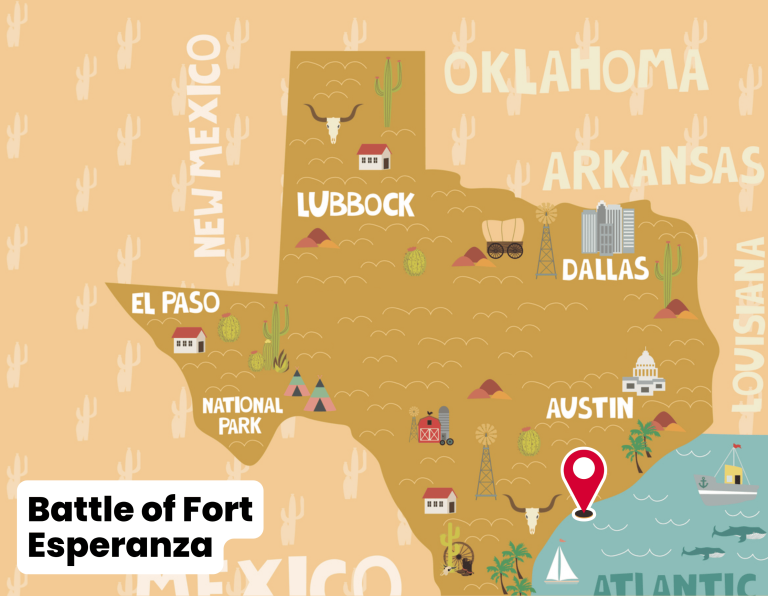
The Battle of Fort Esperanza was a Civil War engagement fought from November 27 to November 30, 1863, on Matagorda Island, Texas. It took place between Union forces, who sought to secure control of the Texas coastline, and a small Confederate garrison defending the fort. The action ended in a Union victory, giving Federal troops greater access to Texas’s Gulf Coast.
Background
During the American Civil War, control of Texas was important for both strategic and political reasons. Texas provided supplies such as cotton to the Confederacy, and its coastline offered access for trade through Mexico, despite the Union blockade.
By late 1863, Union commanders sought to expand operations in Texas after successes at Brownsville and along the Gulf. Fort Esperanza, also known as Fort DeBray, was built by the Confederacy in 1861 to guard the Cavallo Pass between Matagorda Island and the mainland. This narrow waterway connected the Gulf of Mexico to Matagorda Bay, making it a vital defensive position.
The fort consisted of large earthworks armed with heavy artillery. Holding it allowed the Confederates to protect inland routes and deny the Union Navy easy entry into Texas ports.
The Battle
-
Union Advance: On November 27, 1863, Union forces under Maj. Gen. Cadwallader C. Washburn and Brig. Gen. Thomas E. G. Ransom landed on Matagorda Island. They brought several brigades supported by naval gunboats.
-
Confederate Defenders: The fort was defended by about 800 Confederate soldiers under the command of Col. William R. Bradfute of the 8th Texas Infantry. Although well-positioned, the garrison was relatively small compared to the advancing Union force.
-
Artillery Bombardment: Over the next several days, Union troops slowly advanced up the island while gunboats and land-based artillery bombarded the fort. Confederate guns returned fire but were gradually overwhelmed.
-
Confederate Withdrawal: By November 30, 1863, Bradfute recognized that his position was untenable. Rather than risk capture or destruction of his command, he ordered his men to abandon the fort. The Confederates spiked their guns (rendering them temporarily useless) and withdrew across the pass to the mainland.
-
Union Occupation: Union forces marched into Fort Esperanza the next morning, finding it deserted but intact aside from the disabled cannons. The Union flag was raised over the works, marking the capture.
Casualties
The engagement was relatively bloodless compared to major Civil War battles:
-
Union: About 1 killed and 10 wounded.
-
Confederacy: At least 1 killed, with around 10 soldiers captured.
Most of the Confederate garrison successfully withdrew before the Union could trap them.
Significance
The Union victory at Fort Esperanza had both strategic and symbolic importance:
-
It gave the Union control over a key point on the Texas coast.
-
It disrupted Confederate supply routes and weakened their ability to use Matagorda Bay for trade or defense.
-
The capture formed part of a larger Union effort to assert pressure in Texas, following their occupation of Brownsville in November 1863.
However, the Union was unable to maintain long-term dominance in Texas. Logistical difficulties and limited manpower meant that despite this victory, large areas of the state remained under Confederate control until the end of the war.
Key Facts
-
Date: November 27–30, 1863
-
Location: Fort Esperanza (Fort DeBray), Matagorda Island, Texas
-
Belligerents: United States (Union) vs. Confederate States (Confederacy)
-
Commanders: Maj. Gen. Cadwallader C. Washburn (Union); Col. William R. Bradfute (Confederacy)
-
Strength: Union forces in multiple brigades (several thousand); Confederate garrison around 800
-
Result: Union victory; Confederates evacuated the fort
-
Casualties: Light on both sides—Union about 11, Confederates about 11
Legacy
Today, Fort Esperanza is no longer standing, as storms and erosion destroyed most of the remains. However, its site is remembered as part of the network of coastal fortifications built by the Confederacy.
The battle illustrates the Union’s attempts to secure Texas during the Civil War and highlights the challenges of coastal warfare in difficult terrain. While not a major battle, it contributed to the broader Union campaign to limit Confederate access to the Gulf of Mexico.
Photos:
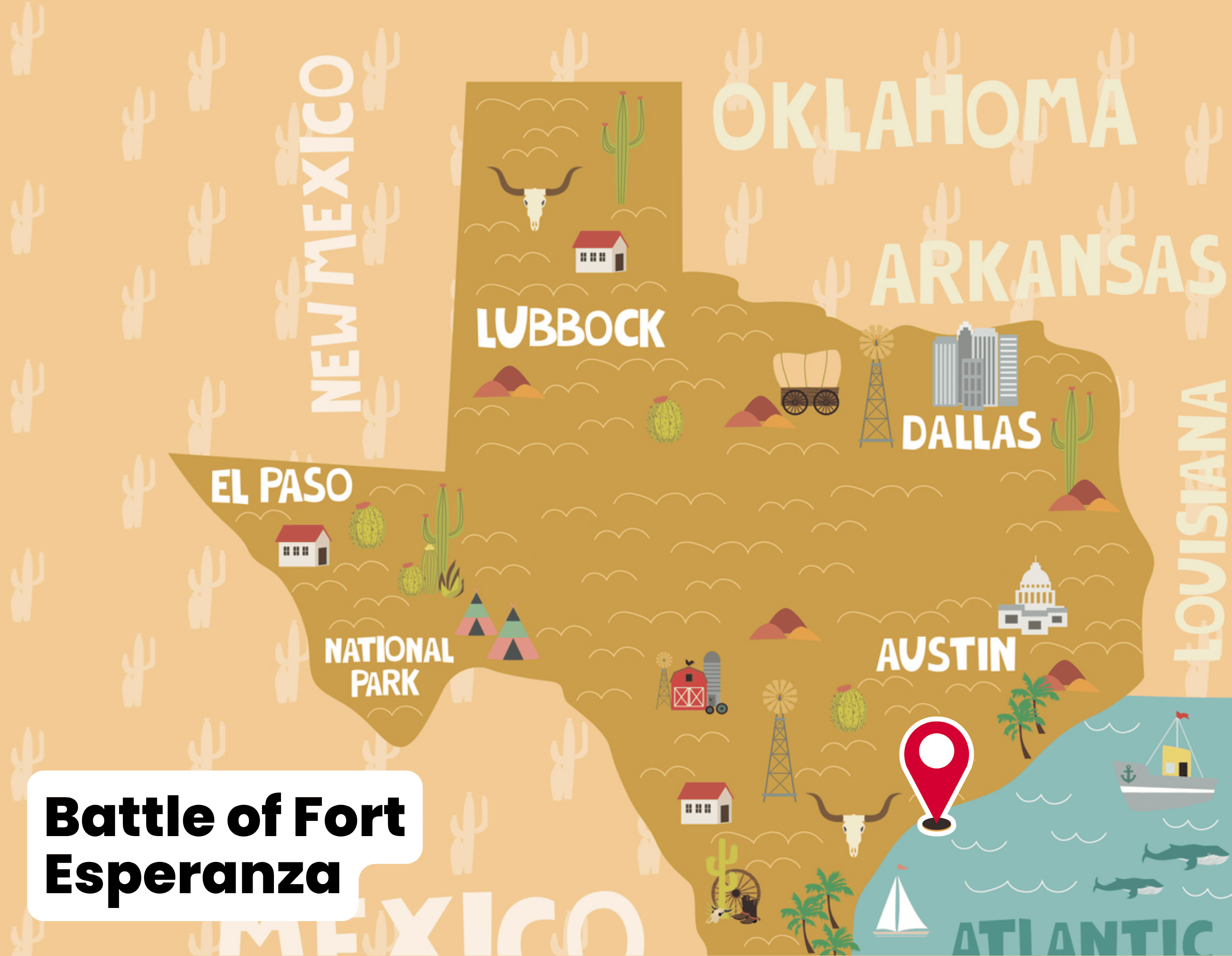
Battle of Fort Esperanza
Map:
Sorry, no records were found. Please adjust your search criteria and try again.
Sorry, unable to load the Maps API.
Calhoun County
Texas
United States
- Likely permitted under standard rules—pets should be leashed and under control to protect wildlife and ecosystems. No official statement found, but follows general public-use policy.
-
Self-guided exploration: Visitors can walk the area, locate faint traces of earthworks or rifle pits, and enjoy coastal landscapes.
-
Military history interest: An interpretive visit to imagine Civil War coastal defenses, though no signage or marked features exist.
-
Nature & photography: Offers photography opportunities featuring marshland, coastal vegetation, wildlife, and expansive views.
-
None at the site. No restrooms, visitor facilities, marked trails, or picnic areas.
-
Primitive camping may be allowed elsewhere under TPWD-managed programs—but not necessarily near the fort.
- Reachable only by boat (private or charter). No vehicle or aircraft access.
- Plan visits carefully—bring all necessary supplies, including water, safety gear, and navigation tools, due to the remote, undeveloped nature of the island.