
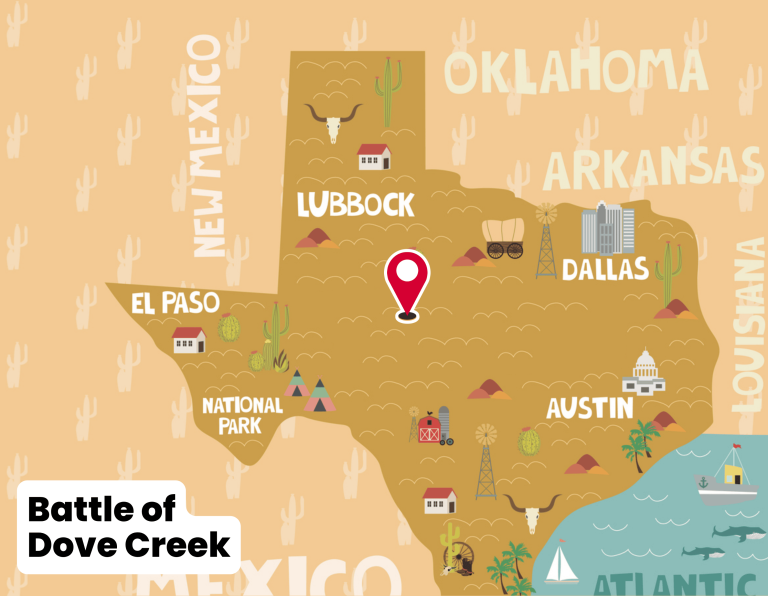
The Battle of Dove Creek, fought on January 8, 1865, was one of the largest and most significant clashes of the Texas–Indian Wars. It took place near present-day Mertzon, Texas, during the American Civil War. Unlike many frontier skirmishes that erupted over raids, this battle stemmed from a misinterpretation of a Native migration.
A large band of Kickapoo, accompanied by Shawnee and Potawatomi families, was traveling from Indian Territory toward Mexico in search of new settlements. Confederate frontier troops and militia misread their movement as a hostile threat and decided to intercept them. The result was a bloody engagement that ended in a decisive Native victory.
Background
During the 1860s, Texas frontier defense was strained. With many regular Confederate troops deployed east to fight in the Civil War, frontier security was left largely to local militia and state troops. Reports of Native raids fueled anxiety among settlers and military leaders. When scouts reported a large Native camp on Dove Creek, Texas commanders assumed it was a raiding party preparing to attack frontier settlements.
In reality, the Kickapoo and their allies were not raiding but migrating. They had long faced displacement and pressure in the United States and sought to establish themselves in Mexico, where the government had offered them land. Their movement, however, was misunderstood, leading directly to conflict.
Forces Involved
-
Texans/Confederates:
-
Around 500–600 men
-
Frontier militia and Texas State Troops
-
Commanded by Colonel James Bourland and Colonel William C. Young
-
-
Native American force:
-
Roughly 1,000 people, including men, women, and children
-
Primarily Kickapoo, with some Shawnee and Potawatomi
-
Warriors fought defensively to protect their migrating community
-
The Battle
The clash began on the morning of January 8, 1865, when Texan militia attacked the Native encampment. Expecting to scatter a raiding party, they instead met heavy resistance. Kickapoo warriors used the terrain and natural cover effectively, forcing the Texans into prolonged and costly fighting.
As the battle wore on, the Texan forces suffered mounting casualties. Colonel William C. Young was killed during the engagement, and the loss of leadership further weakened the militia’s resolve. Eventually, the Texans were forced to retreat, leaving the Kickapoo victorious. The Native group then continued their journey into Mexico largely unimpeded.
Casualties
-
Texans/Confederates:
-
20–34 killed
-
30–40 wounded
-
Colonel William C. Young killed in action
-
-
Native American force:
-
Estimated 15–20 killed
-
Exact numbers uncertain due to limited records
-
Outcome and Significance
The Battle of Dove Creek ended in a decisive Native victory, one of the few clear examples of Native forces overcoming Texan militia in open battle. The Kickapoo successfully defended their people and completed their migration into Mexico, where they later established communities.
For Texas, the battle revealed serious flaws in frontier defense. Poor intelligence, hasty decision-making, and underestimating Native strength all contributed to the defeat. The loss also highlighted the difficulties of protecting settlements while much of Texas’s military manpower was engaged in the Civil War.
In the broader context of the Texas–Indian Wars, Dove Creek serves as a reminder of how misunderstanding and mistrust fueled violence on the frontier. It also stands as one of the rare victories for Native groups in their long struggle to preserve autonomy and secure safe homelands.
Photos:
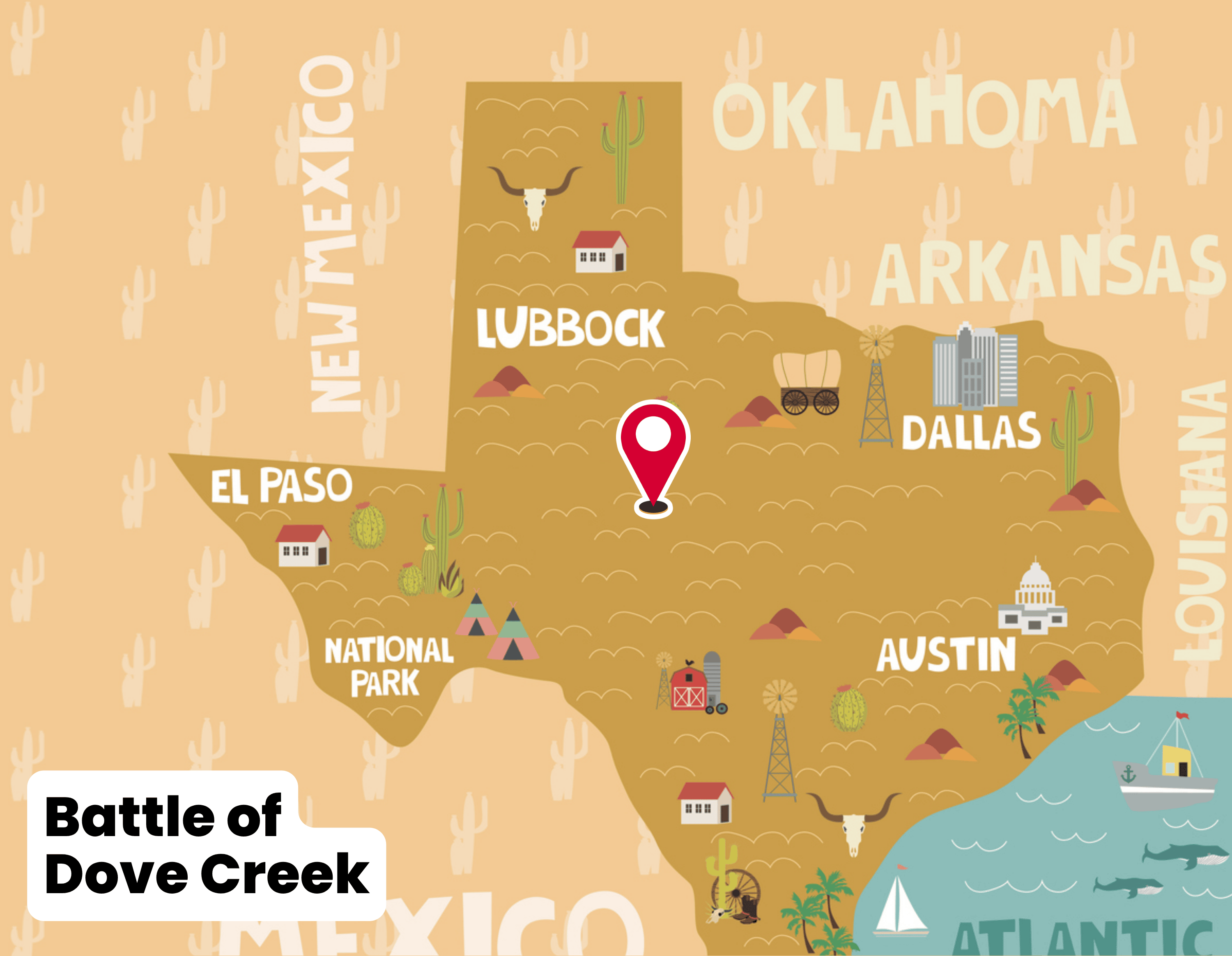
Battle of Dove Creek
Map:
Sorry, no records were found. Please adjust your search criteria and try again.
Sorry, unable to load the Maps API.
Irion County
Texas
United States
-
The marker area is on public ground (courthouse lawn) and, assuming standard local practices, pets are likely allowed there under local leash laws. I couldn’t find explicit rules, but it's reasonable to assume the courthouse grounds follow general public policy allowing leashed pets.
-
The battlefield itself is private property. You would need landowner permission to visit, and pet policies would depend on the landowner, which isn’t documented publicly.
-
Marker location: Read the plaques, learn the history, and photograph.
-
Battlefield: Requires private access—best for researchers or guests with permission.
-
Regional exploration: Includes nearby Irion County Museum and courthouse grounds
-
Marker Site: Accessible via sidewalk near the courthouse; there’s limited street parking and no restrooms or visitor facilities directly at the marker.
-
Battlefield Site: Entirely undeveloped private land. Visitors should prepare appropriately—bring water, maps, and make solid plans if granted permission by the landowner.