
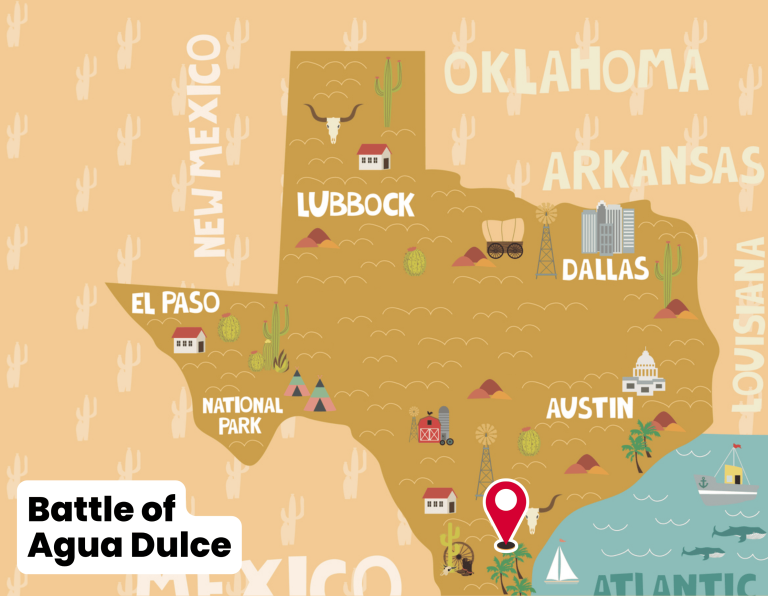
The Battle of Agua Dulce Creek was a minor yet significant skirmish of the Texas Revolution. It took place on March 2, 1836, at a site along Agua Dulce Creek, about 25–26 miles south of San Patricio, Texas. Although small in scale, the encounter highlighted the effectiveness of Mexican military strategy under General José de Urrea and the vulnerabilities of scattered Texian forces during this stage of the revolution.
Background
The skirmish was part of the Goliad Campaign, a series of operations conducted by General Urrea along the Gulf Coast of Texas. The campaign aimed to suppress Texian resistance in the region after the initial outbreak of hostilities at Gonzales and Bexar.
At the time, groups of Texian volunteers operated independently, often without coordination with the larger revolutionary effort. One such group was led by Dr. James Grant, a Scottish-born physician and adventurer who supported the Texian cause. Grant’s force, numbering about 53 men, was engaged in gathering horses and attempting to link up with Mexican federalist allies in Matamoros. This movement, sometimes called the “Matamoros Expedition,” was controversial and ultimately left Grant’s men exposed to attack.
The Battle
On March 2, 1836, the same day the Texas Declaration of Independence was signed at Washington-on-the-Brazos, General Urrea dispatched roughly 150 Mexican troops to intercept Grant’s detachment. The Mexicans caught the Texians by surprise at Agua Dulce Creek, setting off a brief but decisive skirmish.
Despite attempts to fight back, Grant’s men were badly outnumbered and quickly overwhelmed. Dr. James Grant himself was killed in the fighting, along with 12–15 other Texians. About six were captured, and the rest managed to escape into the surrounding countryside.
Casualties and Aftermath
-
Texian casualties: 12–15 killed, including James Grant; 6 captured; about 10 escaped.
-
Mexican casualties: minimal, with reports of only one soldier killed and an unknown number wounded.
The Texians who were captured were not executed. General Urrea, who had a reputation for humane treatment of prisoners, sent them to prison in Matamoros instead.
Of those who escaped the battle, five were later recaptured or killed in the Goliad Massacre on March 27, when Santa Anna ordered the execution of more than 300 Texian prisoners after the fall of Goliad.
Significance
Although overshadowed by larger battles such as the Alamo and San Jacinto, the Battle of Agua Dulce Creek illustrates several important themes of the Texas Revolution:
-
The fragmentation of Texian forces: Grant’s men were operating independently, with little coordination, which left them vulnerable to ambush.
-
The discipline and strategy of Urrea’s command: Mexican forces effectively used mobility and surprise to defeat a larger campaign of Texian volunteers.
-
The timing: The battle coincided with the signing of the Texas Declaration of Independence, symbolizing the simultaneous political and military dimensions of the revolution.
For General Urrea, the victory reinforced his reputation as an effective field commander. For the Texians, the loss underscored the risks of poorly organized expeditions and contributed to the eventual consolidation of Texian resistance under more unified leadership.
Summary
-
Date: March 2, 1836
-
Location: Agua Dulce Creek, 25–26 miles south of San Patricio, Texas
-
Belligerents: Texian volunteers vs. Mexican Army
-
Commanders: Texians – Dr. James Grant; Mexicans – General José de Urrea
-
Strength: Texians ~53; Mexicans ~150
-
Result: Mexican victory
-
Casualties: Texians – 12–15 killed, 6 captured, remainder escaped; Mexicans – minimal losses
Photos:
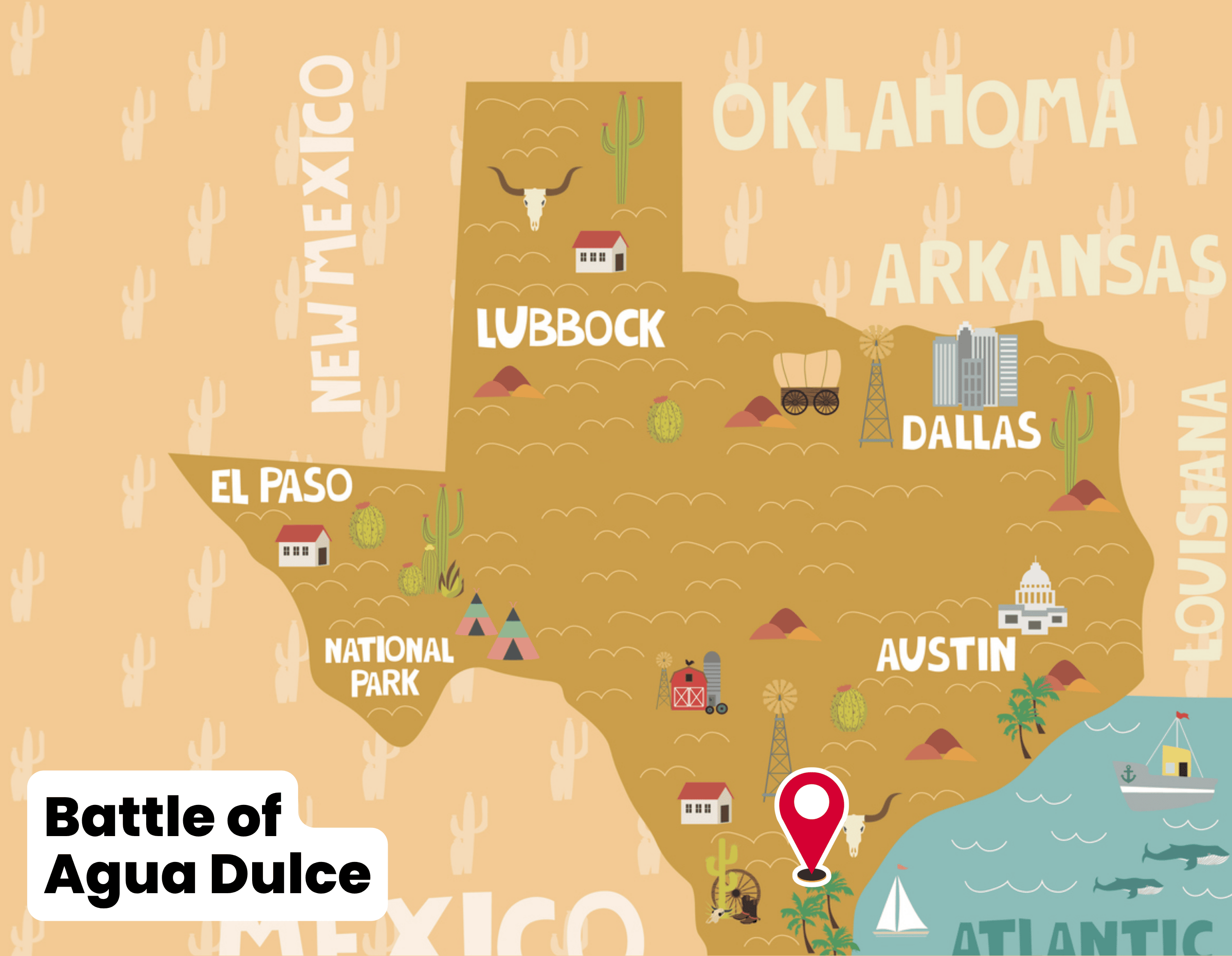
Battle of Agua Dulce
Map:
Sorry, no records were found. Please adjust your search criteria and try again.
Sorry, unable to load the Maps API.
Nueces County
Texas
78330
United States
- Not documented—likely allowed on-leash, but confirm with local authority
- Bird watching and nature observation (especially during migration season)
- Minimal—natural setting, no developed facilities reported