
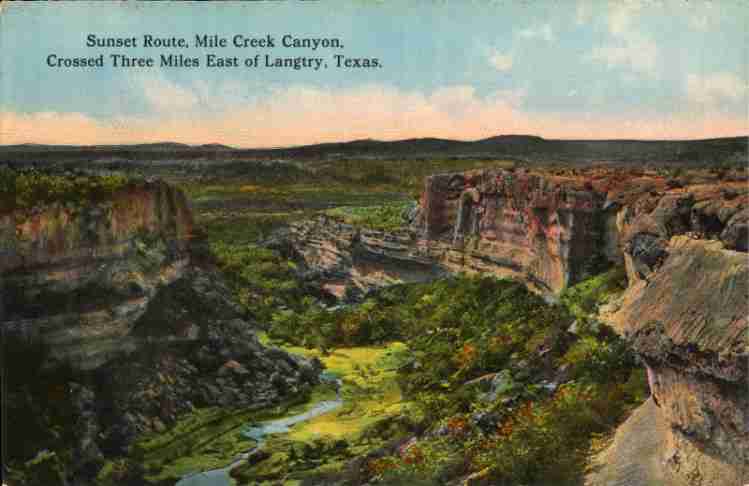
Mile Canyon, more widely known today as Eagle Nest Canyon, is an important archaeological and geological site near Langtry in Val Verde County, Texas. This canyon is a tributary of the Rio Grande and forms part of the Lower Pecos Canyonlands, an area celebrated for its dense concentration of prehistoric rock shelters and artifacts. The final section of Eagle Nest Creek, about one mile long, cuts through high limestone cliffs that define the canyon. Although the creek itself stretches for roughly five miles, it is the last steep section—known historically as Mile Canyon—that has drawn the most archaeological attention.
Archaeological Significance
Eagle Nest Canyon has been a focus of archaeological study for more than a century. Researchers have identified numerous sites within the canyon, including Bonfire Shelter, Eagle Cave, and Kelley Cave. These shelters provide a detailed record of human occupation dating back more than 13,000 years, during the Late Pleistocene and Early Holocene periods. Excavations have uncovered artifacts such as stone tools, hearths, and plant remains, offering insight into the daily lives and survival strategies of the early peoples of the Lower Pecos region.
One of the most significant locations is Bonfire Shelter, which contains evidence of large-scale bison processing events. Radiocarbon dating suggests these activities occurred as early as 11,700 years ago, making it one of the earliest known examples of communal bison hunting in North America. While some researchers interpret the site as a prehistoric bison jump, others view it as a processing site where animals were butchered after being killed nearby. Regardless of interpretation, the findings at Bonfire Shelter highlight the sophistication and cooperation of early hunter-gatherer groups in this region.
Natural and Cultural Features
The canyon’s landscape features high limestone cliffs, dry rock shelters, and areas of burned rock middens—stone piles that formed from centuries of cooking and heating activities. These natural features helped preserve organic materials, allowing archaeologists to reconstruct ancient diets and toolmaking techniques. The arid climate and protective overhangs of Eagle Nest Canyon have contributed to the exceptional preservation of cultural deposits, making it one of the best-documented archaeological areas in Texas.
The name “Eagle Nest Canyon” comes from sightings of golden eagles nesting on the cliffs, while “Mile Canyon” reflects the approximate length of its most dramatic section. Both names are still used interchangeably in historical and scientific references.
Recognition and Preservation
In 1970, Mile Canyon was officially listed on the National Register of Historic Places, recognized for its outstanding archaeological importance. The designation covers roughly 1,500 acres of privately owned land within the Lower Pecos Canyonlands Archaeological District. Although the area is not open to the general public, its protected status helps ensure the preservation of fragile cultural and environmental resources for continued study.
Ongoing research projects led by institutions such as the Texas Archeological Research Laboratory and the Ancient Southwest Texas Project continue to deepen understanding of the canyon’s role in prehistoric life. Findings from these excavations have helped define much of what is known about early human activity in the Lower Pecos region, bridging the gap between ancient foraging communities and the later complex societies that inhabited Texas and northern Mexico.
Photos:
Mile Canyon
Map:
Sorry, no records were found. Please adjust your search criteria and try again.
Sorry, unable to load the Maps API.
Texas
Texas
United States
-
Archaeological Research: The canyon has been the site of extensive archaeological studies, including projects by Texas State University .
-
Educational Expeditions: Due to its rich history, the area serves as an outdoor classroom for understanding prehistoric human activities.
- Facilities: As the canyon is on private land, there are no public amenities or facilities available.
https://en.wikipedia.org/wiki/Mile_Canyon#/media/File:Sunset_Route,_Mile_Creek_Canyon,_Texas.jpg