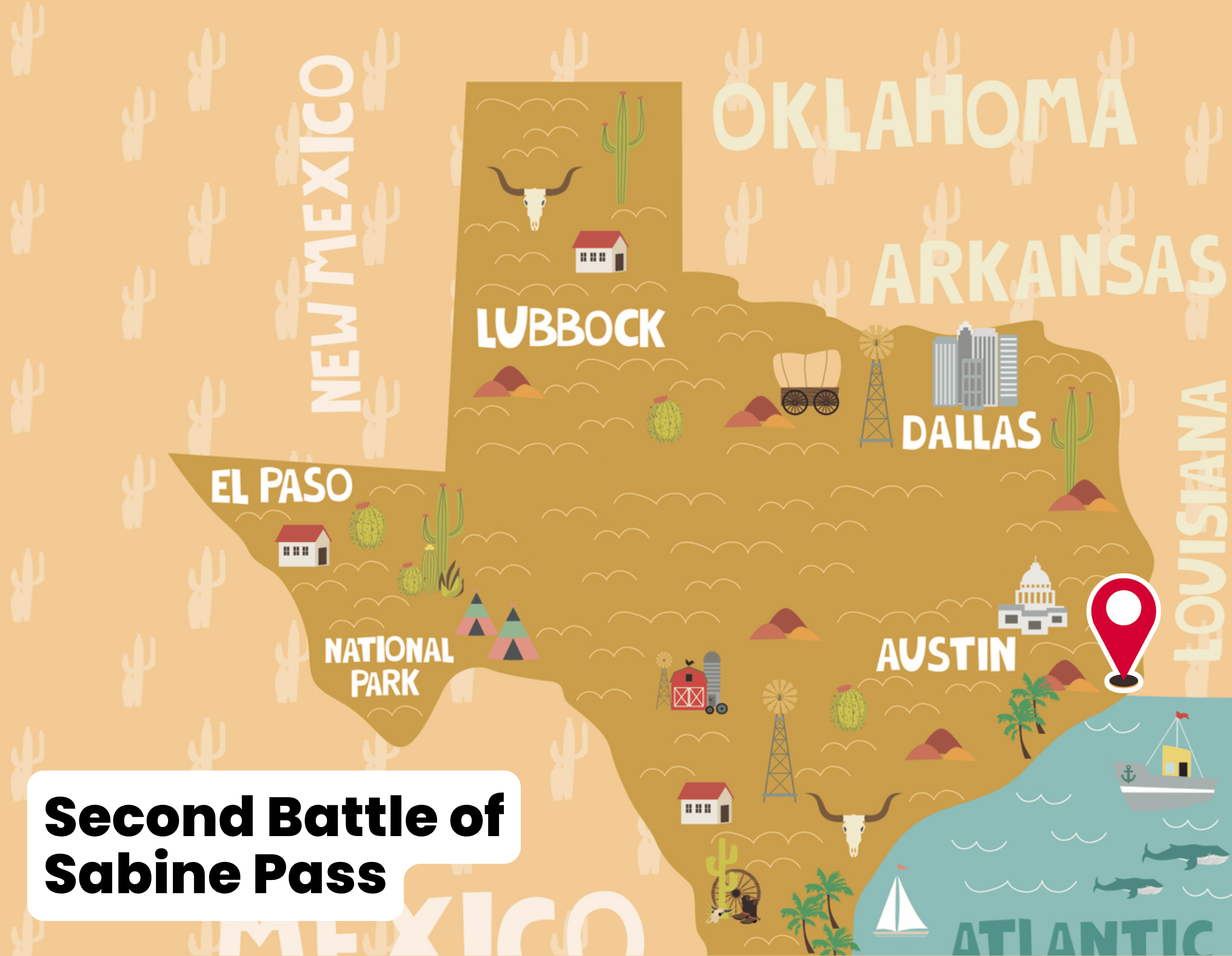
The Second Battle of Sabine Pass was a major Confederate victory during the American Civil War. On September 8, 1863, a small Confederate artillery force successfully repelled a much larger Union expedition attempting to capture Sabine Pass, a strategic waterway on the Texas-Louisiana border.
Background
Sabine Pass, which connected the Gulf of Mexico with Beaumont and Houston via the Sabine River, was a vital entry point for Confederate supply lines and trade with Mexico. The Union sought to invade Texas to block these connections, establish a foothold in the state, and potentially draw French forces in Mexico away from supporting the Confederacy.
To achieve this, the Union organized a large expedition of about 4,000 troops transported on 22 vessels, supported by four gunboats. Their plan was to sail through the narrow channel, silence the Confederate fort, and land troops to march inland.
Opposing Forces
Confederacy
-
Commander: Lt. Richard “Dick” Dowling
-
Force: 47 men of the Davis Guards (an Irish-American artillery unit)
-
Defenses: Fort Griffin with 6 artillery pieces
Union
-
Overall Command: Major General William B. Franklin
-
Naval Support: Lt. Frederick Crocker and Lt. Richard Wainwright Jr.
-
Force: 4,000 men aboard 22 transports, escorted by 4 gunboats (Clifton, Sachem, Arizona, Granite City)
The Battle
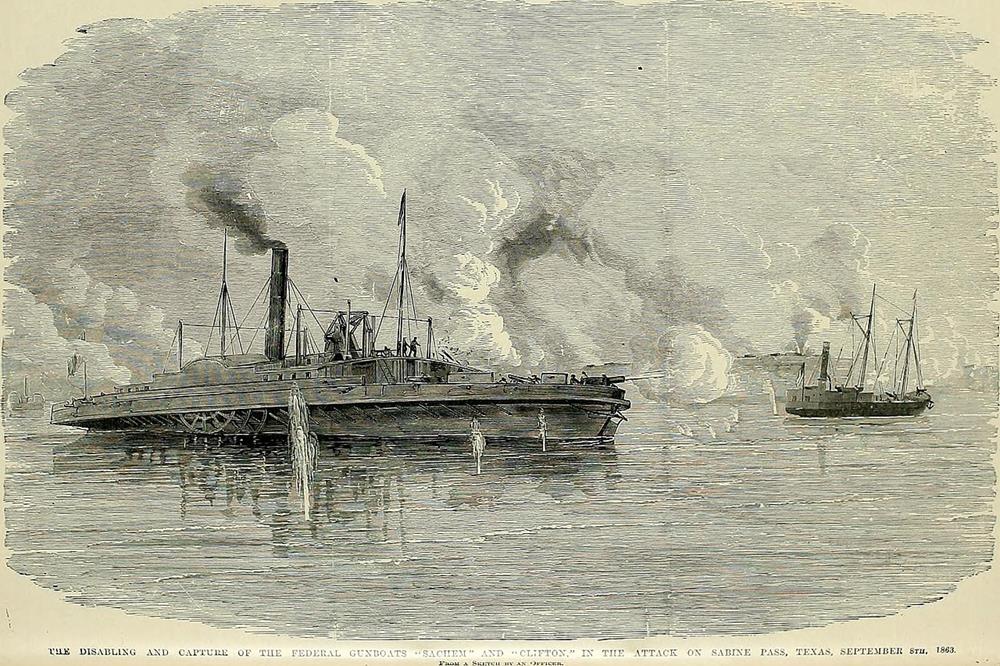
As the Union fleet entered the pass, the gunboats Clifton and Sachem advanced to engage Fort Griffin. Lt. Dowling’s men had prepared by setting range markers in the water, allowing their gunners to fire with precision.
Within 40 minutes:
-
Sachem was disabled and forced to surrender.
-
Clifton ran aground under heavy fire and also surrendered.
-
With two gunboats lost and troops unable to land, the Union fleet withdrew in disarray.
Casualties and Losses
-
Union: About 200 captured (mainly from Clifton and Sachem), several killed and wounded, and two gunboats lost.
-
Confederacy: 0 killed, 2 wounded.
Outcome and Significance
The Confederate victory at Sabine Pass was stunning. A force of fewer than 50 men had defeated thousands and prevented the Union from securing a foothold in Texas.
Key Results:
-
Texas’s southern coast remained under Confederate control.
-
Confederate morale soared, with the Davis Guards celebrated as heroes. Each received a medal made from silver coins, one of the rare Confederate-issued military decorations.
-
The Union abandoned large-scale amphibious operations against Texas for the remainder of the war.
Legacy
The Second Battle of Sabine Pass is remembered as one of the most lopsided victories of the Civil War. It highlighted the value of preparation, defensive positioning, and disciplined artillery fire. Today, monuments at the site commemorate Lt. Dowling and the Davis Guards for their defense of Texas.
Photos: