
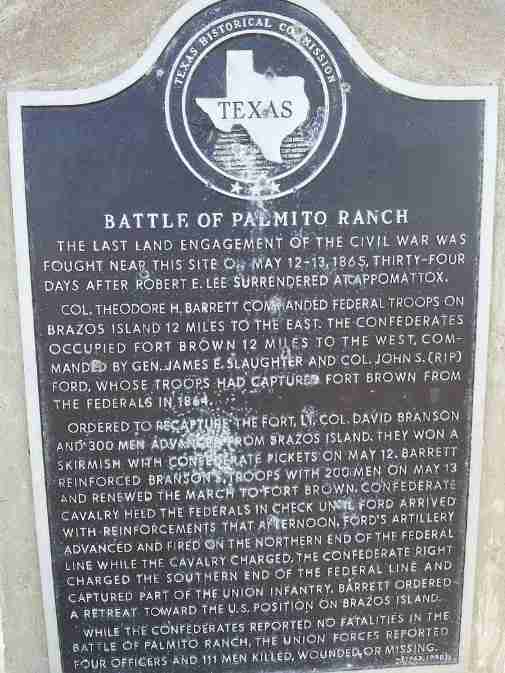
The Battle of Palmito Ranch, fought on May 12–13, 1865, near Brownsville, Texas, is remembered as the last land battle of the American Civil War. Occurring more than a month after Robert E. Lee’s surrender at Appomattox Court House, the engagement was tactically a Confederate victory but strategically meaningless, since the Confederacy was already collapsing.
Background in Texas
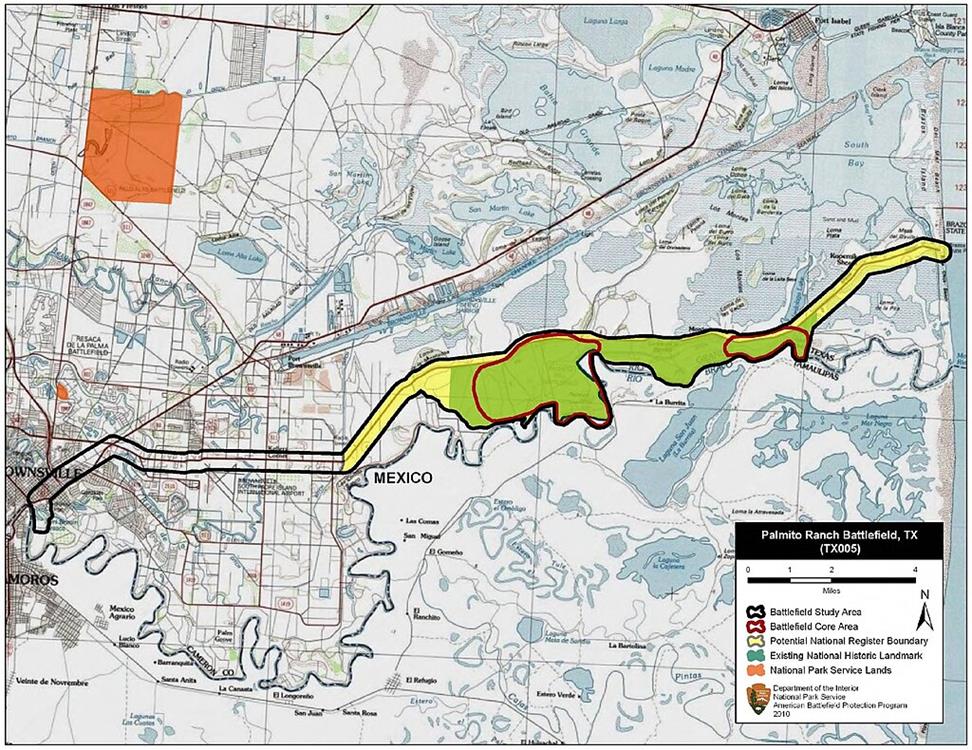
Texas was geographically isolated from the main Civil War theaters. By 1865, much of the South had surrendered, but news traveled slowly, and Confederate authority remained in parts of Texas.
The lower Rio Grande Valley held particular importance:
-
The Union controlled Brazos Santiago, a port near present-day South Padre Island.
-
Confederates under Colonel John S. “Rip” Ford held positions around Brownsville and the ranchlands along the Rio Grande.
-
The river served as a trade route with Matamoros, Mexico, where Confederate cotton was exchanged for supplies, bypassing the Union blockade.
Even as the Confederacy disintegrated elsewhere, this area still functioned as a hub of military activity.
The Union Advance
On May 12, 1865, Union commander Colonel Theodore H. Barrett ordered about 500 men, including the 62nd U.S. Colored Infantry and elements of the 34th Indiana Veteran Volunteer Infantry, to march inland from Brazos Santiago.
Barrett’s decision to attack has been debated:
-
Some accounts suggest he wanted to gain battlefield experience before the war officially ended.
-
Others point to reports of Confederate cattle and cotton supplies near Brownsville that could be seized.
Regardless of motive, the operation set the stage for an unnecessary battle.
The Fighting at Palmito Ranch
Union troops initially gained ground on May 12, scattering small groups of Confederates. But the next day, May 13, Ford countered with about 300–350 men, including cavalry, artillery, and local militia.
The engagement unfolded in skirmishes:
-
Confederate forces harassed the Union soldiers across the open plains.
-
Ford’s men, familiar with the terrain, maneuvered skillfully and cut off Union lines.
-
Union troops, facing artillery fire and aggressive cavalry charges, fell back in disorder toward Brazos Santiago.
By afternoon, the Union retreat had turned into a rout, with Confederate forces pursuing them until nightfall.
Casualties
-
Union losses: About 118 men (killed, wounded, or captured).
-
Confederate losses: About a dozen men.
The Union’s heavier casualties reflected the breakdown of their retreat and the Confederates’ advantage in cavalry mobility.
Outcome
The Confederates won the battle, but it had no bearing on the war’s outcome. By then, the Confederate government was disintegrating, and Union victory nationwide was assured.
In fact, within two weeks:
-
General Edmund Kirby Smith, Confederate commander of the Trans-Mississippi Department, surrendered his forces on May 26, 1865.
-
By June, remaining Confederate resistance in Texas ended.
Significance
The Battle of Palmito Ranch is significant for several reasons:
-
It was the final land battle of the Civil War.
-
It underscores the slow pace of communication in the 19th century. Many soldiers fought unaware that the war had already ended elsewhere.
-
It highlights the continued role of Texas as a Confederate outpost, where the war lingered longer than in the East.
-
It involved African American troops from the 62nd U.S. Colored Infantry, reminding us that Black soldiers played a role up to the very last clash of the war.
Legacy
Although small in scale, the battle has an outsized symbolic role:
-
For the Confederates, it was a final tactical victory.
-
For the Union, it was an unnecessary loss of life, a reminder of the tragic miscommunications and stubbornness that prolonged the war.
-
For historians, it marks the closing chapter of battlefield combat in the Civil War, though the last Confederate ship, the CSS Shenandoah, would not surrender until November 1865.
Today, the battlefield area near Brownsville is recognized as part of Palo Alto Battlefield National Historical Park, preserving the memory of both the Mexican-American War and the Civil War’s last clash.
Photos: