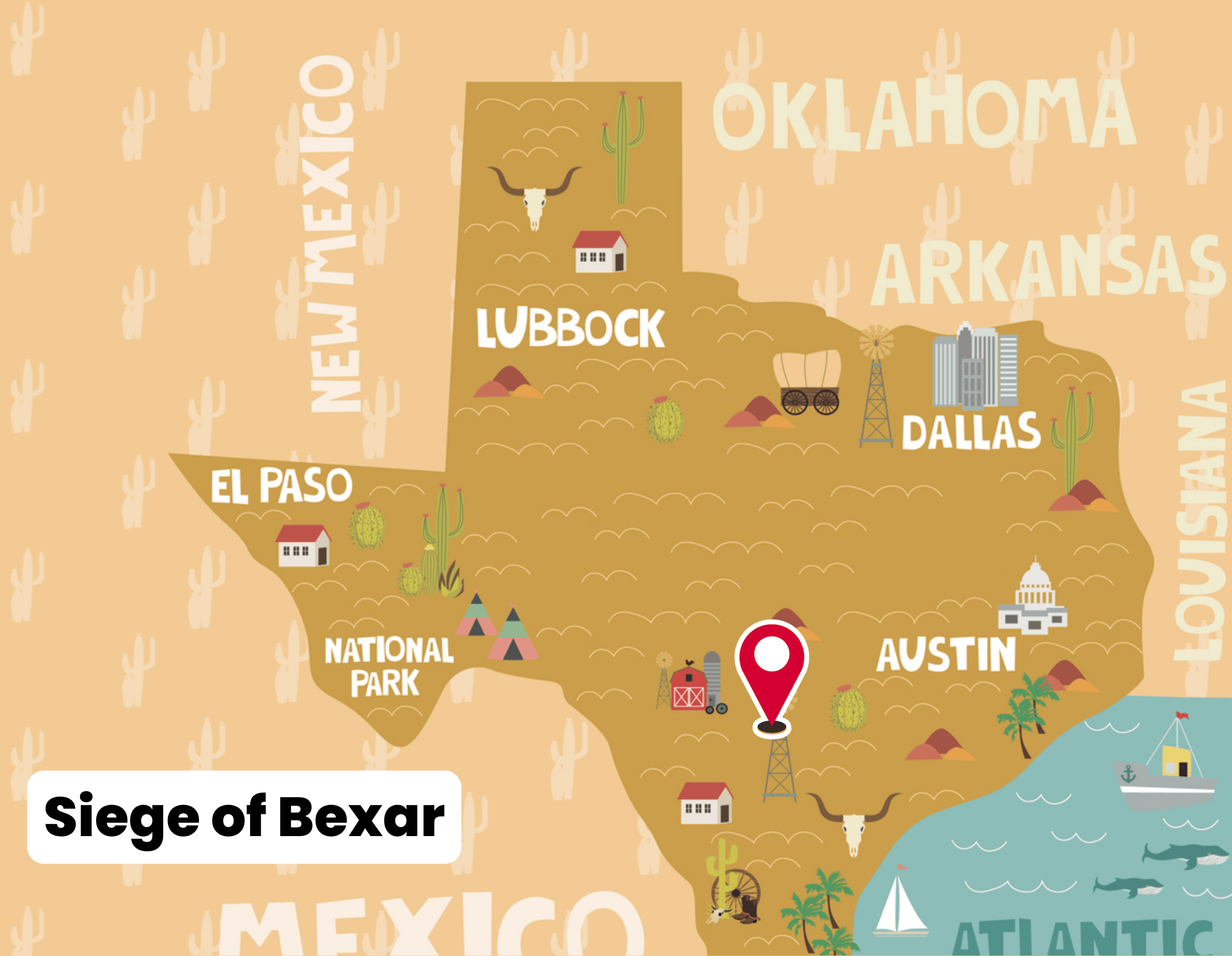
The Siege of Béxar was a crucial early battle in the Texas Revolution, resulting in the Texian and Tejano capture of San Antonio de Béxar from Mexican forces. The confrontation lasted from October to December 1835, with the decisive Texian assault taking place from December 5–9, 1835. The victory forced Mexican General Martín Perfecto de Cos to surrender and retreat south, giving the Texians control of San Antonio.
Background
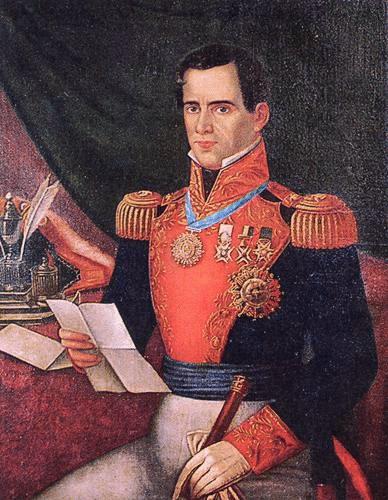
Tensions between Mexican authorities and settlers in Texas had been rising throughout 1835. After the Texian victory at Gonzales in October, Texian volunteers advanced toward San Antonio, the headquarters of Mexican military power in Texas. Edward Burleson replaced Stephen F. Austin as commander of the Texian army during the campaign. The Texians, though poorly supplied and loosely organized, received support from local Tejano allies, who opposed centralist Mexican rule under President Antonio López de Santa Anna.
The Siege
-
Start of Siege: Texian forces surrounded San Antonio in late October 1835, cutting off Mexican supplies and reinforcements.
-
Conditions: Both sides endured shortages of food and ammunition. Disease and desertion weakened Cos’s garrison.
-
Stalemate: For several weeks, the Texians lacked the numbers and confidence to storm the city.
The deadlock was broken in early December when Ben Milam, a Texian officer, urged his comrades to attack rather than abandon the campaign. His rallying cry led to the assault on San Antonio.
The Assault (December 5–9, 1835)
-
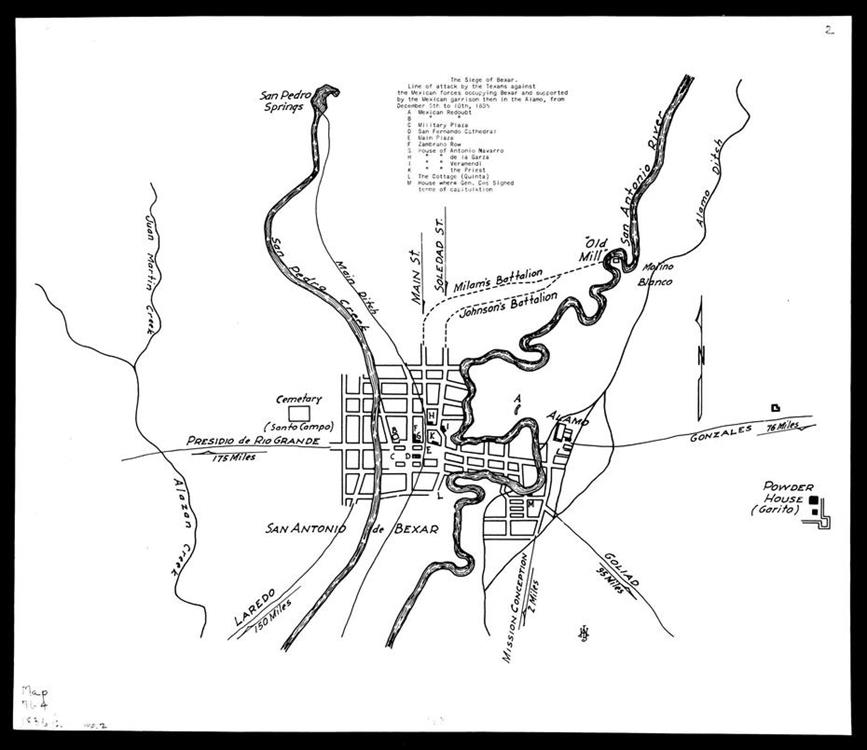
Initial Attack: On December 5, about 300 Texians led by Ben Milam and Frank W. Johnson launched a house-to-house offensive.
-
Urban Fighting: The battle was intense, with soldiers advancing slowly by capturing buildings and moving block by block.
-
Death of Milam: Ben Milam was killed on December 7, but the Texians pressed on under Johnson’s leadership.
-
Mexican Position Weakens: With mounting casualties, dwindling supplies, and no hope of reinforcements, Cos saw no alternative but to negotiate.
On December 9, 1835, Cos surrendered San Antonio and agreed to withdraw his remaining troops beyond the Rio Grande.
Commanders and Leaders
-
Texians and Tejanos:
-
Edward Burleson (commander of Texian Army)
-
Ben Milam (led the final assault, killed in action)
-
Frank W. Johnson (took command after Milam’s death)
-
-
Mexican Army:
-
General Martín Perfecto de Cos (commander, Mexican Centralist Army)
-
Strength and Casualties
-
Texians and Tejanos: About 400–600 troops during the assault (volunteer militia, frontiersmen, and Tejano allies).
-
Mexican Forces: About 1,200–1,400 soldiers under Cos, though many were sick or deserting by December.
-
Casualties:
-
Texians: ~30 killed (including Ben Milam), ~100 wounded.
-
Mexicans: ~150 killed, several hundred wounded, and over 600 surrendered.
-
Significance
-
The capture of San Antonio was the first major Texian military victory of the revolution.
-
It gave the revolutionaries control of nearly all of Texas, at least temporarily.
-
The victory boosted morale among Texians and encouraged more volunteers to join the cause.
-
However, the success was short-lived. In early 1836, Santa Anna marched north with a large Mexican army, leading to the Battle of the Alamo in February.
Result
-
Texian Victory: Mexican forces under Cos surrendered and retreated beyond the Rio Grande.
-
Aftermath: The Texians controlled San Antonio until Santa Anna’s return in 1836. The battle set the stage for later, more decisive confrontations in the Texas Revolution.
The Siege of Béxar was not only a military success but also a symbol of Texian determination. It demonstrated that volunteer forces, with limited resources, could defeat a professional Mexican garrison. Yet, the victory also gave the revolutionaries a sense of confidence that would soon be tested at the Alamo.
Photos: