
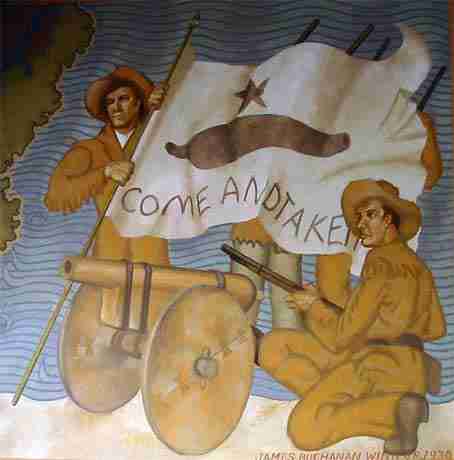
The Battle of Gonzales, fought on October 2, 1835, was the opening skirmish of the Texas Revolution. Though small in scale, it marked the beginning of armed resistance by Texian settlers against Mexican authority and became a powerful symbol of the movement for independence.
Background
In 1831, Mexican officials loaned a small cannon to the settlers of Gonzales, Texas, to help defend against raids by Indigenous groups. By 1835, tensions between Anglo-American colonists (Texians) and the Mexican central government had escalated. After President Antonio López de Santa Anna strengthened central authority and revoked aspects of the federalist Constitution of 1824, unrest spread across Texas.
Fearing rebellion, Mexican authorities ordered the settlers of Gonzales to return the cannon. The Texians refused, arguing that the cannon was essential for their defense. This refusal set the stage for confrontation.
The Skirmish
-
On September 29, 1835, Lieutenant Francisco de Castañeda was dispatched from San Antonio with about 100 Mexican dragoons to recover the cannon.
-
The settlers stalled, buying time to gather reinforcements from nearby communities. Within days, their force grew to around 140–150 armed men under the leadership of John H. Moore and other local militia officers.
-
To taunt the Mexicans, the settlers fashioned a white flag featuring a black image of the cannon and the words “Come and Take It.” This banner became one of the most enduring symbols of Texian defiance.
On the morning of October 2, Texian militia crossed the Guadalupe River and ambushed Castañeda’s men. After a brief exchange of fire, in which one or two Mexican soldiers were killed and others wounded, Castañeda ordered a retreat. The Texians reported no fatalities, though at least one man was injured in a horse accident.
Significance
Although militarily minor, the Battle of Gonzales had an outsized impact:
-
First shots of the Texas Revolution: The engagement marked the official beginning of the Texians’ fight for independence from Mexico.
-
Symbol of resistance: The “Come and Take It” flag became a rallying cry across Texas and remains a symbol of independence and defiance today.
-
Momentum for rebellion: The victory at Gonzales emboldened Texian forces and inspired volunteers to join the revolutionary cause, setting the stage for larger confrontations such as the Siege of Béxar and the Battle of the Alamo.
Key Facts
-
Date: October 2, 1835
-
Location: Gonzales, Coahuila y Tejas, Mexico (present-day Texas)
-
Belligerents:
-
Mexico (Centralist Army under Santa Anna)
-
Texian settlers (Texian militia)
-
-
Commanders:
-
Mexico: Lt. Francisco de Castañeda
-
Texians: John H. Moore, with support from other militia leaders
-
-
Strength:
-
Mexican forces: ~100
-
Texian forces: ~140–150
-
-
Casualties:
-
Mexican: 1–2 killed, several wounded
-
Texian: none killed, minor injuries reported
-
-
Result: Texian victory; Mexican withdrawal
-
Outcome: Sparked the Texas Revolution, ultimately leading to the creation of the Republic of Texas in 1836.
Legacy
The Battle of Gonzales is remembered not for its scale, but for its symbolism. The refusal to surrender the cannon and the defiant “Come and Take It” flag embodied the Texians’ determination to resist Mexican control. Today, Gonzales celebrates the event each year with Come and Take It Days, honoring the battle that launched the Texas Revolution.
Photos:
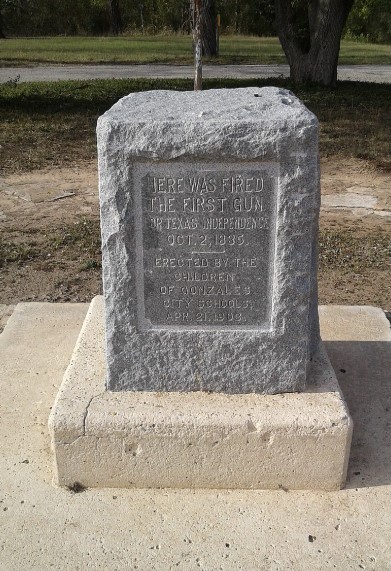
Battle of Gonzales
Battle of Gonzales
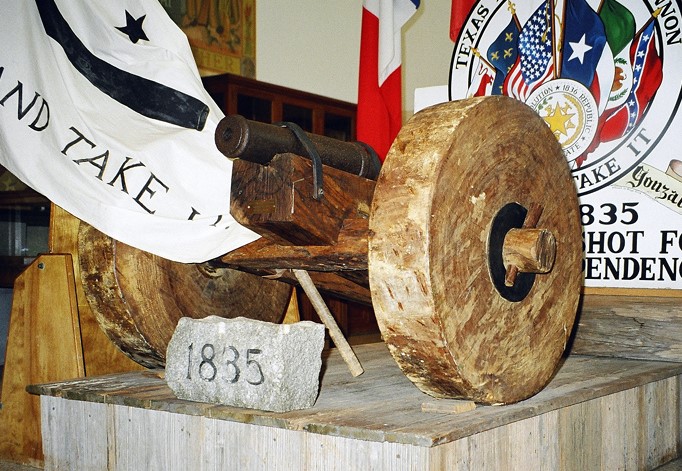
Battle of Gonzales
Map:
Sorry, no records were found. Please adjust your search criteria and try again.
Sorry, unable to load the Maps API.
Gonzales County
Texas
United States
-
Outdoor monument area: No explicit pet restrictions—likely allowed if on a leash.
-
Inside the museum: Pets are typically not allowed (except service animals). Confirm via the official site.
-
Battle monument viewing & photo ops at TX-97 marker.
-
Museum visit: See the famous “Come and Take It” cannon and exhibits on the Texas Revolution.
-
Pioneer Village living history center: Walk through 19th-century structures to experience frontier life.
-
Annual reenactment: “Come and Take It” celebration held every October.
-
Monument site: Informational plaques; parking; roadside pull-off.
-
Museum: Restrooms, reflection pool (no swimming), gift shop (penny‑stroker machine), RV/bus parking.
-
Local area: Gonzales offers picnic areas, local dining, and other museums.
It'sOnlyMakeBelieve, Gonzales Battle Memorial, CC BY-SA 4.0
Larry D. Moore, Gonzales cannon 2005, CC BY 4.0