Texana was one of the earliest Anglo-American settlements in Texas, founded in 1832 on the Navidad River by Dr. Francis F. Wells and Pamelia McNutt Porter. Originally named Santa Anna, it was renamed Texana in 1835 after its namesake Mexican leader fell out of favor. The town served as the Jackson County seat, a mustering site during the Texas Revolution, and a thriving riverport with steamboat service, mail routes, and businesses by the mid-1800s.
Its decline began in the 1880s when the railroad bypassed it in favor of nearby Edna, leading to the loss of its county seat and eventual abandonment. In 1979, the site was submerged by Lake Texana following the completion of the Palmetto Bend Dam, though landmarks like the 1859 Texana Presbyterian Church were preserved and relocated.
Founding and Early Days
Texana, in Jackson County, Texas, began as one of the region’s earliest Anglo-American settlements. It was founded in 1832 by Dr. Francis F. Wells and his sister-in-law Pamelia McNutt Porter, widow of empresario James Porter. The town was originally named Santa Anna, in honor of Antonio López de Santa Anna, then considered a liberal Mexican leader who had supported the Mexican Constitution of 1824.
By 1835, attitudes shifted. As Santa Anna centralized power and clashed with Texian settlers, the town’s name was changed to Texana, reflecting loyalty to the cause of Texas independence.
Role in the Texas Revolution
During the Texas Revolution, Texana became a significant point of entry and activity. Located on the Navidad River, it served as a training camp and mustering site for volunteers, including the Alabama Red Rovers, who later fought under James Fannin. Its river access made it a convenient port of entry for supplies and troops, giving the settlement early importance despite its small size.
Texana was formally designated the Jackson County seat in 1836, further cementing its early prominence.
Growth in the 19th Century
By the mid-19th century, Texana had grown into a busy riverport town. The settlement supported mail and stagecoach routes, legal and commercial institutions, and even a weekly newspaper. Historical accounts note that the town had a courthouse, hotels, warehouses, and a variety of businesses serving both local residents and travelers.
Texana’s location on the Navidad River made it a shipping point for steamboats navigating to and from the Gulf. By 1880, the town was considered one of the most prosperous communities in the region.
Decline After the Railroad Bypass
Texana’s fortunes changed abruptly in the early 1880s. In 1881, the New York, Texas & Mexican Railway (also known as the “Macaroni Line”) approached local leaders, offering to bring the rail line through the town if they provided $30,000 in bonds. Town officials declined. As a result, the line was routed instead through nearby Edna, just a few miles away.
The consequences were swift. By 1883, Edna began to draw businesses and residents away from Texana. In 1884, the county seat was officially moved from Texana to Edna. Without its port advantages and bypassed by rail, Texana could not compete. Within a few decades, it was largely abandoned, becoming a ghost town.
Submersion Under Lake Texana
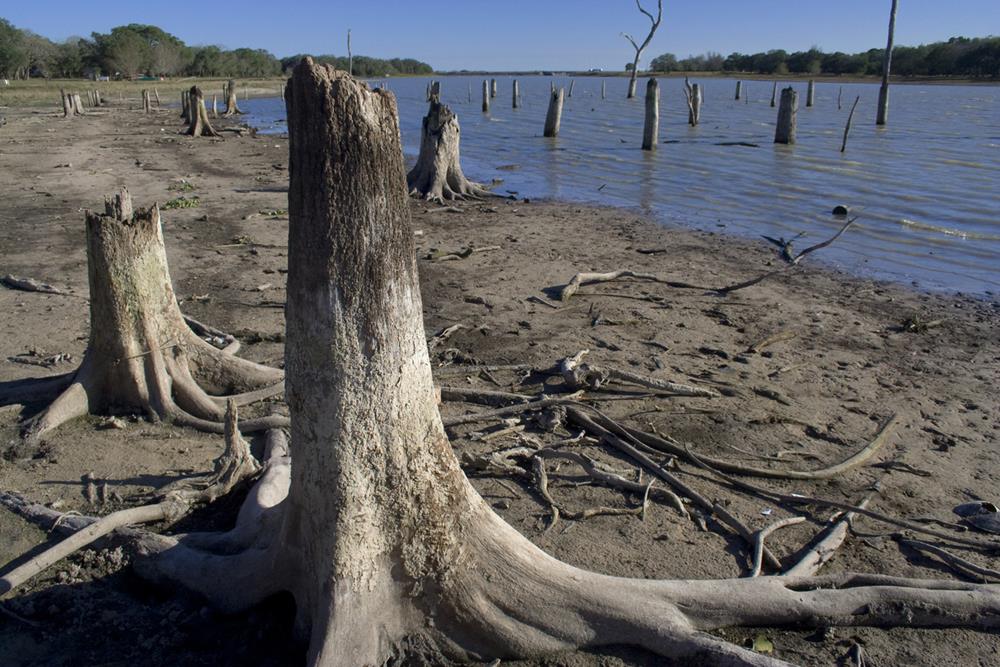
Though it was mostly deserted by the early 20th century, the site of Texana remained visible until the Palmetto Bend Dam project of the 1970s. Authorized by Congress in 1968, construction began in 1975, and by 1979, the dam was complete. The filling of Lake Texana deliberately submerged the remains of the old town, erasing it from the surface but preserving it beneath the water. Today, Lake Texana State Park and the Brackenridge Recreation Complex serve as recreational areas on its shores.
Surviving Relics and Landmarks
Although the town itself lies underwater, parts of Texana’s history have survived:
-
Texana Presbyterian Church: Built in 1859, this church was moved in 2001 to the Brackenridge Recreation Complex. It remains a Recorded Texas Historic Landmark, preserving part of the settlement’s legacy.
-
Cemetery: The cemetery associated with Texana still exists on higher ground, with gravestones marking the town’s early settlers and veterans.
-
Historical Marker: A Texas Centennial marker commemorates the site of Texana and acknowledges its role as one of Jackson County’s earliest towns.
Myths and Legends
One frequently repeated story claims that the Allen brothers, founders of Houston, once offered to purchase Texana’s townsite to establish their city there, but Dr. Wells refused. While colorful, this story is not verified in primary sources and is generally considered anecdotal. The founding of Houston in 1836 appears to have been an independent venture.
Summary of Key Facts
-
Founded: 1832 by Dr. Francis F. Wells and Pamelia McNutt Porter
-
Original Name: Santa Anna, renamed Texana in 1835
-
County Seat: 1836–1884 (Jackson County)
-
Role in Texas Revolution: Mustering site and port of entry for volunteers
-
Peak Prosperity: Mid-19th century, with courthouse, hotels, warehouses, and steamboat activity
-
Decline: Railroad bypassed in 1881; county seat moved to Edna in 1884
-
Ghost Town: By early 20th century
-
Submersion: Site flooded in 1979 by Lake Texana after completion of Palmetto Bend Dam
-
Preserved Landmark: Texana Presbyterian Church (1859), moved to Brackenridge Recreation Complex in 2001
Photos: