
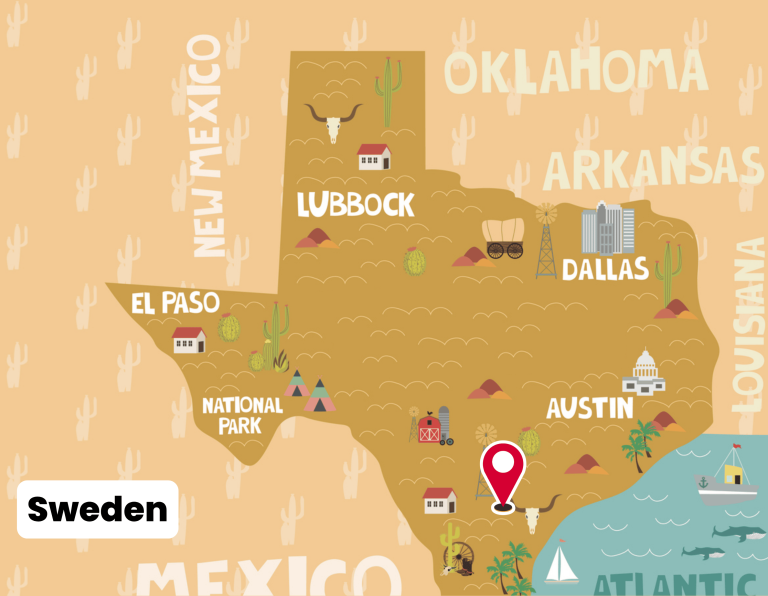
Sweden, Texas, began in the late 19th century as a modest ranching and farming community in southwestern Duval County. Its location was strategic: the Texas–Mexican Railway, completed in 1881, passed nearby and provided access to trade routes connecting ranchers and farmers to larger markets. The settlement stood near Agua Poquita Creek, about four miles southwest of Benavides, in an area of scattered ranchlands.
Like many small Texas towns, Sweden’s development centered on agriculture. Families moved into the region to raise cattle and grow crops, relying on the railway for shipping goods.
Post Office and Community Growth
The U.S. Post Office played a central role in the town’s short-lived prosperity.
-
It was first established in 1884, but operations stopped in 1885 after only a year.
-
In 1907, the post office reopened, serving the scattered ranch families and small farms in the area.
-
It operated until 1932, when mail service was shifted elsewhere and Sweden began to fade as a community.
During its brief high point, Sweden had a population of about 25 residents in 1914. Though never large, it supported several families who worked the land and created a small but steady settlement.
Education and Daily Life
Sweden maintained its own school for local children. The one-room schoolhouse was typical of rural South Texas in the early 20th century, providing basic education to children from ranching families. In the 1950s, this school was consolidated into the Benavides Independent School District, which further reduced the town’s identity as a distinct community.
Life in Sweden revolved around ranch work, small-scale farming, and the railway. Residents lived modestly, but the presence of a school, post office, and railway access gave the settlement a sense of permanence for several decades.
Decline into a Ghost Town
Sweden began to decline after the closure of its post office in 1932. Without mail service, and with schoolchildren sent to Benavides in later years, the settlement lost much of its function as a community hub. The slow depopulation of the region followed broader trends in South Texas, where small rural towns diminished as transportation modernized and larger nearby towns absorbed their populations.
By the mid-20th century, Sweden was effectively abandoned. Today it is recognized as a ghost town. Visitors may still find overgrown foundations, remnants of structures, and an old cemetery that marks the families who once lived there. Occasional signposts or local references keep the name alive, but the community itself has disappeared.
Interesting Notes about Sweden, Texas
-
Railway Roots: The town’s existence was tied to the Texas–Mexican Railway, which enabled its short-lived growth. Without the railway, Sweden may never have been settled.
-
European Place Names: Sweden’s name fits into a pattern of European-inspired settlement names in the region. Nearby communities include Norway, reinforcing this theme.
-
Tiny Population: Even at its peak of around 25 residents, Sweden never developed into a formal town with businesses or large infrastructure, which contributed to its decline.
Present-Day Legacy
Sweden, Texas, serves as a reminder of the many small, rural communities that once dotted South Texas but could not survive the shift to modern transportation, schooling, and centralized trade. For historians and travelers exploring Duval County’s past, Sweden is one of several ghost towns that illustrate the ebb and flow of settlement patterns in the late 19th and early 20th centuries.
Photos:
Sweden
Map:
Sorry, no records were found. Please adjust your search criteria and try again.
Sorry, unable to load the Maps API.
Duval County
Texas
United States
- Yes—on leash at cemetery and roadside; avoid private areas
-
Photograph old foundations or the cemetery
-
Trace local railway history
-
Genealogy research (e.g., Sweden‑era families)
-
Scenic drives through rural South Texas, admiring prairie landscapes
- None