
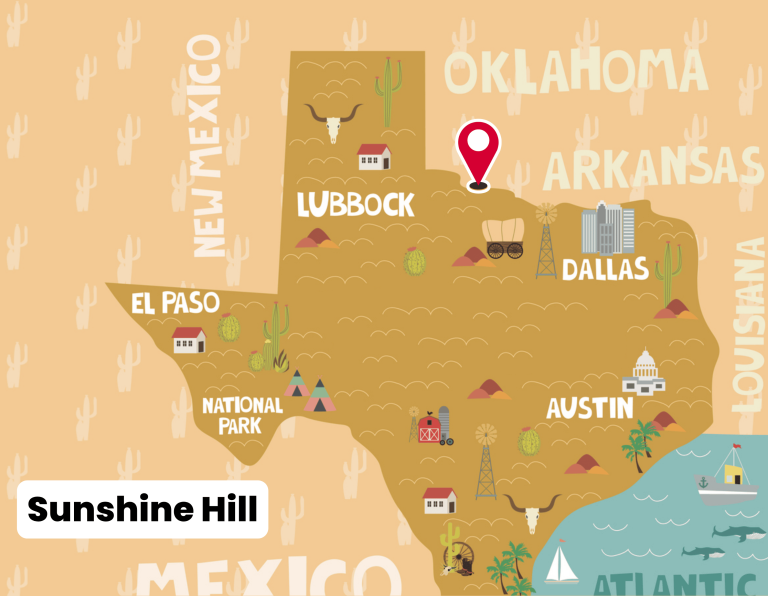
Sunshine Hill developed in the late 19th century as a small farming and ranching community in northwestern Wichita County, Texas. The settlement centered around the Sunshine Hill School, which was founded in 1889 on land donated by local settler C. P. Coble. Like many rural schools of the period, it was not only a place for education but also a gathering point for families in the area.
For decades, the school served as the heart of community life. Children from surrounding farms attended classes there, while parents used the schoolhouse for meetings and social events. Sunshine Hill remained a scattered but stable community into the first half of the 20th century.
Location and Geography
Sunshine Hill stood at the crossroads of county and later farm-to-market roads, about five miles northeast of Electra and roughly thirty-three miles west of Wichita Falls. Its name comes from the summit that rises 1,207 feet above sea level, the highest point in Wichita County. The elevation made it a recognizable landmark, visible from miles away across the surrounding plains. Today, the hill remains a reference point for the county’s topography and is sometimes noted in geological surveys.
Oil Discovery and Economic Shifts
The 1920s brought an oil discovery that briefly changed the fate of Sunshine Hill. Oil was first struck in the Sunshine Hill Oilfield in 1921 by driller E. M. Foster. Though production was never as extensive as the nearby Burkburnett or Electra fields, it did provide an economic boost for the area.
For a short time, new workers and families arrived, small businesses operated near the school, and the farming community gained supplemental income from oil royalties. However, the field’s limited output meant Sunshine Hill never developed into a major boomtown. By the 1930s, Wichita County maps showed the community as little more than a schoolhouse, one business, and a scattering of homes.
Decline and Ghost Town Status
The consolidation of rural schools in 1947 marked a turning point. The Sunshine Hill School merged into the Electra Independent School District, ending nearly sixty years of continuous operation. Without its school, the community lost its focal point, and many families moved to Electra or Wichita Falls in search of jobs and better amenities.
By the early 1980s, the area had effectively become a ghost town. Only traces of the community remained—such as the site of the old school and remnants of oilfield activity—while the population dispersed entirely.
Legacy and Recognition
Although Sunshine Hill no longer exists as an active settlement, its significance endures in several ways:
-
Educational history: The Sunshine Hill School was one of many rural schools that shaped community life in Wichita County before widespread consolidation.
-
Oil heritage: Its oilfield, though modest, forms part of the broader story of North Texas petroleum exploration.
-
Geological importance: Sunshine Hill remains the highest summit in Wichita County at 1,207–1,208 feet, often cited in maps and outdoor guides.
Today, Sunshine Hill is remembered both as a vanished community and as a physical landmark that ties together the cultural, economic, and natural history of Wichita County.
Photos:
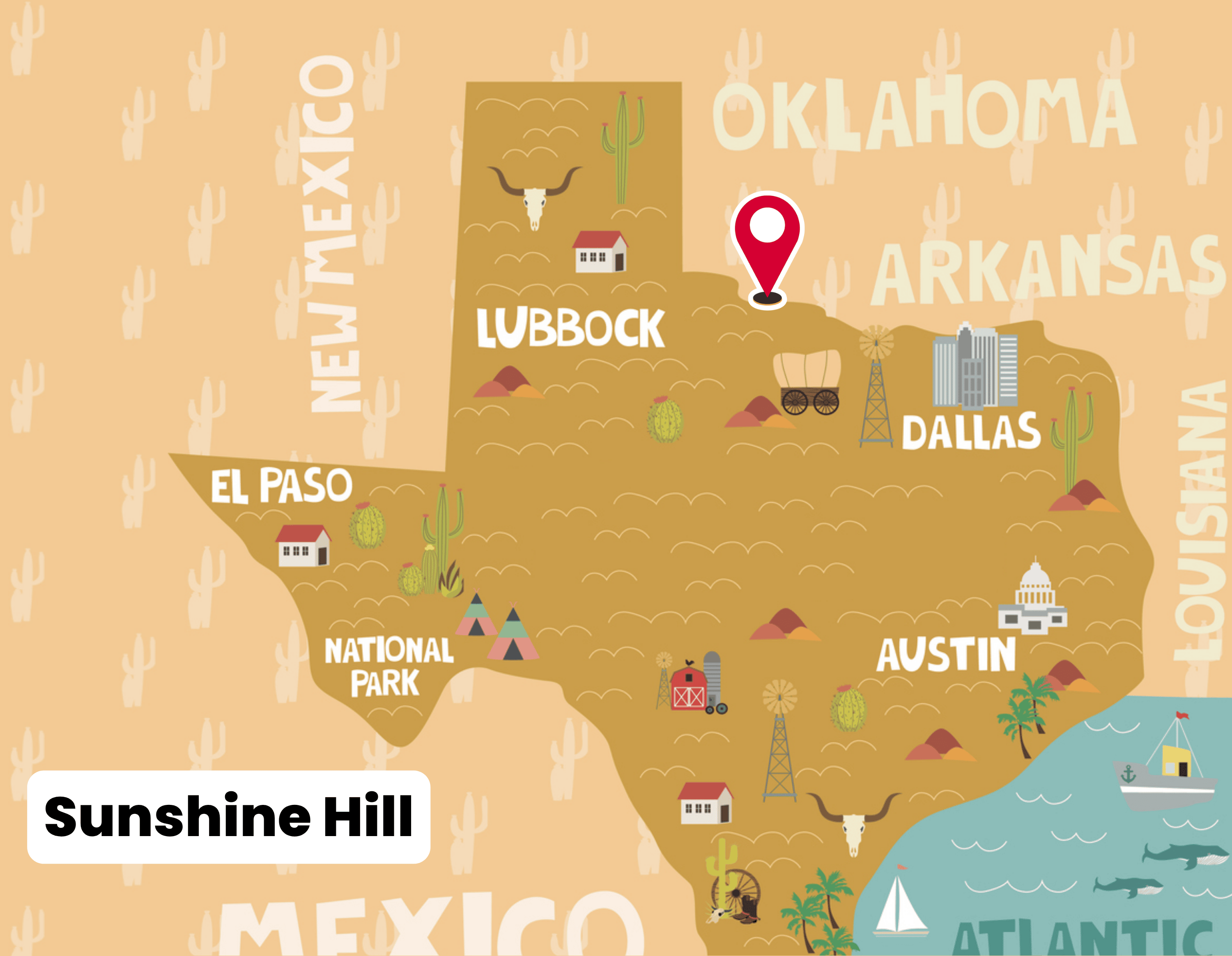
Sunshine Hill
Map:
Sorry, no records were found. Please adjust your search criteria and try again.
Sorry, unable to load the Maps API.
Wichita County
Texas
United States
- Likely yes when visiting accessible roadside areas—on leash and with permission
-
Drive or hike to the summit and enjoy county‑highpoint views.
-
Photograph or visit the site of the former schoolhouse.
-
Explore the surrounding rural and oil‑field landscape.
- None