
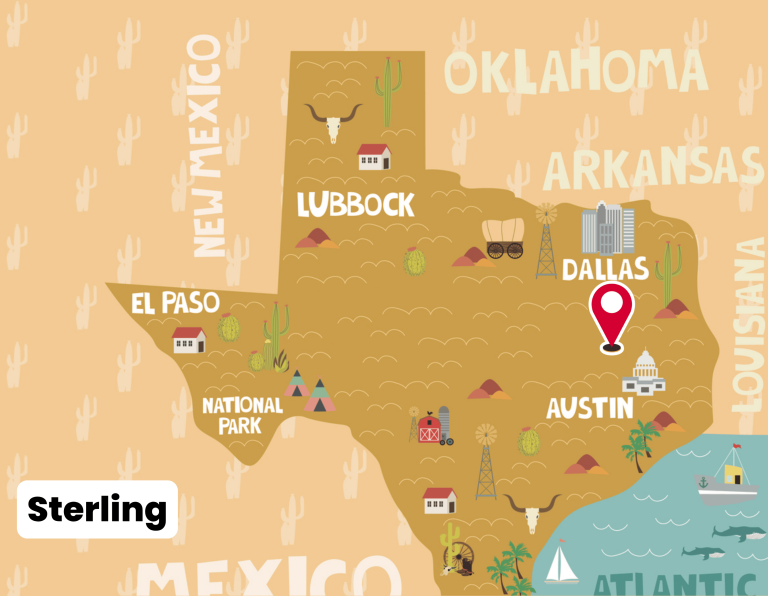
Sterling was one of the earliest Anglo-American settlements in Robertson County, Texas. Established in the 1830s and named in honor of Sterling Clack Robertson, empresario of Robertson’s Colony and signer of the Texas Declaration of Independence, the community grew in the fertile Brazos River bottomlands. By the 1850s it had developed into a notable local center with businesses, institutions, and a cotton-based agricultural economy.
Early Growth
Sterling emerged as a small but thriving community in the mid-19th century. According to the Handbook of Texas, by the 1850s it contained several general stores, three saloons, two churches, a Masonic lodge, and a post office. Local planters produced cotton and other crops, and Sterling became a trading point for area farmers. Its location made it an important settlement in central Robertson County before the arrival of the railroad.
Civil War Role
During the Civil War (1861–1865), Sterling served as a mustering and supply center for Confederate forces. Historical markers in Robertson County note that the community was used to assemble men and to provide cotton, wool, foodstuffs, and horses to the Confederate war effort. While detailed archival records are limited, this role is confirmed through local commemorations and reflects Sterling’s importance as a hub for area planters during the conflict.
Decline After the Railroad Bypass
Sterling’s prosperity was short-lived. In 1869, the Houston and Texas Central Railway laid its line through Robertson County but bypassed Sterling. Instead, investors and landowners established the new town of Calvert about two miles east, directly on the rail line. The choice of route was decisive: businesses, residents, and institutions from Sterling—including churches—moved to Calvert. One of the most notable relocations was the Cumberland Presbyterian Church, which was physically moved by oxen from Sterling to Calvert in 1868, where it still stands as a historic structure.
The establishment of Calvert quickly overshadowed Sterling. By the late 19th century, Sterling was in steep decline as commercial and social life shifted to the railroad town.
Present Condition
By the 20th century, Sterling had disappeared as a functioning town. The Sterling Cemetery remains as the most visible landmark, containing the graves of many of the area’s earliest settlers. A Texas Historical Marker commemorates the community’s role and history. In addition, traces of old structures survive on private land, though they are largely overgrown and not accessible to the public. Today, Sterling is considered a ghost town and remembered mainly through its cemetery, historical marker, and ties to early Robertson County history.
Interesting Facts About Sterling
-
Namesake: The town was named for Sterling Clack Robertson (1785–1842), empresario of Robertson’s Colony, for whom Robertson County itself is also named. Robertson signed the Texas Declaration of Independence at Washington-on-the-Brazos in 1836.
-
Community Institutions: By the 1850s, Sterling had stores, saloons, churches, a Masonic lodge, and a post office, making it a well-rounded settlement for its time.
-
Civil War Hub: Historical markers identify Sterling as a center for Confederate mustering and supply activity during the Civil War, drawing on resources from local planters.
-
Relocation to Calvert: When the Houston and Texas Central Railway bypassed Sterling, much of the town moved to the rail line. The Cumberland Presbyterian Church was hauled by oxen to Calvert in 1868, where it continues to stand as one of the oldest structures in the region.
-
Current Status: Only the cemetery and marker remain as public reminders of Sterling’s history. The site is classified as a ghost town in modern Texas historical records.
Photos:
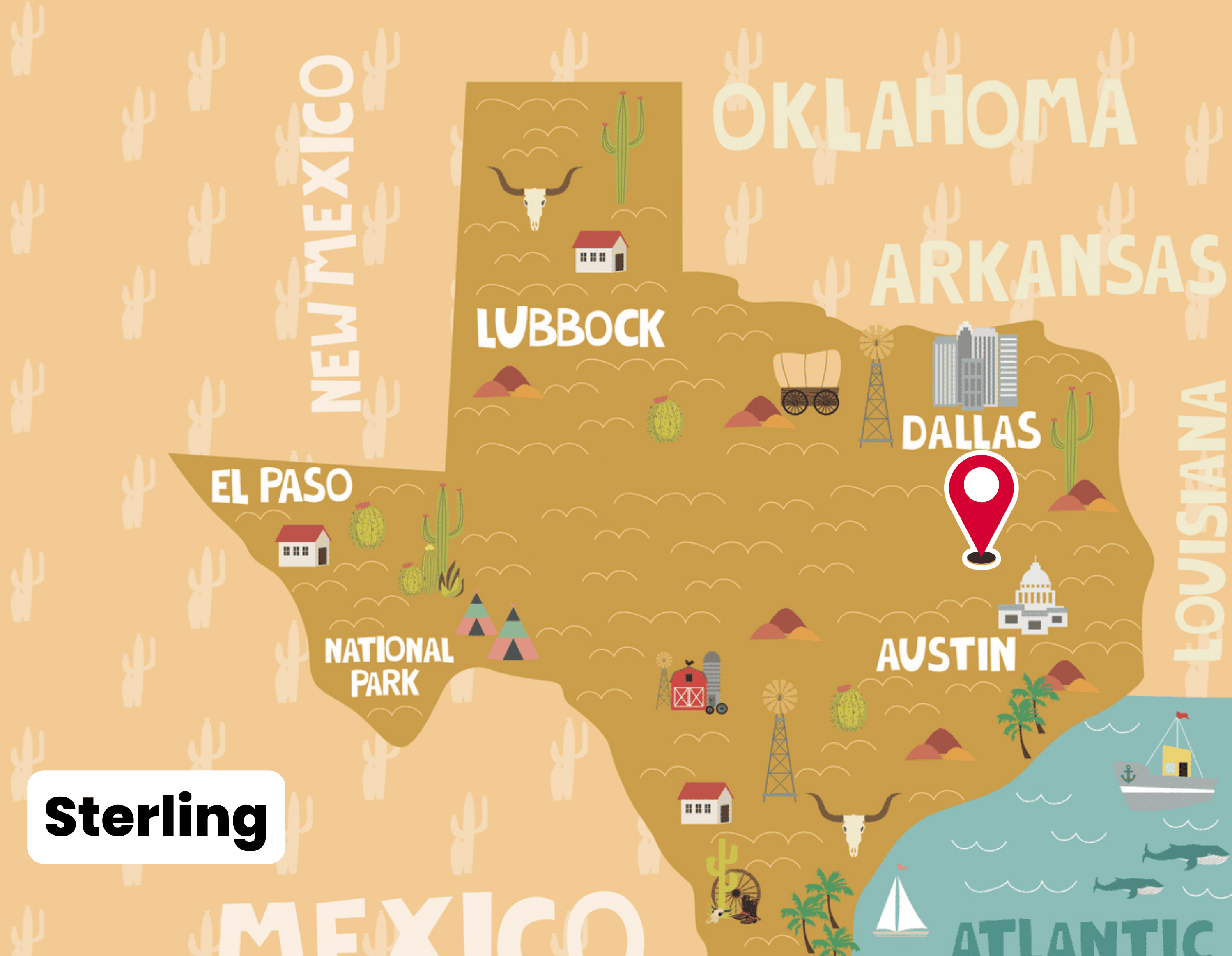
Sterling
Map:
Sorry, no records were found. Please adjust your search criteria and try again.
Sorry, unable to load the Maps API.
Robertson County
Texas
United States
- Yes, on leash along public roads; permissions needed for venturing on private land
- Visit cemetery and historical marker, photograph overgrown ruins, research Robertson family history
- None