
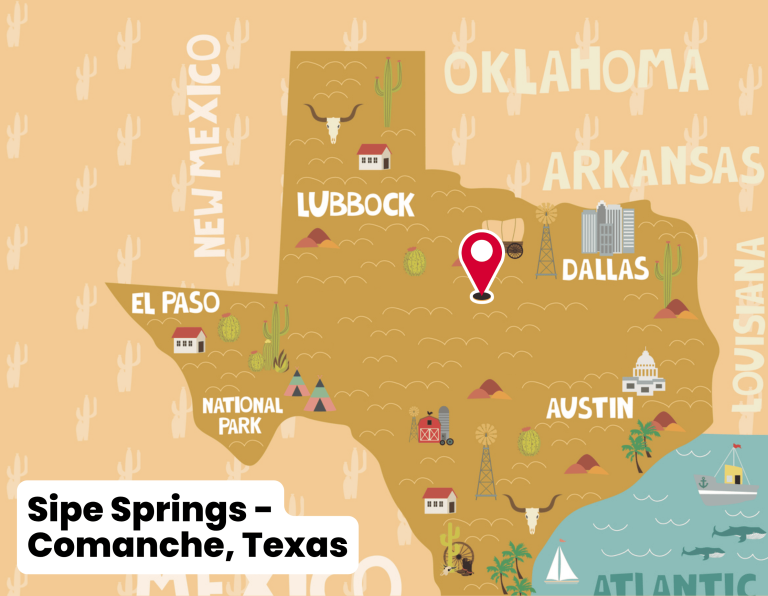
Sipe Springs began around 1870 at a natural spring in northeastern Comanche County and was formally organized in 1873. Its location at the crossroads of what are now Farm Roads 1477 and 587, about 17 miles northwest of Comanche, gave it strategic importance.
By the mid-1880s, Sipe Springs had developed into a modest but thriving farming community. It supported a schoolhouse, several churches, five general stores, two hotels, and two gin-gristmills. The town also had a post office (opened in 1883), and by around 1890, a local newspaper called The Cyclone was being published. Telephone service reached the town by 1909, showing its early embrace of modern amenities.
Railroad and Banking Era
The arrival of the Texas Central Railroad in 1911 spurred new growth. Although the line ran just north of the original settlement, Sipe Springs expanded in that direction. By 1914, the population had risen to about 500, and new institutions included a state bank and another newspaper, the Sipe Springs Record.
The Oil Boom (1918–1921)
Everything changed in 1918, when oil was discovered nearby. Almost overnight, the community transformed into a bustling boomtown. Population estimates from the time range between 8,000 and 10,000 residents, though many were temporary oilfield workers living in tents and makeshift housing around the town.
During its peak years, Sipe Springs boasted an impressive range of establishments:
-
An opera house
-
A professional baseball team
-
Hotels and rooming houses
-
Two banks
-
A cotton gin
-
Numerous drugstores, cafés, barbershops, and businesses
-
A movie theater and dance hall
For a brief moment, Sipe Springs rivaled larger towns in the region as a commercial and cultural hub.
Decline and Fire (1921–1924)
The prosperity proved short-lived. By 1921, the shallow oil fields began to dry up. Both local banks failed that year, and businesses quickly closed. The situation worsened in 1922, when a fire destroyed much of the town’s business district. With the boom over and infrastructure devastated, population figures plummeted. By 1924, only about 575 residents remained.
Mid-Century Changes
The following decades saw continued decline:
-
In 1937, local schools still served 152 students with six teachers, but numbers soon dropped.
-
By 1940, the population was about 200, shrinking to 120 by 1949.
-
The local post office closed in 1957, marking another step in the town’s dwindling significance.
-
In 1952, the schools were consolidated with nearby districts.
Modern Era
By the late 20th century, little remained of Sipe Springs beyond scattered homes, a cemetery, and reminders of its boomtown past. In 2000, the population was estimated at 75, though some sources note counts as low as 15.
A Lasting Memory: The Roadside Grave
One of the most enduring features of Sipe Springs is the roadside grave of a three-year-old girl, believed to have died in 1870 while her family was traveling west. The grave has become a local landmark and a symbol of the community’s history. Visitors often leave flowers, coins, or toys in remembrance. Local residents continue to maintain this poignant site, preserving a tradition that links today’s Comanche County with its pioneer past.
Summary
Sipe Springs tells the classic Texas boom-and-bust story. From its agricultural roots in the 1870s to its meteoric rise as an oil boomtown in the 1910s, the community once hosted thousands of people, banks, schools, and even an opera house. Yet within a few years, oil exhaustion, financial collapse, and fire erased most of its prosperity. Today, Sipe Springs survives as a small rural settlement and a ghost town in memory, its cemetery and roadside grave standing as reminders of both its promise and its decline.
Photos:
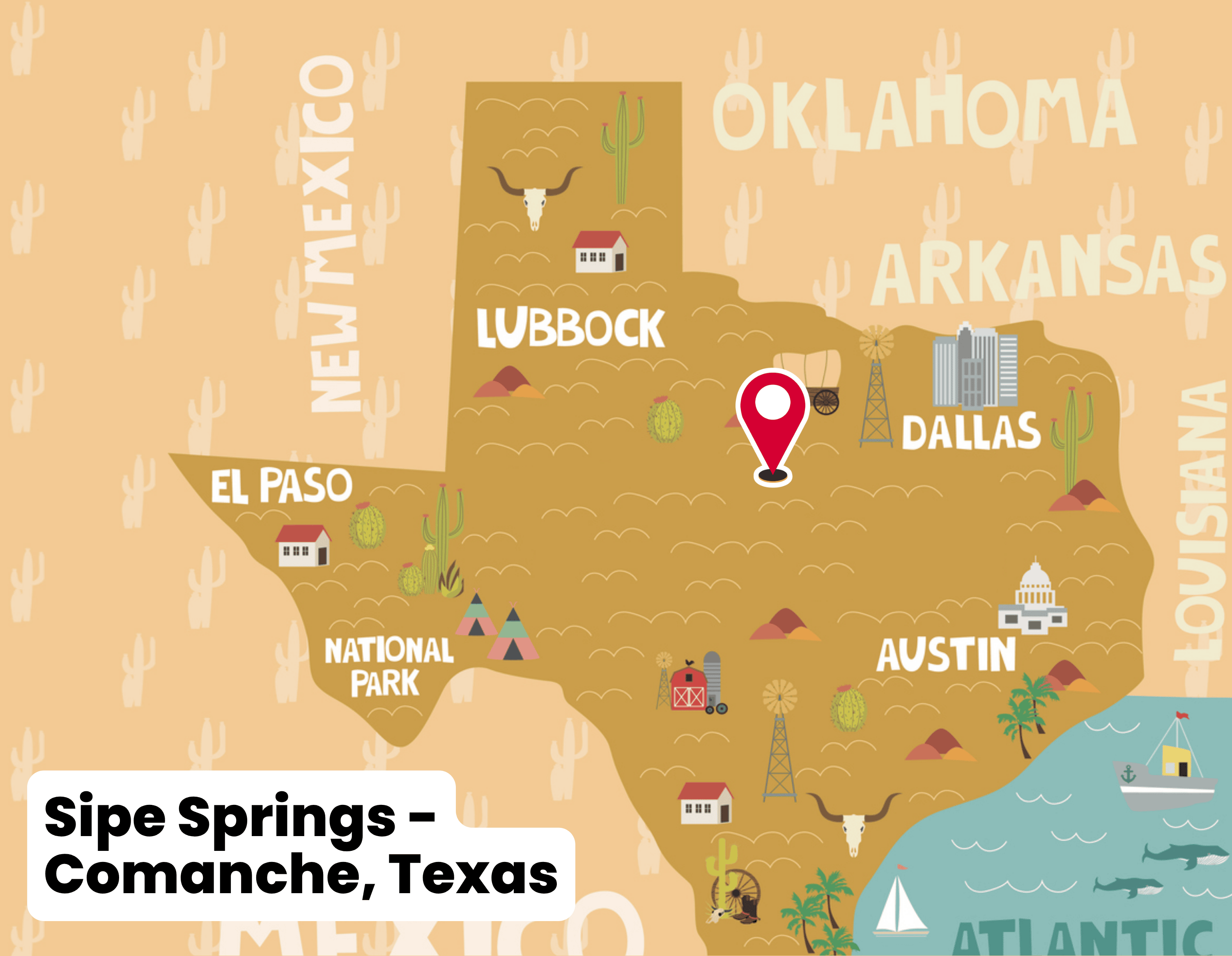
Sipe Springs - Comanche, Texas
Map:
Sorry, no records were found. Please adjust your search criteria and try again.
Sorry, unable to load the Maps API.
Comanche County
Texas
United States
- No official pet policy found. Since the area is private and informal, typical courtesy—leashing pets and staying on roads—would be good practice.
-
Visit the historic cemetery—including the poignant children’s roadside graves.
-
Photograph remaining structures, ruins, or the rural landscape.
-
Drive the scenic country roads surrounding the historic townsite.
-
Cemetery (active, with ~1,150 graves including veterans).
-
A few scattered structures or remnants; possibly a newer Masonic hall.
- No restrooms, visitor center, or formal facilities.