
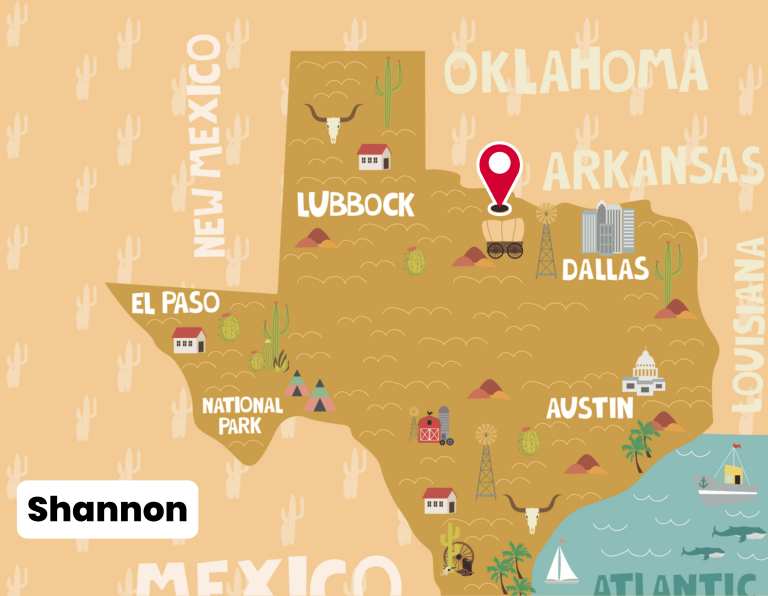
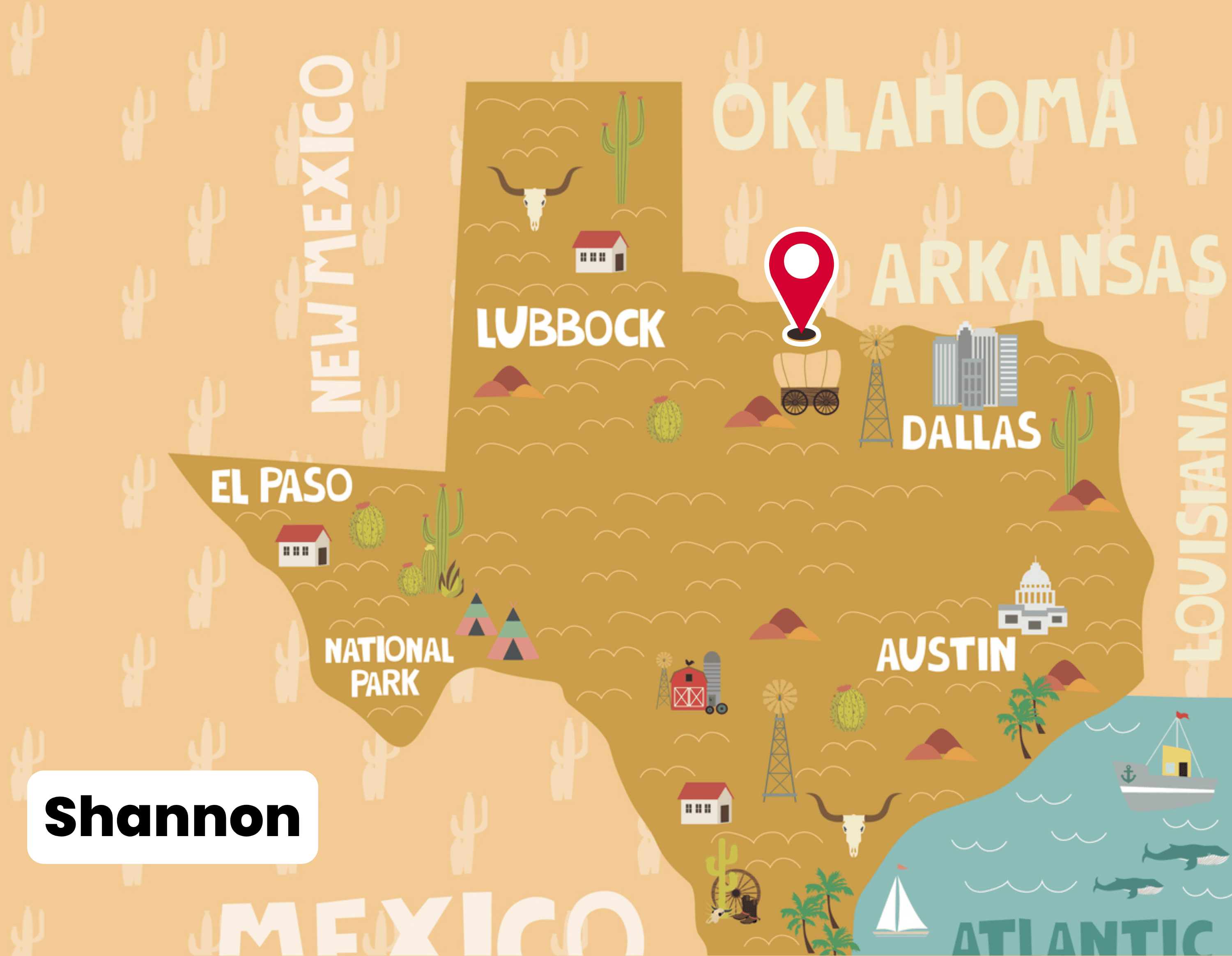
Shannon is a small unincorporated farming community in extreme south-central Clay County, Texas. It lies along Farm-to-Market Road 175, about twenty miles southwest of Henrietta, the county seat. Though its population has always been modest, Shannon has a history that reflects the experiences of many small rural settlements in North Texas.
Founding and Early Growth
The origins of Shannon date to 1878, when Rachel D. Ivie built a general store near a natural spring. The area was initially known as Stampede Springs. As more families moved in, the settlement was renamed Shannon, likely in honor of a pioneer family whose ancestors came from Ireland’s Shannon Valley.
The opening of a post office in 1893 helped establish Shannon as a permanent community. For decades, the post office served as a lifeline, connecting local farmers and families to the wider region.
Education and Community Life
By 1910, Shannon supported a rural school with 82 students taught by only two teachers. This was a remarkable number for such a small settlement and suggests that the surrounding farms were home to many children. Like other rural schools of the era, it likely doubled as a gathering place for meetings, community events, and church services.
Church life was also a visible part of the community. A church building once stood across from the Shannon cemetery, and although the congregation eventually dispersed, the church site remains a landmark tied to the town’s history.
Agriculture and Economy
For much of its existence, Shannon’s residents relied on farming and ranching. Cotton and livestock were the mainstays of Clay County agriculture during the late 19th and early 20th centuries, and Shannon’s economy reflected those broader regional patterns. The general store, post office, and school anchored local life, while families worked the surrounding land.
By the mid-1920s, Shannon’s population reached about 112 residents. At its height, the community included not only the school and store but also a few other businesses, such as a small bank whose vault can still be seen today.
Decline in Population
Like many rural towns, Shannon experienced steady decline after the 1930s. Improved transportation drew trade and services to larger nearby towns, and farm mechanization reduced the need for labor. By the late 1960s, only about 80 residents remained.
From the late 1970s through 2000, the population stabilized at just 23 people. Despite its small size, Shannon endured as a named community, remembered by longtime residents and preserved in county records.
Tornado Events
Severe weather also marks Shannon’s history. On April 2, 1955, a tornado struck the community, though it caused no reported injuries or deaths. Decades later, on May 22, 2020, another tornado passed through or near Shannon before moving toward Joy. Classified as EF-U, it produced no reported damage, but it was noted by storm chasers and the National Weather Service.
Shannon Today
By the early 2000s, Shannon consisted of scattered homes, a church site, a cemetery, and remnants of earlier businesses along FM 175. Though the community no longer functions as a town in the traditional sense, it remains part of Clay County’s cultural and historical landscape. The surviving structures and landmarks tell the story of a settlement that peaked in the early 20th century and then declined, yet never disappeared entirely.
Key Historical Facts
-
Founded: 1878 by Rachel D. Ivie (general store)
-
Original name: Stampede Springs; later renamed Shannon
-
Post office established: 1893
-
School enrollment in 1910: 82 students, 2 teachers
-
Population peak: ~112 in mid-1920s
-
Population decline: ~80 by late 1960s; 23 from late 1970s–2000
-
Severe weather: Tornadoes in 1955 and 2020, no casualties or damage reported
Photos:
Shannon
Map:
Sorry, no records were found. Please adjust your search criteria and try again.
Sorry, unable to load the Maps API.
Clay County
Texas
United States
- Yes—on-leash in public areas; ask before entering private property
- Rural drives, photography of old buildings, birding, chatting with locals
- A small church, general store (if open), public roadside parking on FM 175