
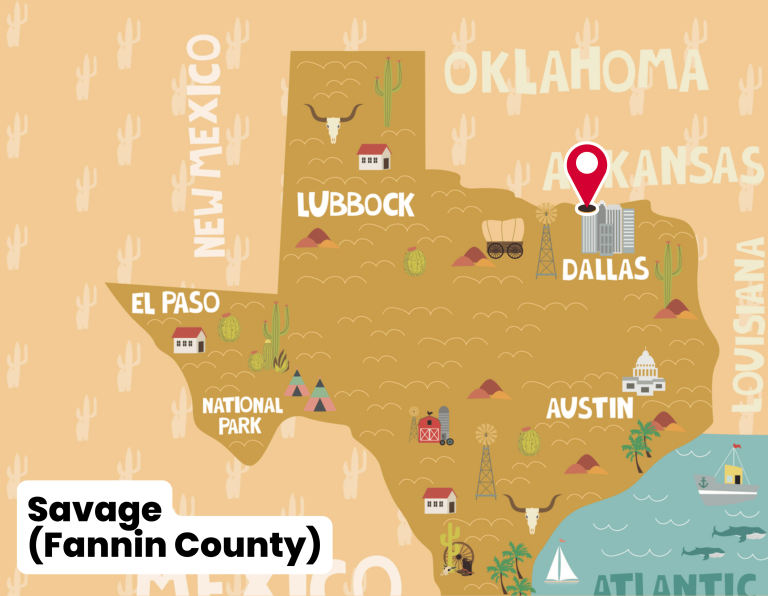
The community of Savage was founded in 1869 when William Hamilton “Uncle Billy” Savage and his wife Elizabeth settled in the area. Savage, a Tennessee native, had moved to Texas after the Civil War. Recognizing the poor road access and the challenges faced by neighboring farming families, the couple opened a small store to provide basic goods and supplies. This store soon became the focal point of the settlement, drawing in nearby families and travelers.
The community took its name from the Savage family, who were among the earliest settlers in this part of southern Fannin County. As was common with small rural settlements in Texas during the late 19th century, the store served multiple purposes, doubling as a meeting point and a hub for trade.
Growth in the Late 19th Century
By the 1870s and 1880s, Savage had grown steadily from a single trading post into a thriving rural community. Farming was the economic backbone, with cotton and corn as the principal crops. To support local agriculture, a cotton gin was established, which gave farmers the ability to process their crops locally rather than hauling them to more distant towns.
The community also expanded with essential services:
-
Post Office – A post office was officially opened in 1891, cementing Savage’s status as a recognized settlement.
-
Blacksmith Shop – Provided vital services to farmers, repairing tools and shoeing livestock.
-
Medical Services – A local doctor practiced in the town, serving both Savage and nearby farm families.
-
Stores – Several small general stores opened, supplying everything from dry goods to farm equipment.
-
School – William Savage himself established a one-room schoolhouse, which became known as Evans School in 1901. The school operated until 1916, when it was consolidated with the larger Leonard Independent School District.
-
Church – A church was built, providing not only a place of worship but also a center for community gatherings.
By the end of the 19th century, Savage was a self-sustaining community, typical of many small rural towns in Texas that flourished before the automobile age.
Peak and Decline in the 20th Century
Savage entered the 20th century as a modest but stable farming community. It supported dozens of families and continued to serve as a hub for trade, education, and worship. However, like many rural Texas towns, Savage’s prosperity was closely tied to the transportation routes of the time.
Following World War I, the town began to decline. As new highways and railroads were built in Fannin County, they bypassed Savage, funneling traffic and commerce into nearby towns like Leonard. Without easy access to larger markets, local businesses could not compete.
The closure of the post office, along with the consolidation of the school in 1916, signaled the town’s gradual fading. Families began moving closer to Leonard and other towns with better opportunities, leaving Savage as little more than a quiet crossroads community.
What Remains Today
Today, very little is left of Savage. Visitors to the area can still find traces of the old school cellar and scattered stone foundations, visible along gravel roads that cut through the farmland where the community once stood.
A Texas Historical Marker, located on State Highway 78 near Leonard, commemorates the history of the town and its founders. This marker is one of the few visible reminders of Savage’s role in Fannin County’s settlement history.
Interesting Facts
-
Founding Family: The community was named for the Savage family, early settlers who established the first trading post and school.
-
Education: The school founded by William Savage was renamed Evans School in 1901 and served the community until its consolidation with Leonard schools in 1916.
-
Community Life: At its peak, Savage included a cotton gin, doctor, blacksmith, general stores, church, and post office, making it a fully functioning rural town.
-
Remnants: Today, only foundations and the school’s cellar remain, along with a historical marker that keeps the memory of the town alive.
Photos:
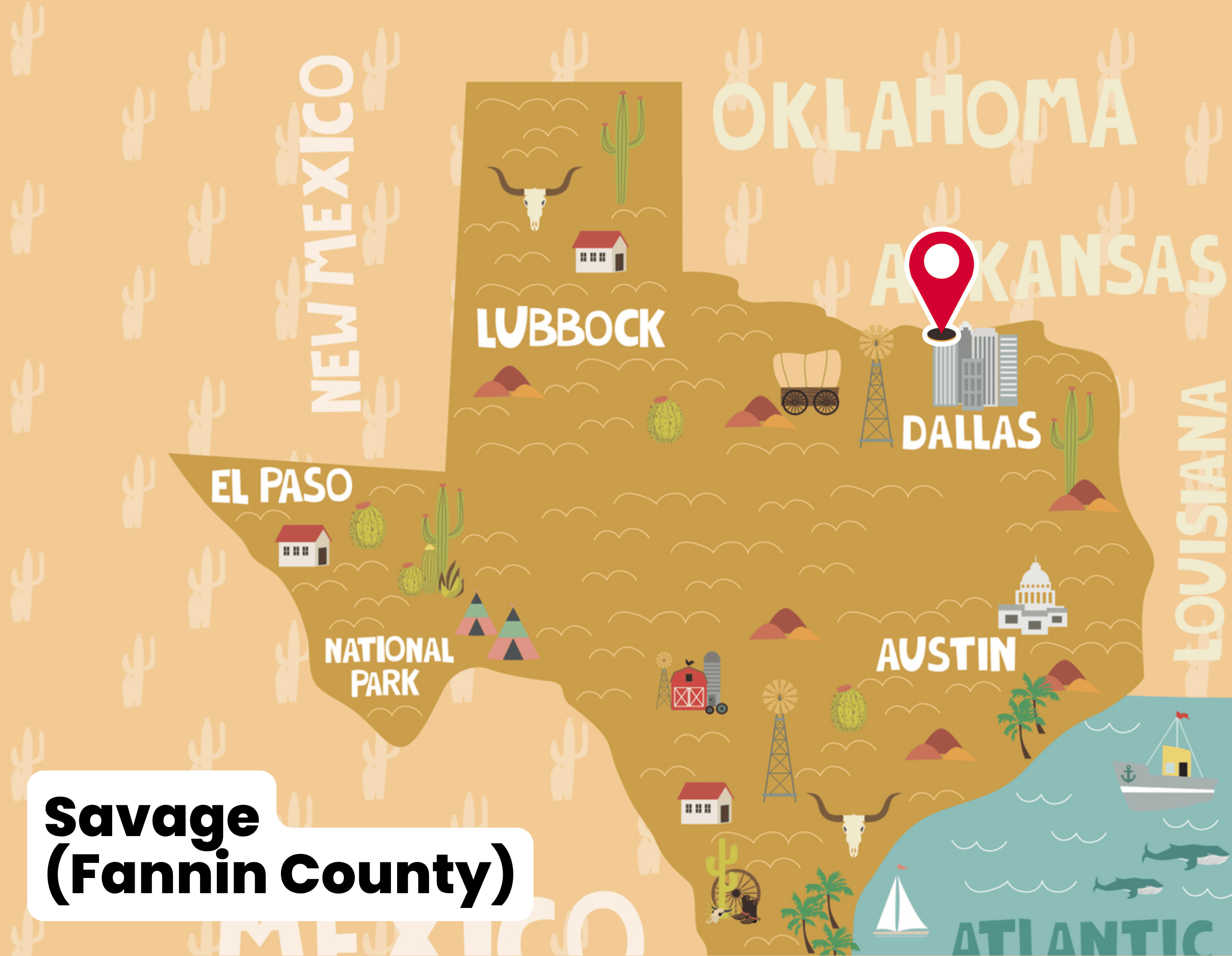
Savage, Fannin County
Map:
Sorry, no records were found. Please adjust your search criteria and try again.
Sorry, unable to load the Maps API.
Fannin County
Texas
United States
- Yes—on-leash, permitted along roadside areas only
- Scenic countryside drives, photography of rural ruins, genealogy/historic research
- None