
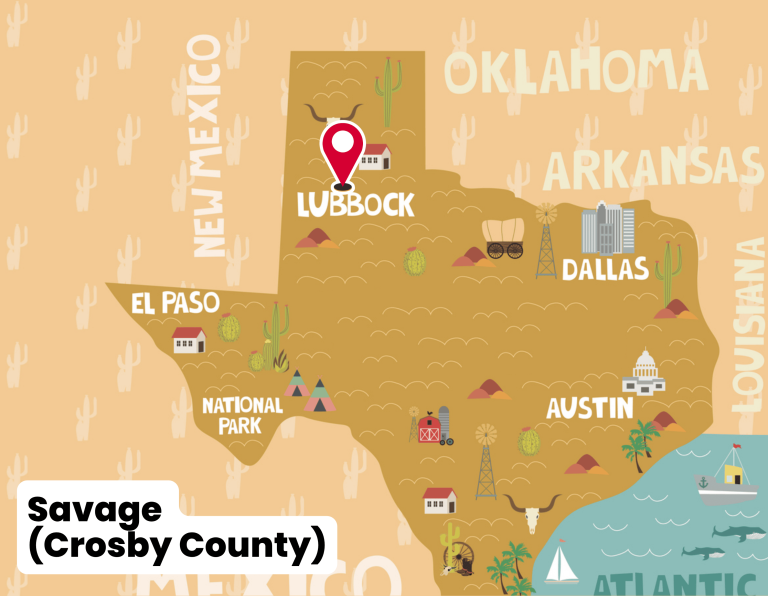
Savage is a former rural community in Crosby County, Texas. It lies along Farm Road 40 about twenty-five miles east of Lubbock. Though little remains today beyond an abandoned cotton gin and scattered residences, the site is still identified on U.S. Geological Survey maps as a “populated place.”
Early History and Settlement
The area that became Savage was settled during the late 19th century, when farming families moved into the South Plains region following the expansion of ranching and the arrival of small agricultural communities. In 1891, a post office was established under the name Savage, marking its recognition as a distinct settlement.
By the early 20th century, the village had developed into a modest but functional center of local life. It included a doctor, a blacksmith shop, several stores, a church, and a school. These institutions supported farm families who worked the surrounding land, much of it devoted to cotton. Cotton farming shaped both the economy and the identity of Savage from its beginning.
The Cotton Gin
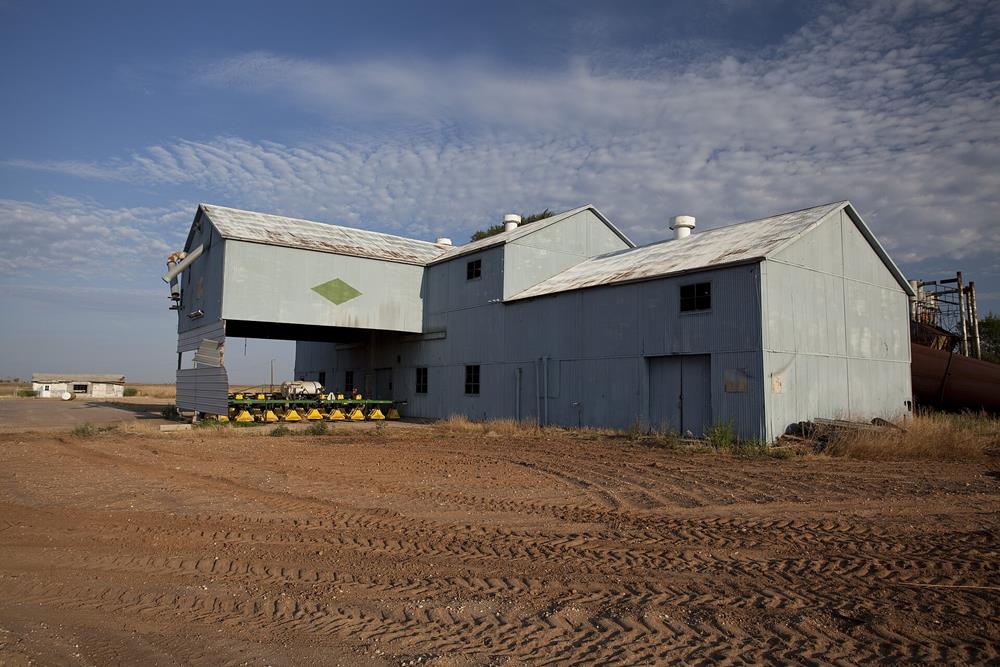
Cotton was the backbone of Savage’s economy. To support local farmers, the first cotton gin was built in 1924 on land owned by E. E. Savage. This facility gave farmers a nearby place to process their crops, reducing the need to haul cotton long distances.
In 1927, the original gin burned down. The following year, C. P. Dean rebuilt it, and the new gin remained the principal business in Savage. The cotton gin not only processed crops but also served as a gathering point for residents. Its operation tied the fortunes of Savage to the cycles of agriculture in Crosby County.
The gin was eventually abandoned, but its structure has endured. Photographs taken in 2011 show the building still standing near the community crossroads, a recognizable landmark even as other features of the town faded away.
Transportation and Decline
The decline of Savage began early in the 20th century. After World War I, new roads were constructed across Crosby County, and Savage was bypassed by these routes. Without direct access to major transportation, commerce and travel shifted elsewhere. This gradual isolation contributed heavily to the loss of population and businesses.
As people moved to larger nearby towns such as Crosbyton, Savage’s institutions closed one by one. The school shut down, the post office was discontinued, and stores and services disappeared. By the mid-20th century, Savage no longer functioned as a self-sustaining community, though some residents remained in the area.
Present-Day Savage
Today, Savage has no operating businesses, post office, or public services. It is still recognized in official records and appears on U.S. Geological Survey maps as a populated place, though in practice it is considered a ghost town. The most visible reminder of its past is the abandoned cotton gin, located near the intersection of Farm Road 40 and local farm-to-market routes.
While the town itself has disappeared, its history reflects a larger pattern seen across rural Texas. Communities that once flourished around agriculture often declined when changes in transportation, economics, and population movement redirected growth to larger centers.
Key Facts
-
Post office: Established in 1891.
-
Community features: Doctor, blacksmith, church, school, stores, cotton gin.
-
Cotton gin history: Built 1924 (E. E. Savage), destroyed by fire in 1927, rebuilt in 1928 (C. P. Dean).
-
Decline: Began after World War I when roads bypassed the community.
-
Current status: No active services; recognized as a “populated place” on maps.
-
Location: Along Farm Road 40, about 25 miles east of Lubbock, Crosby County, Texas.
Photos:
