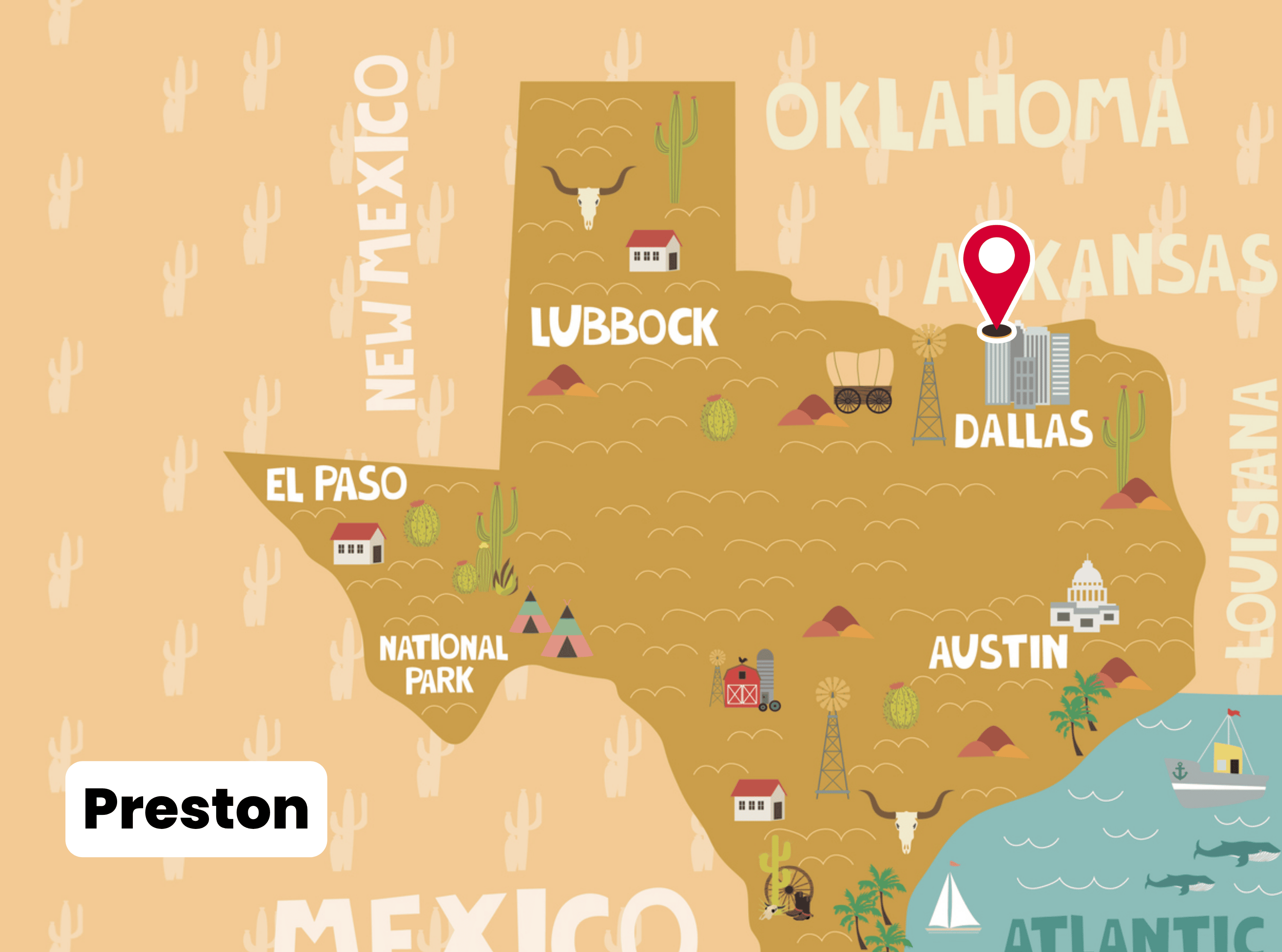
Preston, often called Preston Bend because of its location on a large bend of the Red River, was an early trading and settlement hub in what later became Grayson County, Texas.
Early Settlement and Founding
In the 1830s, trading pioneer Holland Coffee and his partner Silas Cheek Colville established a post on the Red River to facilitate commerce with local tribes and settlers. Coffee’s trading post became one of the earliest centers of Anglo settlement in the area. The location, on a bluff above the river, was ideal for ferry crossings and trade.
In 1845, a townsite called Preston was surveyed and platted. The settlement grew quickly, serving as a major stop for migrants moving into Texas and the Indian Territory (now Oklahoma). Preston became a recognized point of entry into Texas, especially before railroads reached the region.
Growth as a Trading Hub
By the 1850s, Preston was well established as a commercial and travel center. A U.S. post office opened in 1856, anchoring the community’s importance. The town had general stores, blacksmith shops, and multiple ferries crossing the Red River. Its location placed it along the Texas Road (sometimes called the Shawnee Trail), one of the earliest cattle and travel routes through the region. Thousands of settlers, traders, and drovers passed through Preston on their way south.
Decline
Despite its early prominence, Preston never became the county seat. When Grayson County was organized in 1846, the seat was located at Sherman, which drew more settlers and businesses. Preston’s fortunes further declined in the 1870s when the Missouri, Kansas & Texas Railroad (MK&T) bypassed the area. Without direct rail access, much of the trade that had sustained the town shifted elsewhere.
The post office remained until 1914, but by then the town’s population and activity had dwindled. A few farms and residences remained into the 20th century, but Preston was no longer a thriving settlement.
Submersion Under Lake Texoma
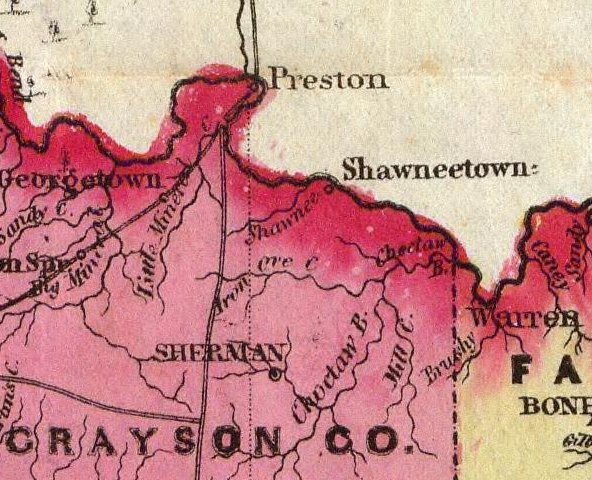
In the late 1930s, the U.S. Army Corps of Engineers began construction of Lake Texoma, created by Denison Dam on the Red River. As the reservoir filled in the early 1940s, much of the original Preston townsite was inundated. Around 1944, when the lake was completed, the low-lying areas of old Preston were submerged.
The Preston Bend Cemetery, containing graves of early settlers and families, was relocated or reinforced on higher ground at Preston Point, where it remains accessible today.
Notable Figures and Legacy
-
Holland Coffee: A trader and early settler, Coffee was influential in Red River frontier life. He later built Glen Eden, a plantation near Preston. He was killed in 1846 during a skirmish at his home.
-
Sophia Suttonfield Coffee: Holland’s widow, who later remarried. While she played a role in frontier society, there is no verified evidence that she acted as a Confederate spy, a claim sometimes repeated without documentation.
-
Strategic Crossing: Preston was one of the most important crossing points on the Red River in the mid-19th century, used by settlers, military expeditions, and cattle drives.
Legacy and Remains
Today, Preston survives only in name. The waters of Lake Texoma cover most of the original townsite. At times of low water, remnants of the old settlement occasionally resurface. The cemetery at Preston Point serves as a reminder of the community’s place in early Texas history.
Photos: