
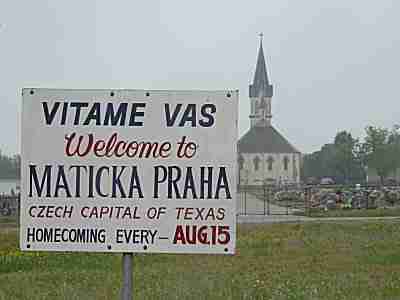
Praha, an unincorporated community in Fayette County, is one of the earliest and most historically significant Czech settlements in Texas. Located near Mulberry Creek, about three miles southeast of Flatonia, the community has been a focal point of Czech culture, Catholic faith, and small-town resilience since the mid-19th century.
Founding and Early Growth
Praha traces its beginnings to the mid-1850s when Bohemian immigrant Mathias (Matej) Novák purchased land in the area. Novak built a home where early Catholic masses were held, drawing together a growing number of Czech settlers.
The settlement was originally known as Mulberry, after the nearby creek. For a time, it carried the nickname “Hottentot”, reportedly because of rowdy activity in the settlement’s early years. In 1858, the settlers formally renamed the community Praha, the Czech word for Prague, in honor of their homeland’s capital city.
By the 1860s and 1870s, Praha had developed into a vibrant center of Czech life in Texas. Families established farms, a Catholic parish, and a school. Small businesses such as general stores, saloons, and blacksmith shops supported the local economy. By the 1880s, sources estimate the population at around 700 residents, making Praha one of the largest and most prominent Czech communities in the region.
Decline After the Railroad Bypass
Praha’s prosperity began to wane in the 1870s when the Southern Pacific Railroad laid its line just north of the settlement. The railroad bypassed Praha and instead created the new town of Flatonia in 1873. Flatonia quickly became the dominant trading and shipping hub, and businesses that once thrived in Praha either closed or relocated.
The community retained its post office until 1906, but afterward mail service was rerouted through Flatonia. Over the 20th century, Praha’s population steadily decreased. Its public and parochial schools both closed in 1973, marking the end of an era when the town sustained its own institutions. By the late 20th century, Praha’s population rarely exceeded 100 residents, though the community remained active in church and cultural life.
St. Mary’s Church of the Assumption
The most enduring symbol of Praha is St. Mary’s Church of the Assumption, one of Texas’s famous Painted Churches. The current limestone church was constructed between 1892 and 1895, replacing earlier wooden structures that had served the parish since the 1860s.
Built in the Gothic Revival style, the church features pointed arches, a tall steeple, and stained glass windows. Inside, the sanctuary is decorated with intricate trompe-l’oeil frescoes painted in 1895 by Swiss-born artist Gottfried (Godfrey) Flury. The artwork includes ornate designs that give the illusion of three-dimensional detail, making the modest country church appear grander than its size.
St. Mary’s remains an active Catholic parish today and attracts visitors from across Texas who come to admire its artistry and to connect with the heritage of the Czech settlers.
Wartime Sacrifice
Praha is also remembered for its extraordinary sacrifice during World War II. Nine young men from the small community lost their lives in service, a loss deeply felt in a town of fewer than 100 people.
This per-capita toll has often been described as among the highest of any community in the United States during the war. The memory of the nine men is preserved in three small roadside chapels near the church and in a pink granite veterans memorial on the church grounds. Every year, the community honors them during Memorial Day observances, drawing visitors from across Texas.
Legacy
Today, Praha is a quiet, unincorporated community. While its population is small, it holds an outsized place in Texas history as one of the state’s earliest and most important Czech settlements.
Its identity centers on St. Mary’s Church of the Assumption, which continues to serve as a parish and as a cultural landmark for Texans of Czech descent. Each August, Praha hosts a large parish picnic and homecoming celebration, attracting descendants of the original settlers and visitors eager to experience Czech food, polka music, and traditional fellowship.
Though the businesses, schools, and larger population have faded, Praha endures as a site of faith, memory, and cultural pride, linking present-day Texans with the 19th-century immigrants who brought their traditions to Fayette County.
Photos:
Praha
Map:
Sorry, no records were found. Please adjust your search criteria and try again.
Sorry, unable to load the Maps API.
Fayette County
Texas
United States
- Yes—leashed pets welcome on church grounds
- Worship services, Czech heritage events (Pražská Pouť each Aug 15), cemetery visits, church interior tours
- St. Mary’s hall (restrooms), picnic area; no general store or hotel
The original uploader was Aida at Czech Wikipedia., Praha texas, CC BY-SA 3.0