
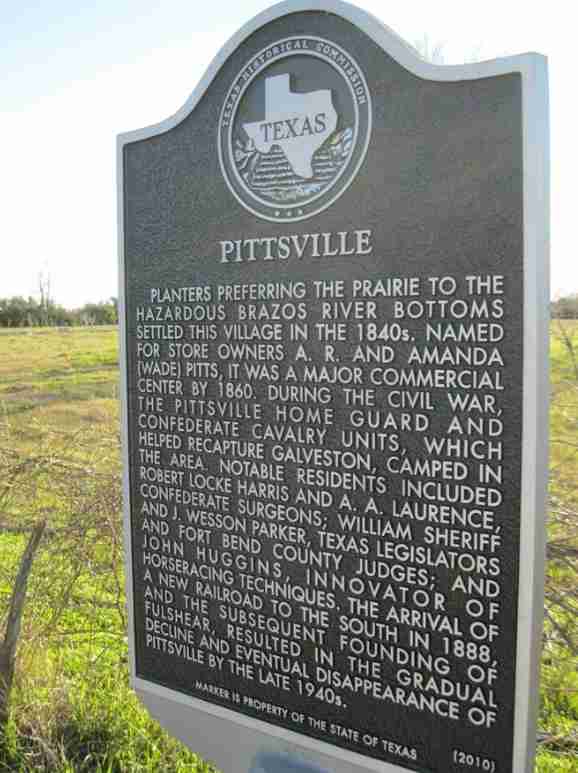
Pittsville was a small community in northern Fort Bend County, located about three miles north of Fulshear at the present-day junction of Farm Road 359 and Hunt-Jordan Road. Although the settlement has disappeared, its story reflects the rise and decline of many rural towns in nineteenth-century Texas.
Origins and Growth
Pittsville developed in the 1840s, when plantation owners sought higher prairie ground to avoid the frequent flooding of the Brazos River bottomlands. The community was named for A. R. Pitts and his wife Amanda (Wade) Pitts, who operated a store and were responsible for mail distribution in the early years.
By the time of the 1860 U.S. Census, Pittsville’s population had reached around 240 residents. It became an important agricultural and commercial center for the surrounding area. Farming and stock raising formed the backbone of the local economy, but the town also supported a broad mix of skilled tradespeople. Occupations included wagoners, carpenters, teachers, brick masons, ministers, engineers, physicians, machinists, and well borers, showing that Pittsville functioned as a self-sufficient settlement.
Institutions and Daily Life
The community built institutions and services typical of a thriving mid-nineteenth-century Texas town. Pittsville boasted a two-story school or academy, general stores, a blacksmith shop, a millinery shop, and even a photographic studio. These businesses reflected the town’s role as both a farming hub and a place where local families could find education and specialized services.
A post office was established on May 31, 1870, with Lucy Upton appointed as the first postmistress. The post office continued until June 15, 1889, when service was discontinued after the town entered its period of decline.
Civil War Period
During the Civil War, Pittsville hosted local Home Guard troops and Confederate cavalry units. According to the official state historical marker, some of these units later took part in the recapture of Galveston in January 1863. The presence of these forces shows the community’s role, however modest, in regional military activity during the conflict.
Decline and Disappearance
The decline of Pittsville began with the arrival of the San Antonio and Aransas Pass Railroad in the late 1880s. The new line bypassed Pittsville in favor of nearby Fulshear, which quickly drew away businesses and residents. Without a railroad connection, Pittsville could not compete economically.
Families gradually left over the next several decades. The last residents, Mrs. Alice (J. R.) Nesbitt and her daughter Doris, moved away in 1947. By then, the town had effectively ceased to exist as a living community.
Present-Day Remnants

Today, little remains of Pittsville. The site is marked by a few visible traces, including an abandoned cistern and a grove of trees. The most prominent reminder is the Texas Historical Marker located on FM 359. The marker commemorates A. R. and Amanda Pitts, the town’s Civil War connections, and the community’s decline after the railroad bypass.
Although Pittsville disappeared as a town, its history reflects the challenges faced by many small Texas communities that flourished briefly in the nineteenth century before vanishing in the twentieth.
Photos: