
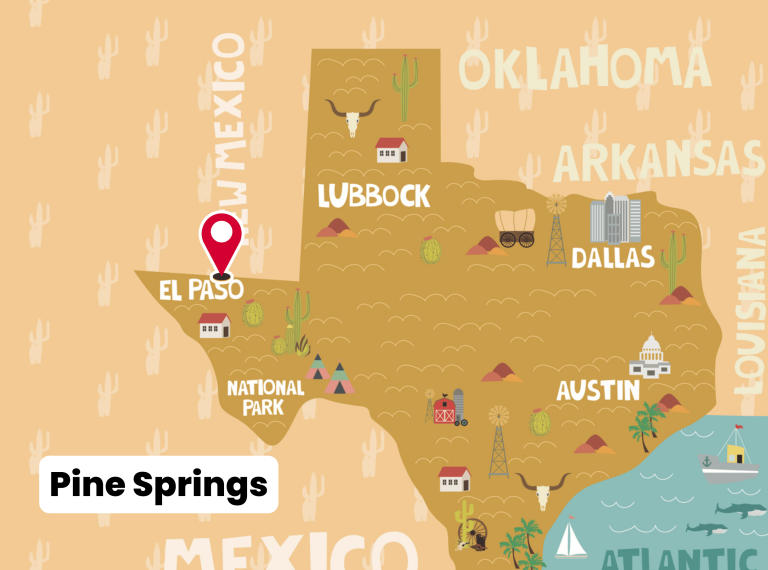
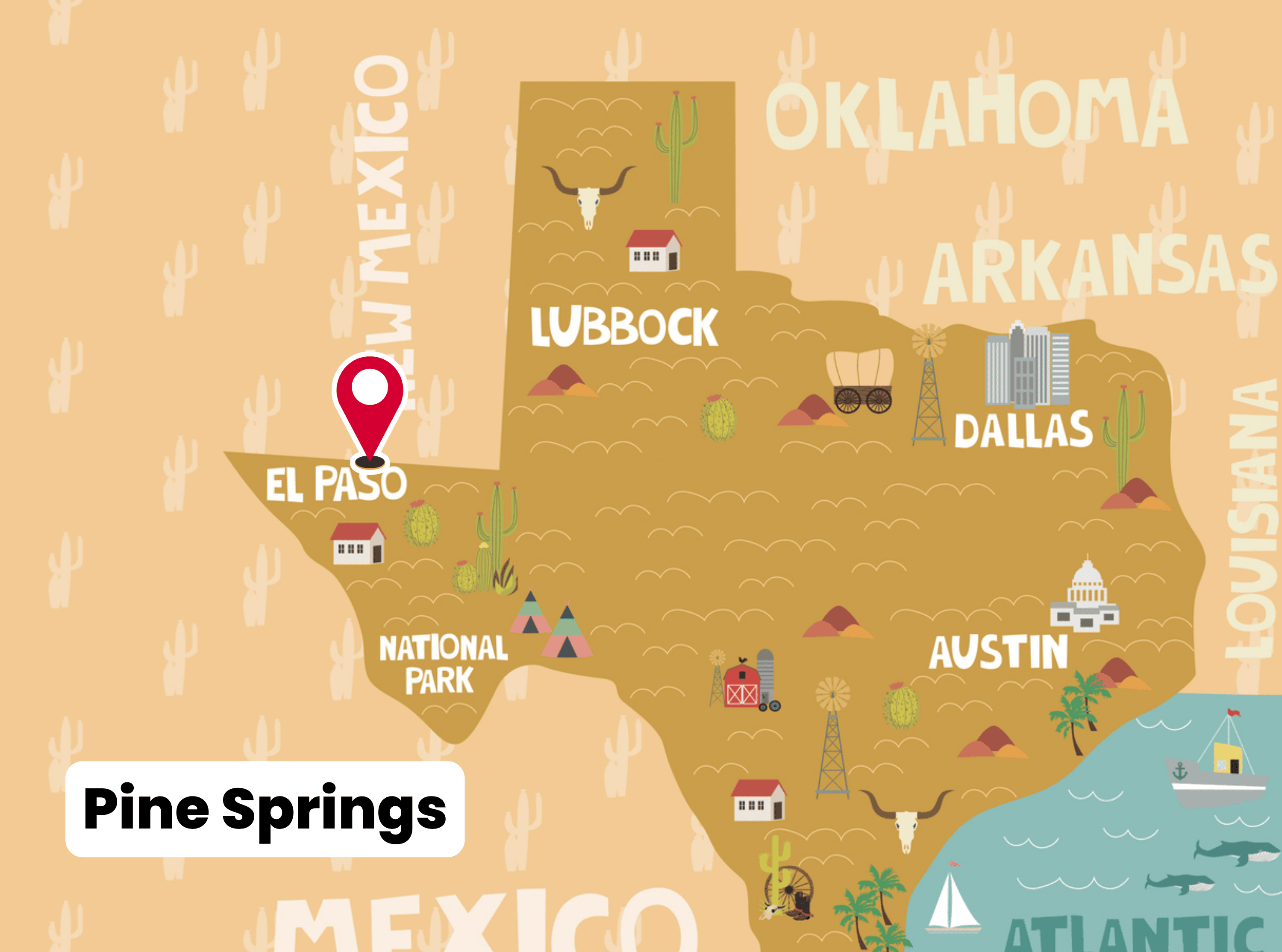
Pine Springs is an unincorporated community in northern Culberson County, Texas, located at the junction of U.S. Highways 62 and 180. It lies about 60 miles north of Van Horn and approximately three miles southeast of Guadalupe Peak, the highest point in Texas. Today, it serves primarily as a small residential and service area for Guadalupe Mountains National Park, but its roots extend back to the mid-19th century.
Early History: The Pinery Station
The earliest recorded development at Pine Springs dates to 1858, when the site became home to The Pinery, also known as Pinery Station. This way station was part of the Butterfield Overland Mail route, which carried passengers and mail across the Trans-Pecos region of Texas. Located along Guadalupe Pass, the station provided fresh horses, food, water, and shelter to stagecoach travelers. The Pinery operated for less than a year before the route was altered in 1859, but the stone ruins of the station remain preserved within Guadalupe Mountains National Park and can be visited via the Pinery Trail.
Ranching Era and the Glover Family
By the early 20th century, the surrounding land was used for ranching. In 1907, Walter Glover settled in the area and eventually purchased property at Pine Springs. With the construction of the El Paso–Carlsbad highway in the late 1920s (now U.S. Highways 62/180), the Glovers adapted to the increase in automobile traffic. In 1928, Walter and his wife Bertha Glover established the Pine Springs Store and Café, which served as a combined grocery, café, gas station, and community center.
Post Office and Community Growth
A post office opened at Pine Springs in 1942 with Bertha Glover as postmistress. It operated only briefly, closing the following year in 1943. Despite its short-lived postal service, Pine Springs developed into a small community. In the mid-1940s, it was recorded as having about 70 residents and three businesses. Through the 1940s and 1950s, it remained a modest but important stop for travelers moving between El Paso and Carlsbad.
Decline and Transition to National Park Service
The population of Pine Springs declined after the 1950s. By the mid-1960s, the number of residents was estimated at only 10. When Guadalupe Mountains National Park was established in 1972, the federal government acquired much of the surrounding land, including the Glover property.
The Pine Springs Store continued to operate for several more years. After Bertha Glover’s death in 1982, the business changed hands but remained in use until it finally closed at the end of 1992. In 1994, the National Park Service removed the remaining structures, leaving little physical trace of the roadside community aside from the historic ruins of The Pinery and remnants of the old stagecoach trail.
Climate and Wind
Pine Springs is known for its windy conditions, due in part to its elevation at the base of the Guadalupe Mountains. Weather stations in the area regularly record strong gusts, sometimes reaching extreme levels during seasonal storms. On March 13, 2019, Pine Springs experienced a peak wind gust of 103 mph during a blizzard, one of the strongest wind events recorded in Texas.
Present Day
Today, Pine Springs serves as the headquarters and main visitor service area for Guadalupe Mountains National Park. The park’s visitor center, campground, and ranger housing are located here. Although the commercial hub of the Glover era no longer exists, the site continues to provide shelter and orientation for modern travelers exploring the mountains, echoing its historic role as a way station more than 160 years ago.
Photos:
Pine Springs
Map:
Sorry, no records were found. Please adjust your search criteria and try again.
Sorry, unable to load the Maps API.
Culberson County
Texas
United States
- Pets are prohibited on most trails in the park—only service animals are allowed
-
Explore the historic Pinery Trail, with interpretive signage about the stage station ruination.
-
Access trailheads for major hikes: Guadalupe Peak, Devil’s Hall, and other scenic routes .
-
Visit the Pine Springs Visitor Center, staffed by rangers, featuring exhibits, a gift shop, and trail info.
-
Visitor Center: Restrooms, water refill station, park information, gift shop .
-
Campground: Desert-style campground near Visitor Center (no hookups).
-
Trails: Numerous hiking routes with reliable signage and ranger support.
-
Note: All former town/service buildings are now removed—amenities are strictly park facilities.