
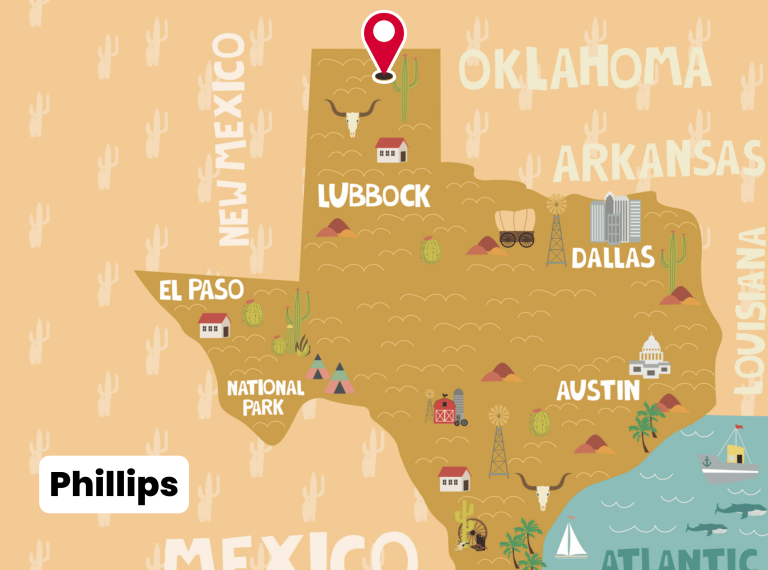
Phillips was a company town in Hutchinson County, Texas, located about three miles northeast of Borger. It developed in the 1920s during the oil boom in the Texas Panhandle and later became one of the best-known oil towns in the region. By the late 1980s, however, the community had been dismantled, leaving behind only memories, historical records, and alumni associations.
Early History and Founding
The area that became Phillips began as two neighboring oil camps. Whittenburg was founded in 1926 by James A. Whittenburg following the discovery of oil in the Panhandle. Nearby, another settlement named Pantex grew alongside the expanding oil industry. In 1938, the two communities voted to merge, and the combined town was renamed Phillips after its major employer, the Phillips Petroleum Company, which dominated the local economy.
Growth and Peak Population
During the 1940s and 1950s, Phillips prospered as oil production and refining in the Panhandle reached peak levels. The company town model provided residents with housing, schools, and community services. By 1947, the population had climbed to about 4,250 residents, its recorded high point. Phillips developed a strong identity as a tight-knit community centered on the oil industry and local schools.
Decline
By the late 1950s and into the 1960s, changes in transportation and commerce began to erode Phillips’s stability. As nearby Borger expanded, many businesses and services relocated there, drawing both customers and residents away from Phillips. This trend gradually weakened the community.
The 1980 Explosion
On January 20, 1980, a hydrocarbon explosion at the Phillips petroleum refinery severely damaged parts of the industrial plant and nearby residential areas. The blast marked a turning point in the town’s history. Although some people continued to live there for a few more years, the disaster led to legal battles, corporate land acquisitions, and mounting safety concerns.
In the aftermath, Phillips Petroleum gradually acquired property in the town. Homes were bought out or condemned, and residents were relocated. By the late 1980s, the residential community was dismantled, and Phillips ceased to exist as an inhabited town.
Education and School Consolidation
The Phillips Independent School District was an important part of the community’s identity. In 1987, it merged with the Plemons and Stinnett districts to form the Plemons-Stinnett-Phillips Consolidated Independent School District. This merger preserved the legacy of Phillips in local education even after the town itself disappeared.
Athletics
Phillips High School gained statewide recognition in athletics, particularly in football. Known as the Phillips Blackhawks, the team won the Class 2A state championship in 1954, defeating Killeen 21–13. This achievement remains one of the town’s proudest moments and is still remembered by alumni.
Notable Residents
Several prominent figures spent their formative years in Phillips:
-
Mary Castle, actress best known for 1950s television and film roles, lived in Phillips as a girl and attended school there.
-
Max Sherman, who went on to serve as Texas State Senator and later as president of West Texas State University (now West Texas A&M University), grew up in Phillips and graduated from its high school.
Legacy
Although Phillips no longer exists as a residential town, its history is preserved through alumni associations, local histories, and records in the Handbook of Texas. Former residents often describe it as a unique example of a Texas oil company town that rose quickly during the boom years of the mid-20th century and disappeared just as dramatically after industrial decline and disaster.
Photos:
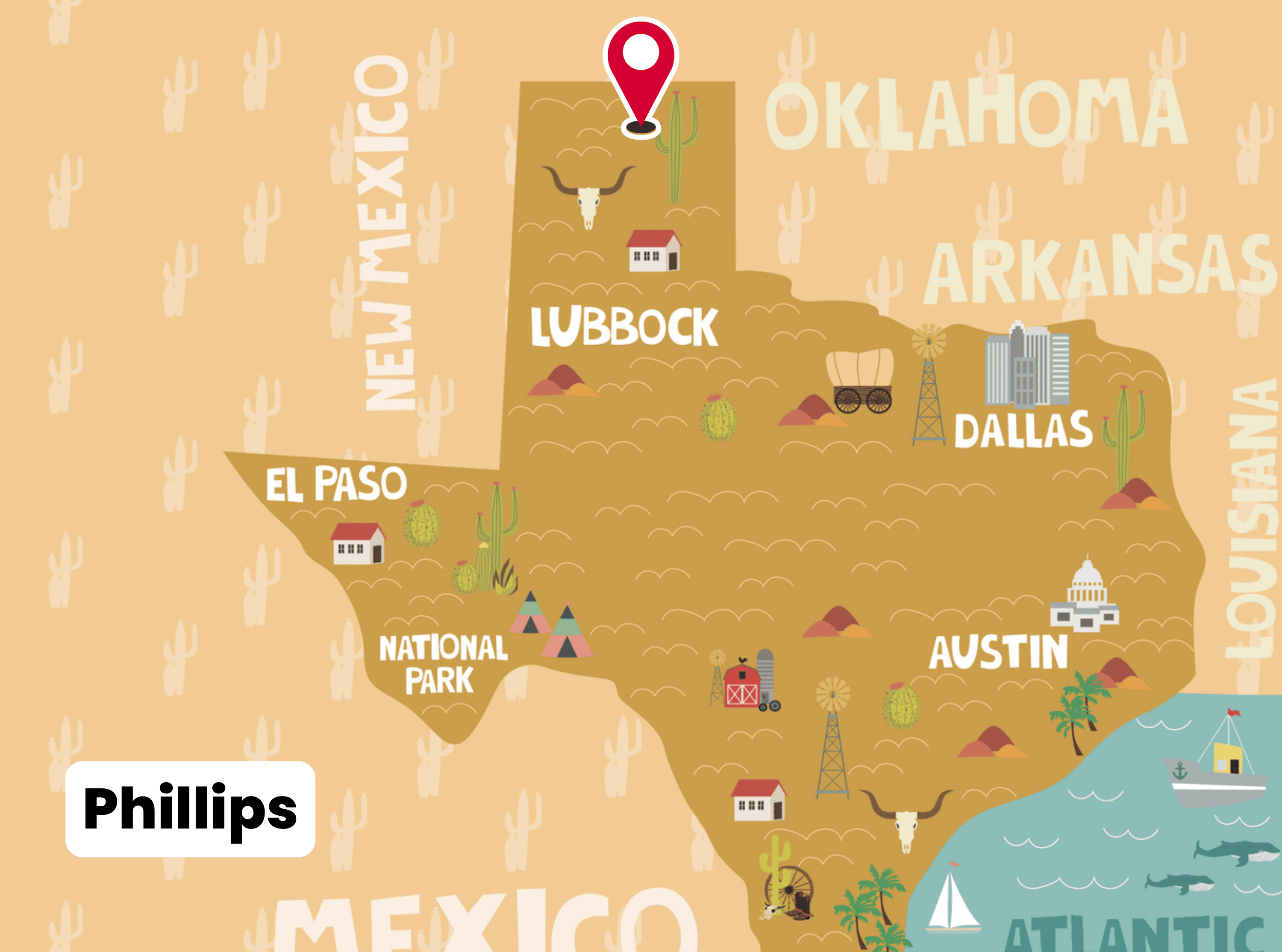
Phillips
Map:
Sorry, no records were found. Please adjust your search criteria and try again.
Sorry, unable to load the Maps API.
Hutchinson County
Texas
United States
- Not applicable – site is closed/industrial
- None – no public access
- None – only industrial/rail infrastructure remains