
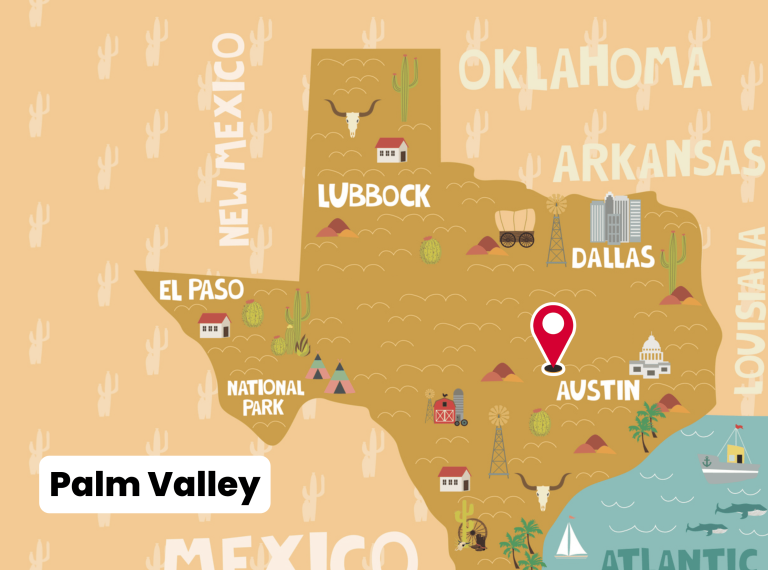
Palm Valley was established in 1853 when Anna (Andersdotter) Palm, a Swedish widow, and her six sons settled along Brushy Creek in what is now Williamson County. The family and other Swedish immigrants created a farming community just east of Round Rock, near present-day U.S. Highway 79. Palm Valley became one of the earliest Swedish settlements in central Texas, laying the foundation for a distinct ethnic and agricultural community.
The Church and Community
The first Swedish Lutheran congregation in Palm Valley was organized in 1870 under the name Swedish Evangelical Lutheran Brushy Congregation. The settlers initially met in homes, but a log structure was soon built to serve as both a church and a school. In 1872, a second building was constructed, and it too hosted both worship services and classes for local children. By 1896, the congregation dedicated a larger Gothic Revival style sanctuary, which still stands today as Palm Valley Lutheran Church. It has been recognized as a Recorded Texas Historic Landmark. The church long functioned as the social, spiritual, and cultural center of the Palm Valley community.
The Palm House
One of the most enduring pieces of Palm Valley’s history is the Andrew J. Palm House, built in 1873 by Anna Palm’s son, Andrew. The house is the oldest Swedish-American structure in Round Rock. In 1976, the home was relocated to downtown Round Rock and opened to the public as the Palm House Museum, preserving the story of early Swedish immigration and farm life in Texas. The house is designated as a Recorded Texas Historic Landmark. The museum operated for several decades before closing in 2019, though the building itself remains an important historic site.
Decline and Incorporation into Round Rock
Through the late 19th and early 20th centuries, Palm Valley thrived as a small Swedish farming community with homes, farms, and family life centered around the church and school. However, as Round Rock expanded, Palm Valley gradually lost its independent character. By the early 2000s, the school had closed and the community had largely been absorbed into the city of Round Rock. Today, Palm Valley is considered a historic area within Round Rock rather than a separate community. Its legacy survives in its landmarks and in the preservation of local history.
Key Facts
-
1853 – Anna Palm and her six sons settle Palm Valley, establishing a Swedish farming community.
-
1870 – The Swedish Evangelical Lutheran Brushy Congregation is organized.
-
1872 – A new church building is completed, also serving as a school.
-
1873 – Andrew J. Palm builds a family home, later moved and preserved as the Palm House.
-
1896 – Present Palm Valley Lutheran Church dedicated; now a Recorded Texas Historic Landmark.
-
1976 – The Palm House is relocated to Round Rock and opened as a museum.
-
2019 – The Palm House Museum closes, though the building remains standing as a landmark.
Photos:
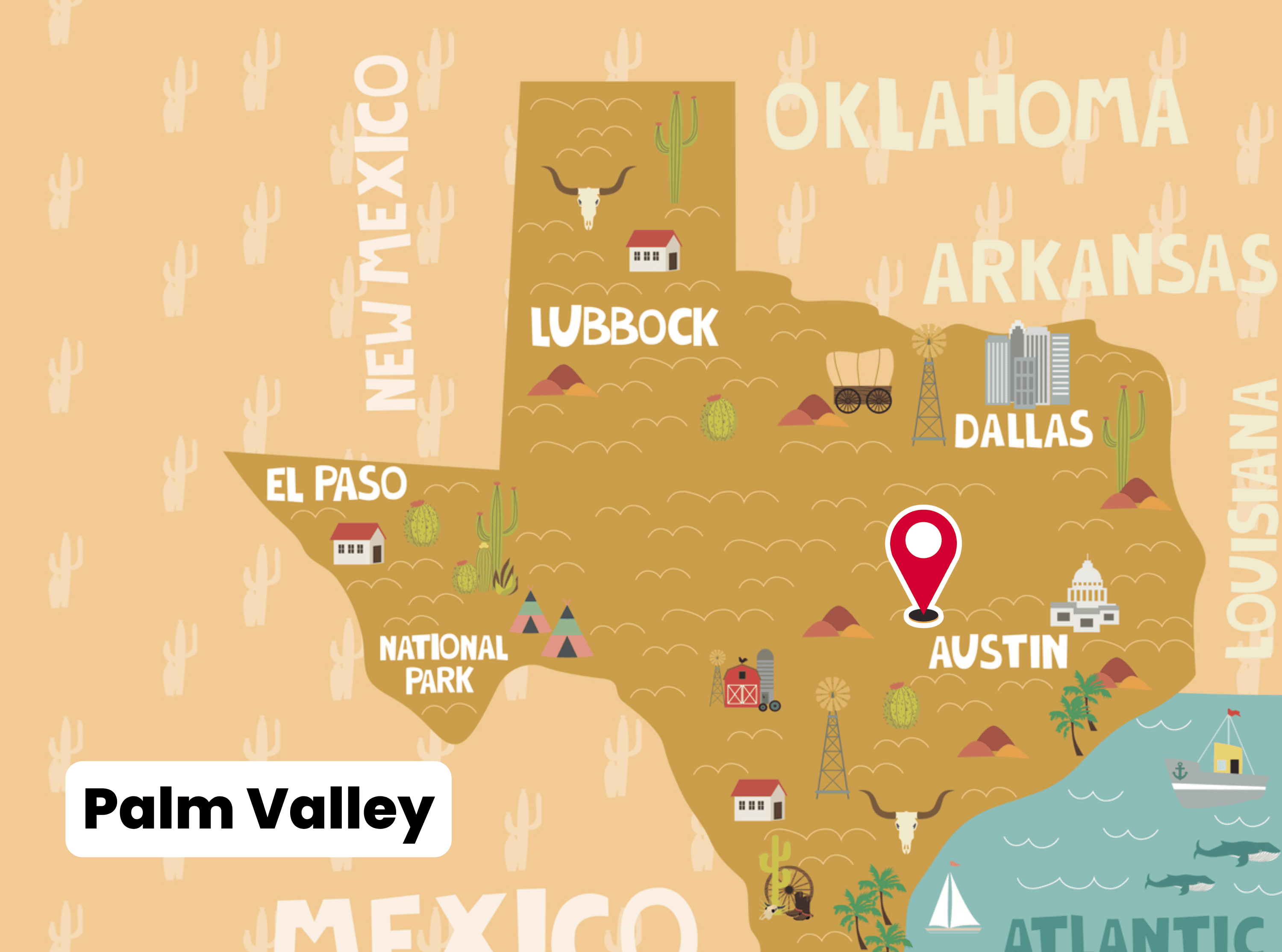
Palm Valley
Map:
Sorry, no records were found. Please adjust your search criteria and try again.
Sorry, unable to load the Maps API.
Williamson County
Texas
United States
-
Leashed pets are welcome along public sidewalks and outdoor spaces in the area.
-
Private properties should be respected; seek owner consent before entering. Check with church or local property owners for pet rules
-
Historic walking/driving tour: explore the church, former museum site, and community markers along Palm Valley Blvd. Self-guided exploration is possible; there is no confirmed official tour program (unless otherwise noted).
-
Photography: capture the church, farmhouse architecture, and merging of rural heritage with suburban growth.
-
Heritage education: learn about early Swedish settlers in central Texas and their cultural legacy.
-
Community events: Round Rock occasionally hosts cultural or heritage events related to Palm Valley history.
-
On-site:
-
Palm Valley Lutheran Church (historic landmark)
-
Public sidewalks and street signage
-
-
Nearby: Round Rock offers restaurants, retail, lodging, and services along nearby Sam Bass Road and I‑35.