
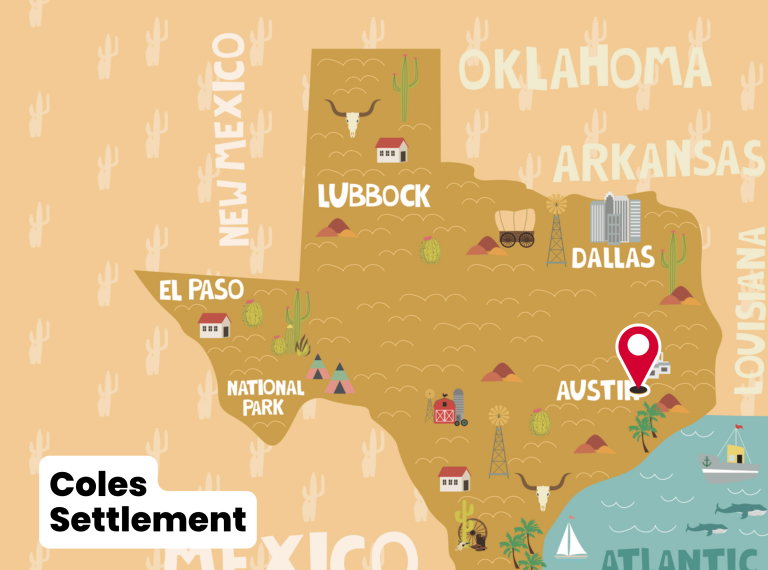
Coles Settlement was one of the earliest Anglo-American communities established in what is now Washington County, Texas. The area was founded in 1824 by John Prince Coles, a member of Stephen F. Austin’s “Old Three Hundred”. Coles was granted land by the Mexican government as part of Austin’s first colony, and his cedar log cabin became the focal point around which the community developed.
The settlement was strategically located in the fertile Brazos River valley, a region that attracted many settlers during the early 1820s. The surrounding area soon filled with other families from the United States, many of whom were part of Austin’s colonization efforts under Mexican authority. Coles’s home became a gathering place for settlers, and by the 1830s, the community was informally known as Coles Settlement.
The Transition to Independence
In 1836, as Texas declared its independence from Mexico, the residents of Coles Settlement decided to rename their community Independence to commemorate the new Republic of Texas. The renaming reflected the patriotic spirit of the time and the settlers’ role in shaping the early Republic. Independence quickly became a cultural and educational center for the surrounding area.
Its central location between Houston and Austin made it a convenient stop for travelers and traders, helping it grow into a thriving town through the 1840s. By the mid-19th century, Independence had established itself as a significant hub in Washington County and a symbol of early Anglo-Texan settlement.
Baylor University and the Town’s Growth
In 1845, Independence gained distinction as the original home of Baylor University, the first institution of higher learning chartered by the Republic of Texas. Baylor was founded by the Texas Baptist Education Society, led by Rev. William Milton Tryon and Judge Robert Emmett Bledsoe Baylor. The university opened its doors in 1846, with separate campuses for men and women.
The men’s department was located on the south side of the town, while the women’s department, known as Baylor Female College, operated nearby. The town soon became known as a center of education, religion, and culture in central Texas.
In addition to Baylor, the town hosted several churches, schools, and businesses that served the growing population. For a time, Independence was considered one of the most important towns in Texas, home to educated professionals, ministers, and merchants who contributed to the early intellectual life of the state.
Sam Houston’s Connection
Sam Houston, one of the most prominent figures in Texas history, lived in Independence with his wife Margaret Lea Houston between 1853 and 1858. The Houston family resided in a modest home near the town center. In 1854, Sam Houston was baptized in Little Rocky Creek, located nearby, a significant event in his personal and spiritual life.
The Houstons were active members of the Baptist community in Independence, attending services and participating in local civic life. Their residence further enhanced the town’s reputation as a place of influence and leadership during the mid-19th century.
Decline of Independence
Despite its early success, Independence began to decline after the 1870s. The main reason was the railroad bypass, which diverted trade and travel to newer towns like Brenham and Burton. According to local accounts, town leaders and Baylor trustees refused to grant a right-of-way to the Santa Fe Railroad, fearing it would disrupt the peaceful academic environment. This decision proved costly, isolating Independence from the expanding transportation network that fueled growth across Texas.
By the 1880s, both divisions of Baylor University had left the town. The men’s department relocated to Waco in 1886, merging with Waco University, while the women’s department moved to Belton, where it became Mary Hardin–Baylor College (now the University of Mary Hardin–Baylor). With the loss of its educational institutions and limited access to trade routes, Independence’s economy and population steadily dwindled.
Independence Today
Today, Independence, Texas, is an unincorporated community known for its preserved historical sites and quiet rural charm. Though often described as a “ghost town,” it continues to draw visitors interested in early Texas history. Many of its historic buildings and ruins, including the Baylor University historic sites, Houston-Lea House, Old Independence Cemetery, and ruins of Baylor Female College, remain open to the public.
The community’s role in Texas history is commemorated by historical markers and preservation efforts supported by local organizations and the Texas Historical Commission. Independence stands today as a reminder of the early settlers who helped shape Texas, the growth of education in the Republic, and the changing fortunes of small towns during the age of the railroad.
Photos:
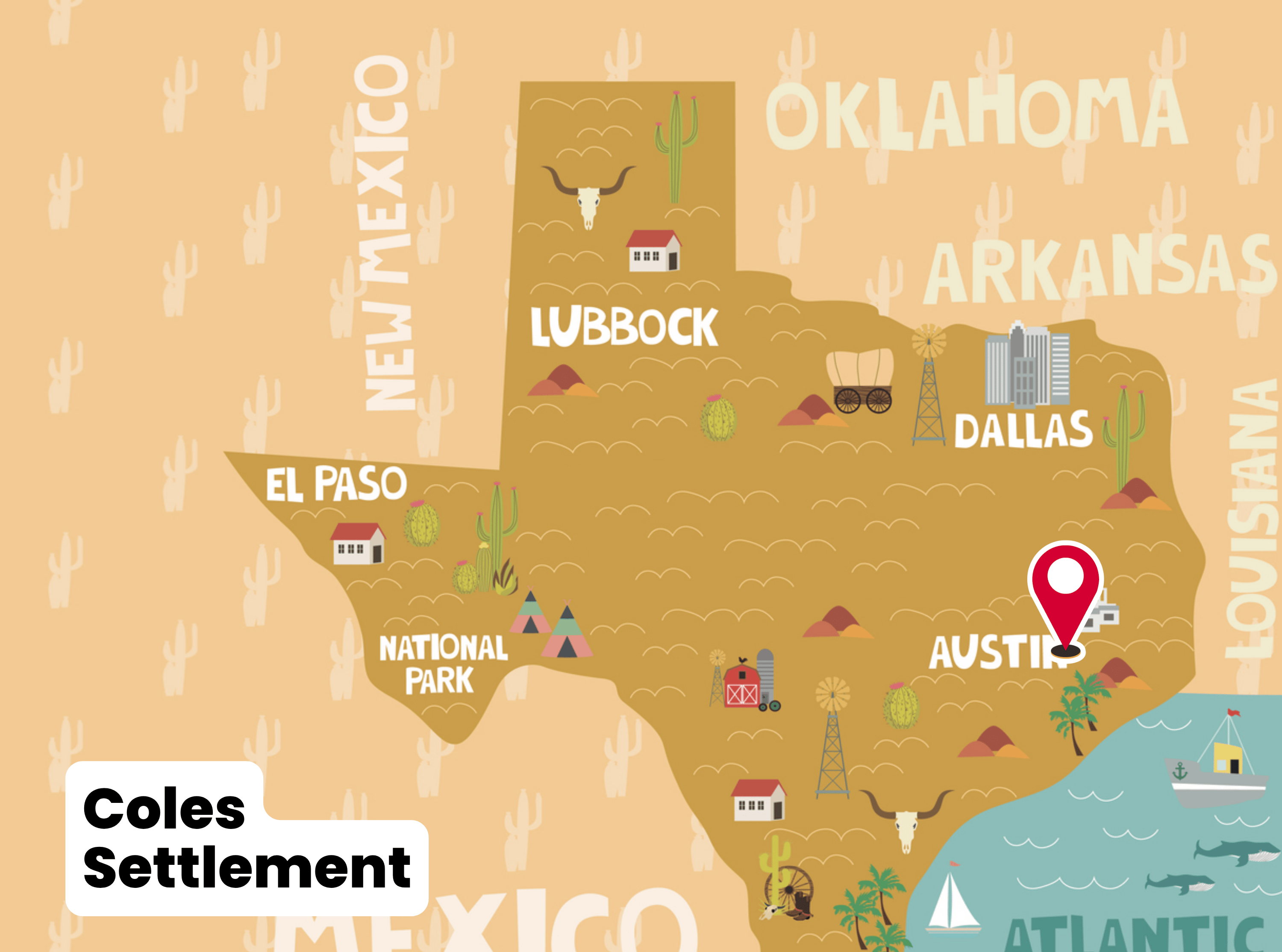
Coles Settlement
Map:
Sorry, no records were found. Please adjust your search criteria and try again.
Sorry, unable to load the Maps API.
Washington County
Texas
United States
- Not applicable; no public facilities
- Historical exploration (note: access may be restricted due to private ownership)
- None