

Baker Cave is an important prehistoric rock shelter located in Val Verde County, Texas, near the Devils River in the Lower Pecos Canyonlands. Positioned well above the river’s floodplain, the cave’s dry environment has helped preserve fragile organic materials that rarely survive elsewhere. The shelter measures roughly 120 feet in length and 56 feet in depth, with a ceiling that rises about 18 feet at the entrance and narrows toward the back. Its natural protection from the elements has made it a key site for studying early human life in the region.
Archaeological Significance
Excavations have shown that Baker Cave was used by hunter-gatherers during the Late Paleoindian and Early Archaic periods. Radiocarbon dating from charcoal samples and hearth features indicates human activity as early as around 9,000 BCE. This makes it one of the oldest known habitation sites in Texas and an important benchmark for understanding early occupation in the Lower Pecos area.
Archaeologists uncovered layers of sediment containing stone tools, faunal remains, and plant materials that reflect thousands of years of use. Among the most notable artifacts is a Golondrina projectile point, a distinctive tool type associated with the transition between the Paleoindian and Archaic periods. This discovery provides evidence that Baker Cave’s earliest residents belonged to groups adapting to changing climates and food sources at the end of the Ice Age.
Evidence of Daily Life
The cave’s hearths and refuse deposits reveal much about how its inhabitants lived. Burned animal bones from snakes, fish, small mammals, and birds were found alongside charred seeds, nuts, and other plant materials. These remains show that the people who lived here relied on a broad diet of both wild plants and animals. The presence of grinding stones and fire pits suggests that food processing and cooking were regular activities within the shelter.
Excavators also identified spatial organization inside the cave, with separate areas likely used for cooking, toolmaking, and sleeping. The combination of hearths, stone tools, and food remains paints a vivid picture of a well-used seasonal camp rather than a brief stopover.
Research and Excavations
Initial investigations at Baker Cave began in 1962, conducted by the University of Texas Archaeology Research Laboratory. Later, in 1976, the University of Texas at San Antonio’s Center for Archaeological Research carried out more extensive excavations. The findings from these projects helped define the cultural sequence of the Lower Pecos region and contributed to broader research on how prehistoric peoples adapted to arid environments.
The site’s exceptional preservation has made it a reference point for archaeologists studying the early inhabitants of Texas. Its layers continue to provide valuable information about ancient lifeways, environmental change, and the long human presence in the Pecos River basin.
Photos:
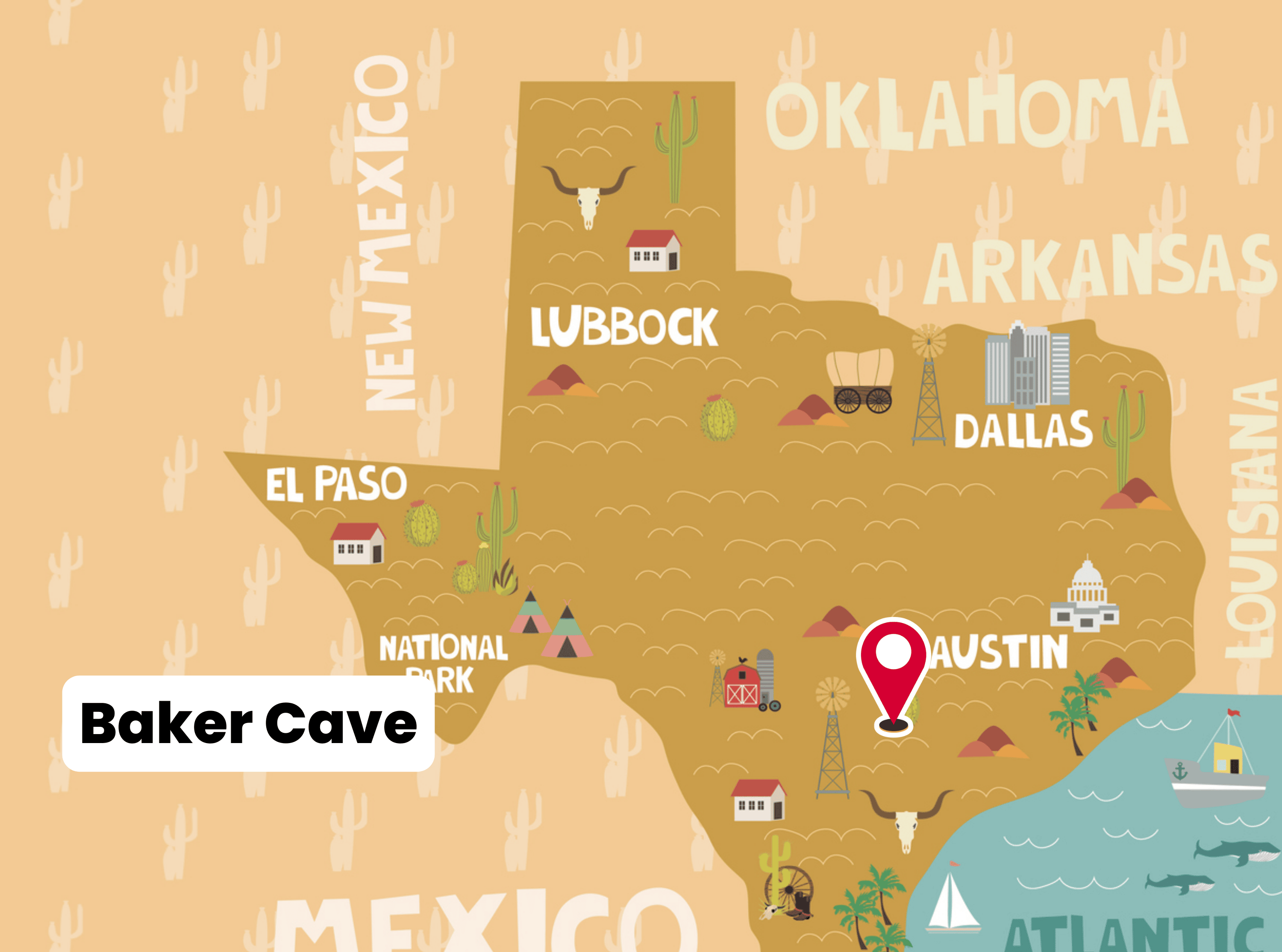
Baker Cave
Map:
Sorry, no records were found. Please adjust your search criteria and try again.
Sorry, unable to load the Maps API.
Val Verde County
Texas
78840
United States
No
- Guided cave tours
- Caving and spelunking
- Wildlife observation
- Parking area
- Restrooms
- Picnic areas