
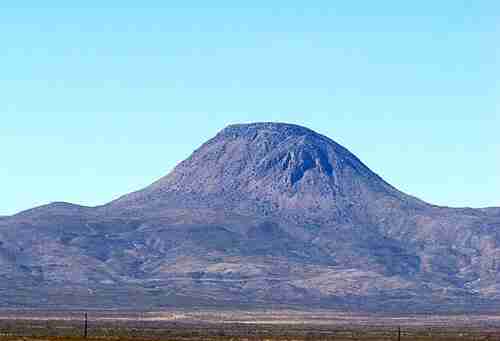
Santiago Peak is the highest point in the Santiago Mountains of central Brewster County, Texas. Rising to an elevation of 6,524 feet (1,989 meters), it ranks eighth in topographic prominence among all peaks in the state. The summit rises dramatically above the surrounding desert terrain, standing out as a defining landmark within Big Bend country. From many points along State Highway 118, the peak’s profile is a familiar sight against the vast Chihuahuan Desert landscape.
Geology and Formation
The mountain’s striking shape comes from its composition and geologic history. Santiago Peak is primarily made of syenite, a coarse-grained igneous rock similar to granite but with less quartz. This material formed as magma intruded into older Cretaceous limestone around 35 million years ago during the region’s period of volcanic and tectonic activity. Over time, erosion stripped away the softer limestone, leaving behind the more resistant syenite mass that forms today’s peak. The feature is classified as an igneous intrusion rather than a volcano, meaning it solidified underground without erupting to the surface.
Landscape and Environment
Santiago Peak lies within the northern portion of the Chihuahuan Desert, one of North America’s largest and most biologically diverse arid regions. The slopes and foothills support a variety of hardy desert vegetation, including creosote bush, lechuguilla, prickly pear, and ocotillo. In sheltered canyons and higher elevations, live oak and mesquite trees appear among patches of grasses and shrubs. The area experiences wide temperature swings between day and night, typical of the desert climate, and receives most of its rainfall during summer monsoon storms.
Cultural and Historical Notes
For centuries, Santiago Peak served as a landmark for Indigenous peoples who lived and traveled throughout what is now West Texas. Local accounts and historical notes indicate that Apache groups once used the summit as a lookout point due to its broad visibility across the desert. The name “Santiago” has several origin stories. Some say it honors Saint James (Santiago in Spanish), the patron saint of Spain, while others attribute it to a Spanish soldier’s son or possibly an Apache chief named Santiago. Though these stories vary, all reflect the blend of Native and Spanish influences that shaped the region’s cultural history.
Modern Significance
Today, Santiago Peak remains a striking feature of Brewster County’s rugged landscape. Its steep rise of more than 2,400 feet (about 730 meters) over a short horizontal distance makes it one of Texas’s most visually impressive mountains. Hikers and travelers along Highway 118 often use it as a natural reference point while crossing the desert toward Big Bend National Park. The mountain stands as a symbol of the region’s unique mix of geology, ecology, and heritage—an enduring high point both literally and historically in the Big Bend area.
Photos:
Santiago Peak close-up
Map:
Sorry, no records were found. Please adjust your search criteria and try again.
Sorry, unable to load the Maps API.
Alpine
Texas
79830
United States
- Hiking and climbing (with landowner permission)
- Photography of desert landscapes
- Study of geological formations
- Observation of desert flora and fauna
There are no public amenities available at Santiago Peak. Visitors must be self-sufficient and prepared for backcountry conditions.
Idawriter, Santiago Peak close-up - panoramio - Idawriter, CC BY-SA 3.0