
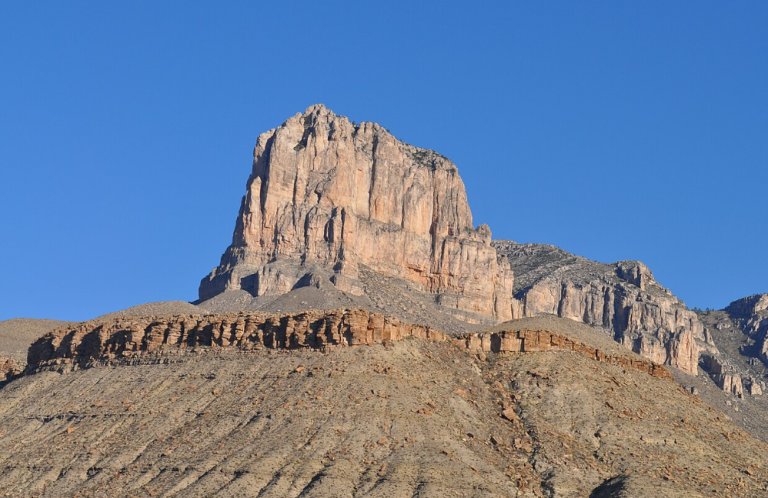
El Capitan rises proudly within Guadalupe Mountains National Park in West Texas. With an elevation of 8,085 feet (2,464 meters), it ranks among the highest peaks in the state, standing just below the summit of nearby Guadalupe Peak, Texas’s highest point. The mountain’s striking limestone face towers above the Chihuahuan Desert, creating one of the most recognizable silhouettes in the region. Visible for miles, it has long served as a natural landmark for travelers crossing this rugged stretch of desert.
Geological Significance
El Capitan is part of the ancient Capitan Reef, a massive fossilized reef that formed during the Permian Period roughly 260 million years ago. At that time, a shallow inland sea known as the Delaware Basin covered much of the area. Over millions of years, layers of marine life built up, eventually hardening into limestone and dolomite. When the basin’s waters receded, tectonic activity lifted the reef, exposing its dramatic cliffs and steep slopes. Today, the Capitan Reef remains one of the world’s best-preserved examples of a fossilized reef system, offering scientists valuable insight into early marine ecosystems and geological processes.
Cultural and Historical Importance
For centuries, El Capitan has been a vital landmark in the arid landscape of West Texas. Indigenous peoples of the region, including the Mescalero Apache, regarded it as a guidepost during seasonal migrations. Later, Spanish explorers, ranchers, and stagecoach travelers also relied on its distinctive profile to navigate the desert. During the 19th century, the Butterfield Overland Mail route passed nearby, and El Capitan stood as a visible point of reference for those making the difficult journey across the American Southwest.
Ecology and Modern Significance
The Guadalupe Mountains, including El Capitan, host an array of desert and mountain ecosystems. Lower elevations are home to creosote bush, agave, and yucca, while higher slopes support pinyon pine, juniper, and mountain mahogany. Wildlife such as mule deer, golden eagles, and black bears inhabit the area. Today, El Capitan draws hikers, photographers, and geology enthusiasts who are captivated by its rugged beauty and the sweeping desert views it offers. Though climbing to its summit is challenging, the nearby Guadalupe Peak Trail provides panoramic vistas of El Capitan’s sheer cliffs and the surrounding desert expanse.
Photos:

El Capitan
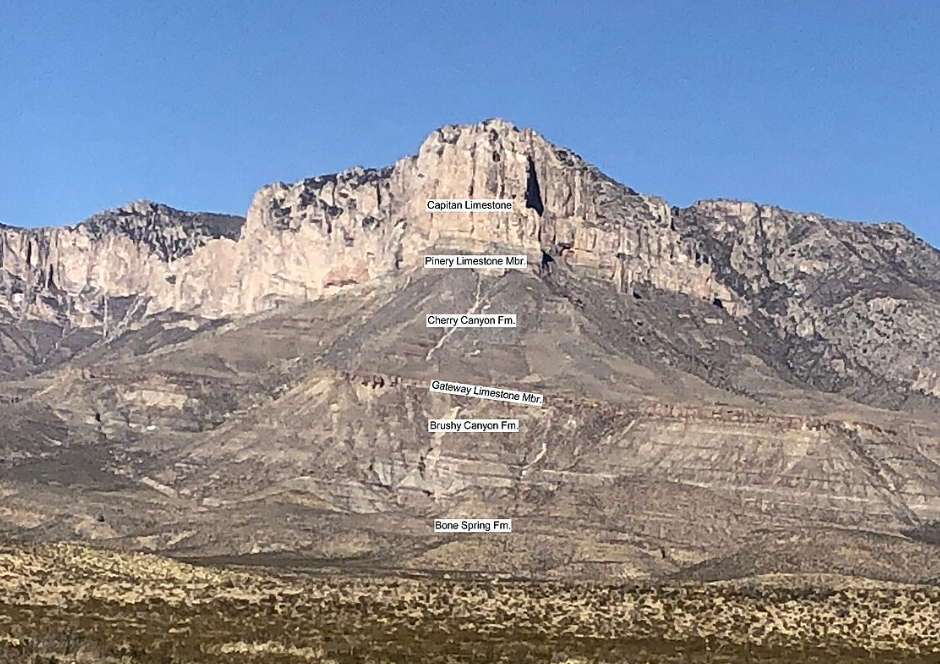
Labeled strata making El Capitan
Map:
Sorry, no records were found. Please adjust your search criteria and try again.
Sorry, unable to load the Maps API.
Houston
Texas
79847
United States
Pets are permitted in campgrounds, picnic areas, and along roads, but they are not allowed on trails, in the backcountry, or in park buildings.
-
Hiking: While there is no formal trail to the summit of El Capitan, experienced hikers can reach the peak by traversing from Guadalupe Peak via the connecting ridge. This route requires technical climbing skills and should only be attempted by well-prepared individuals. NPS.gov+1NPS.gov+1
-
Wildlife Observation: The park's diverse habitats support a variety of wildlife, including mule deer, mountain lions, and numerous bird species, making it a great destination for wildlife enthusiasts.
-
Photography: The striking landscapes, especially around sunrise and sunset, offer excellent opportunities for photography.
-
Visitor Center: Provides information, exhibits, and restrooms to enhance your visit.
-
Picnic Areas: Equipped with tables and grills, perfect for family outings.
-
Campgrounds: Pine Springs Campground offers sites with picnic tables and grills; RV sites are available with limited hookups.